









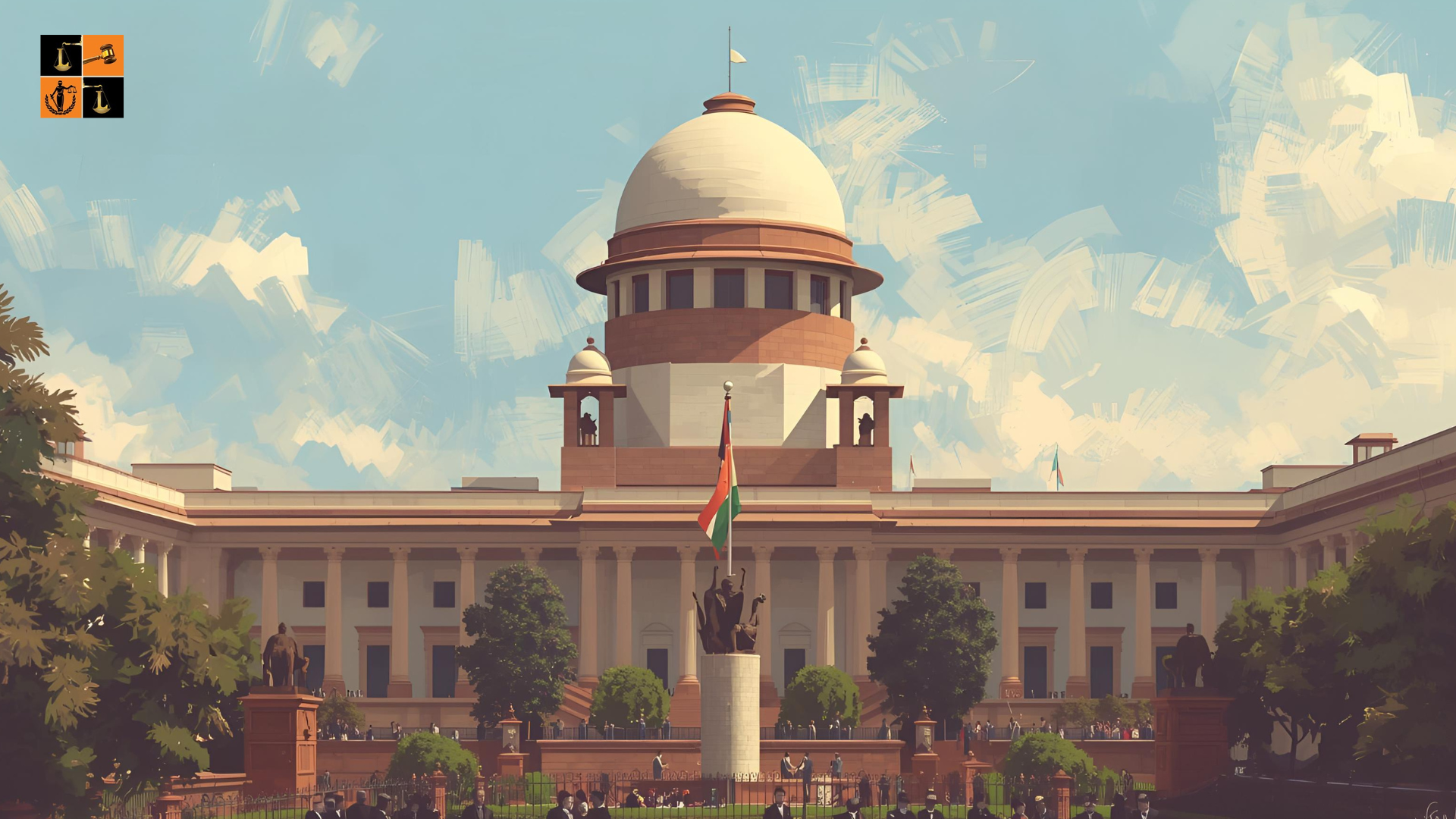
Recently, the Supreme Court examined a challenge arising out of repeated grants of bail in a serious criminal case involving allegations of caste-based violence, attempt to murder, and the subsequent killing of a key eyewitness, raising concerns about misuse of liberty, witness intimidation, and the propriety of judicial discretion in granting bail in grave offences under special statutes.
Brief Facts:
The case arose from an alleged armed assault on the defacto complainant, a Scheduled Caste member, while fencing agricultural land in Madurai district. An FIR was registered under Sections 147, 148, 447, 341, 294(b), 323, 324, 307 and 379 IPC and Section 3(2)(va) of the SC/ST (Prevention of Atrocities) Act, 2015. While on bail, the accused allegedly murdered the injured eyewitness, leading to a second FIR under Sections 147, 148, 341, 302 and 506(ii) IPC. Though bail was earlier cancelled, the High Court later granted bail again and ordered a joint trial, which was challenged before the Supreme Court.
Despite this, the High Court later allowed fresh bail applications filed by the accused and also directed that both criminal cases be tried jointly, prompting the defacto complainant to approach the Supreme Court challenging the legality of the bail order and the direction for a joint trial.
Contentions of the Appellant:
The counsel for the Appellant argued that the High Court failed to consider the gravity of the offences and the fact that the accused had demonstrably misused bail by eliminating a prime witness. The counsel contended that prior cancellation of bail, criminal antecedents, and repeated attempts to interfere with the trial were ignored. It was further submitted that the statutory right of the victim to be meaningfully heard under the SC/ST (POA) Act was reduced to a mere formality. The petitioner also assailed the direction for joint trial, arguing that the two cases arose from separate FIRs, involved distinct offences, and could not legally be clubbed together.
Contentions of the Respondents:
The counsel for the Respondents contended that the criminal proceedings were an extension of a long-standing civil dispute relating to land and encroachments. The counsel alleged that the Appellant had falsely implicated them due to personal enmity arising from earlier public interest litigation initiated by the accused. It was further argued that the accused had no criminal antecedents, had suffered prolonged incarceration as undertrial prisoners, and that several co-accused had already been granted bail without violating any conditions. According to the Respondents, the delay in trial could not be attributed to them and did not justify the continued denial of bail.
Observation of the Court:
The Supreme Court found that the High Court failed to consider crucial circumstances while granting bail. The Court observed that “A determinative factor completely ignored by the High Court is that the respondents / accused were earlier enlarged on bail by the trial Court, and that such bail was subsequently cancelled owing to grave supervening circumstances. These included the death of Suresh, a material witness… indicating intimidation of witnesses and attempts to derail the trial.”
Emphasising the seriousness of the allegations, the Court noted that the offences disclosed were grave and carried significant societal impact, particularly under the special statute. It held that“The FIR discloses commission of serious offences… including Section 307 IPC read with Section 3(2)(va) of the SC/ST (POA) Act. The High Court’s judgment does not reflect any meaningful evaluation of the nature and gravity of the offences.”
On the issue of misuse of liberty and fairness of trial, the Bench categorically stated that “The omission to consider prior cancellation of bail and demonstrated abuse of liberty renders the impugned judgment manifestly perverse.”
The Court further disapproved the reliance on extraneous considerations such as the existence of a civil dispute and cautioned “Pendency of civil litigation neither dilutes criminal liability nor overrides considerations of gravity, antecedents, or witness safety.”
The decision of the Court:
The Supreme Court set aside the High Court’s bail order and cancelled the bail granted to the accused. The accused were directed to surrender before the trial court. The direction for a joint trial was also quashed, with the trial to proceed independently as per law.
Case Title: Lakshmanan V. State Through The Deputy Superintendent Of Police & Ors. Etc.
Case No.: SLP (Crl.) Nos. 6647 - 6650 of 2025
Coram: Hon’ble Mr Justice B.V. Nagarathna and Hon’ble Mr Justice R. Mahadevan
Counsel for the Appellant: AOR Ram Sankar & Co., Sr. Adv. A Mariarputham, Adv. Anuradha Arputham, Adv. K R Bharathi Kumar, Adv. Purushothaman, Adv. Ram Sankar, Adv. Harini Ramsankar.
Counsel for the Respondent: AOR Sabarish Subramanian, Adv. Arpitha Anna Mathew, Adv. Vishnu Unnikrishnan, Adv. Jahnavi Taneja, Adv. Veshal Tyagi, Adv. K.S. Badhrinathan, Adv. Danish Saifi, Adv. Aashigaa Pravaagini, AOR Narender Kumar Verma, Adv. C.R. Jaya Sukin, Adv. Yashimka Anand, Adv. Divya Mishra, Adv. Issac Haiding, Adv. Suresh Kumari.
Read Judgement @LatestLaws.com
Picture Source :



















