









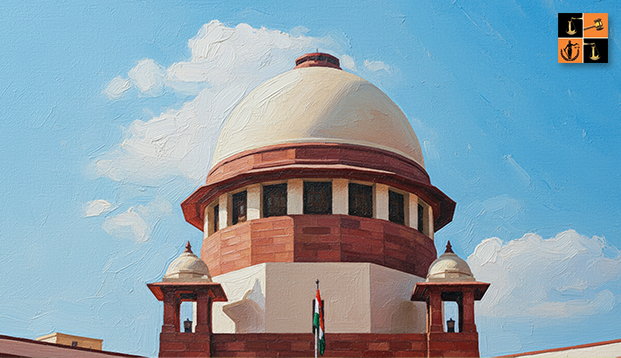
On Tuesday, in a detailed pronouncement arising from a high-stakes trademark dispute between the proprietors of the Beverly Hills Polo Club brand and Amazon Technologies Inc., the Apex Court examined the contours of judicial discretion under Order XLI Rule 5 of the CPC. At the heart of the matter lay a crucial question, can an appellate court grant an unconditional stay on a money decree without insisting on deposit or security, and if so, under what circumstances? Read more to know how the Supreme Court interpreted the boundaries of discretion and procedural fairness in granting stays of execution under the CPC.
Brief Facts:
The case stemmed from a trademark dispute wherein the proprietors and licensees of the Beverly Hills Polo Club (BHPC) brand, engaged in the manufacture, distribution, and sale of lifestyle products bearing the distinctive “charging polo pony with mounted rider” logo, accused Amazon Technologies Inc. of unauthorised use of an identical or deceptively similar mark. The proprietors, holders of exclusive rights under a licensing arrangement, alleged infringement of their registered trademark and copyright, coupled with passing off, dilution of goodwill, and unfair competition.
They sought a decree of permanent injunction, delivery up of infringing materials, damages, rendition of accounts, and litigation costs. The trial court, after proceeding ex parte against Amazon, decreed the suit in favour of the proprietors, awarding substantial compensatory damages and costs. On appeal, the Division Bench granted an unconditional stay of the decree under Order XLI Rule 5 of the CPC, prompting the proprietors to move the Supreme Court.
Contentions of the Petitioner:
The petitioner contends that the Division Bench of the High Court erred in granting an unconditional stay of the execution of the money decree, violating the mandatory provisions of Order XLI Rules 5(1) and 5(3) CPC. The High Court’s finding of “no valid service of summons” is incorrect, as Order XLI Rule 1(3) mandates that an appellant must deposit the decretal amount or furnish security before a stay can be granted, and Order XLI Rule 5(5) makes such deposit or security a condition precedent for staying execution. If the decree was allegedly ex parte, the defendant should have applied under Order IX Rule 13, but no such step was taken, despite having knowledge of the hearing date under the second proviso to Rule 13.The suit papers and the High Court’s ex parte injunction constituted adequate service under the law, and granting a stay based solely on the defendant’s undertaking to deposit the amount, in case the appeal fails, cannot be regarded as sufficient security.
Furthermore, the second proviso to Section 36(3) of the Arbitration Act indicates that unconditional stays are ordinarily not permissible under Order XLI Rule 5 CPC, except in cases of fraud or corruption. Even if such a proviso allows unconditional stays, it limits the Court’s discretion to cases arising from fraud, corruption, or analogous grounds, and not on extreme or egregious views of the merits.
Contentions of the Respondent:
The respondent contends that no error of law was committed by the High Court in granting the stay. The Division Bench thoroughly examined all aspects and, in its discretion, allowed the stay without requiring the deposit of the decretal amount or any tangible security. The word “shall” in Order XLI Rule 5 CPC is not mandatory, and in exceptional cases, the Appellate Court may grant a stay without insisting on a deposit. The Bench found that valid summons were not served on the defendants, the suit proceeded ex parte, and the decree prima facie suffers from multiple legal infirmities. It also highlighted serious irregularities, including the plaintiffs enhancing their claim from Rs. 2 crore to Rs. 3,780 crore in written submissions without amendment or notice to the defendants. Given these gross perversities and legal flaws, requiring the defendant to furnish security or deposit any amount as a condition for the stay would be disproportionate and excessive.
Observation of the Court:
The Division Bench of Justice J.B. Pardiwala and Justice K.V. Viswanathan observed, "Order XLI Rule 5 contains the provision for the grant or refusal of stay of execution of the decree by the appellate court under the CPC. It categorically stipulates that mere filing of an appeal against an order of execution, shall not ipso facto operate as stay of proceedings. Any execution proceeding or an order therein, shall be stayed only if a specific, reasoned order granting such stay is passed by the appellate court, after proper application of mind."
It was further noted that "For the grant of stay of execution of a decree in terms of Order XLI, a prayer to such effect has to be specifically made to the appellate court and the appellate court has the discretion to grant an order of stay or to refuse the same."
On the scope of discretion, the Court clarified, "The power of the Appellate Court to order stay of execution of the decree is circumscribed and made subject to the existence of a 'sufficient cause' in favour of the appellant being shown. In order to ascertain whether a 'sufficient cause' exists for the grant of stay of execution of a decree under Order XLI of the CPC, the appellate court as per sub-rule 3 of Rule 5 is required to examine:
(i) Whether there will be substantial loss to the party applying for stay;
(ii) Whether the application has been made without unreasonable delay; and
(iii) Whether security has been given by the applicant for due performance of the decree."
The Court emphasized the need for reasoned satisfaction, stating, "For the grant of stay of execution of the decree, the appellate court is required, after perusing the materials on record, to assign reasons for its satisfaction regarding the existence of a 'sufficient cause'. Such reasons should be cogent and adequate. The reasons assigned must indicate the necessity for the status quo prevailing on the date of the decree and/or the date of making of the application for stay, to continue by granting stay, and not merely the reasons why stay should be granted."
Regarding the question of conditions for stay, the Bench observed, "Although, Order XLI Rule 5 of the CPC, uses the word 'shall', yet a combined reading of the sum and substance of Rules 1(3) and 5(5) would reveal, that for the grant of stay of execution, it is not mandatory for the appellate court to impose a condition for deposit of the amount in dispute. The aforesaid provisions make it abundantly clear that the appellate court, for the grant of stay of execution, has a discretion to impose a condition of deposit of the amount depending on the facts and circumstances of each case."
On the mode of security, the Court noted, "There is no provision under Order XLI Rule 5 of the CPC imposing a mandate to deposit cash security as the only mode of security for execution of the decree. Security, for the purpose of the said provision, can be in the shape of property, bond and or in the form of an appropriate undertaking from the appellant to abide by the decree, seeking stay of execution."
Finally, the Court clarified the circumstances under which an unconditional stay may be warranted, stating, "The benefit of stay of execution of a money decree may be granted by the Appellate Court unconditionally, if it
(i) is egregiously perverse;
(ii) is riddled with patent illegalities;
(iii) is facially untenable; and/or
(iv) such other exceptional causes similar in nature."
The decision of the Court:
In the light of the foregoing discussion, the Court dismissed the special leave petition, upholding the High Court's unconditional stay on the execution of the money decree without requiring deposit of the decretal amount.
Case Title: Lifestyle Equities C.V. & Anr. Vs. Amazon Technologies Inc.
Case No: Petition for Special Leave to Appeal (C) No.19767 of 2025
Coram: Justice J.B. Pardiwala, Justice K.V. Viswanathan
Advocate for Appellant: Sr. Advs. Mukul Rohatgi, Gaurav Pachnanda, AOR Garima Bajaj, Advs. Sidhant Goel, Mohit Goel, Mohit Goel, Karmanya Dev Sharma, Udbhav Gady,
Advocate for Respondent: AOR Swikriti Singhania, Advs. Saikrishna Rajagopal, Sidharth Chopra, Sneha Jain, Devvrat Joshi, Angad Makkar,
Picture Source :




















