









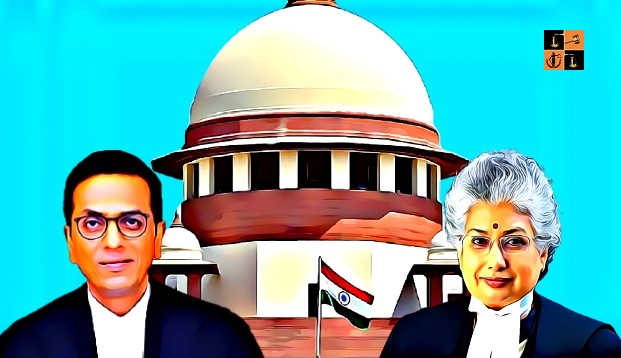
The Supreme Court Bench has set aside the interim order of the Madras High Court wherein High Court has held that no copyrighted work may be broadcast in terms of Rule 29 of the Copyright Rules, 2013 without issuing a prior notice.
The Supreme Court Bench comprising Justice Dhananjaya Y Chandrachud and Justice B. V. Nagarathna in the case titled Saregama India Limited v. Next Radio Limited & Ors dated 27-04-2021 have given their views on rewriting of the statutory language.
Facts of the Case:
In the instant case, the writ petitions have been instituted before the High Court challenging the validity of Rule 29(4) of the Copyright Rules 2013 on the ground that it (i) violates Article 19(1)(a) of the Constitution; and (ii) is ultra vires Section 31D of the Act. The High Court by its interim order has held that no copyrighted work may be broadcast in terms of Rule 29 of the Copyright Rules, 2013 without issuing a prior notice.
Submissions of the Appellants:
Mr. Mukul Rohatgi and Mr. Akhil Sibal, learned Senior Counsel appearing on behalf of the appellants, submitted that:
(i) The interim order of the High Court re-writes Rule 29(4), which is impermissible, in any event at the interim stage;
(ii) The validity of Rule 29(4) is yet to be adjudicated upon and a presumption would attach to the constitutionality of both - the Rules and the Statute;
(iii) There is no challenge to the validity of Section 31D in terms of which Rule 29 has been framed;
(iv) The order of the IPAB dated 31 December 2020 specifically requires compliance with the provisions of Rule 29 while fixing the rates of royalty; and
(v) The High Court has, in the course of its interim order, extended it only to the petitioners before it and to the broadcasters who have been impleaded as parties, as a result of which the pan-India operation of the Rule is left in the realm of uncertainty.
Contentions of the Respondent:
Mr. Navroz Seervai and Mr. Neeraj Kishan Kaul, learned Senior Counsel appearing on behalf of the respondents submitted that:
Mr. Navroz Seervai:
(i) Section 31D(2) stipulates that the broadcasting organization shall give prior notice, in such manner as may be prescribed, of its intention to broadcast the work, stating the duration and territorial coverage of the broadcast, together with the payment of royalty;
(ii) Section 31 D, in referring to a notice in the manner as may be prescribed, does not envisage that conditions incorporating minute details should be provided in the prior notice; and
(iii) The rule making power in Section 78 makes a distinction between ‘form’, ‘manner’ and ‘conditions’. Since Section 31D refers to the manner in which the notice may be issued, the ‘manner’ cannot extend to stipulating ‘conditions’.
Mr. Neeraj Kishan Kaul:
(i) Section 31D was introduced by Parliament by an amendment of 2012 to obviate the exercise of monopolistic rights wielded by copyright owners to the detriment of the public at large;
(ii) Section 31D creates a statutory right in favour of broadcasters to obtain licenses as a result of which the earlier regime of voluntary licensing has been replaced by the regime of statutory licenses envisaged in Section 31D;
(iii) Until December 2020, in the absence of a duly constituted IPAB, broadcasters were functioning under the ambit of voluntary licensing agreements;
(iv) Rule 29(4) defeats the object of Section 31D insofar as it incorporates minute details in the prior notice which has been prescribed;
(v) Many broadcasters operate in the context of interactive dynamic sites as a result of which the requirements which have been prescribed in Rule 29(4) are onerous and impossible to fulfill;
(vi) The broadcasters are ready and willing to pay royalties which are prescribed by the IPAB according to the statute at the end of every month and even inspection of records is furnished to copyright owners; and
(vii) Whereas Section 31D provides for only the duration and territorial coverage of the intended broadcast, the notice which has been prescribed by Rule 29(4) has gone far beyond the statutory ambit of Section 31D and is ultra vires for that reason.
Issue: Whether the interim order of the High Court can be sustained?
Supreme Court’s observation and Judgment:
After hearing both the parties, the Supreme Court has held that an exercise of judicial re-drafting of Rule 29(4) was unwarranted, particularly at the interlocutory stage. The difficulties which have been expressed before the High Court by the broadcasters have warranted an early listing of the matter and this Court has been assured by the copyright owners that they would file their counter affidavits immediately so as to facilitate the expeditious disposal of the proceedings.
The Court observed that an exercise of judicial re-drafting of Rule 29(4) was unwarranted, particularly at the interlocutory stage.
“We are of the view that an exercise of judicial re-writing of a statutory rule is unwarranted in the exercise of the jurisdiction under Article 226 of the Constitution, particularly in interlocutory proceedings. The High Court was also of the view that the second proviso may be resorted to as a matter of routine, instead of as an exception and that the ex post facto reporting should be enlarged to a period of fifteen days (instead of a period of twenty four hours). Such an exercise was impermissible since it would substitute a statutory rule made in exercise of the power of delegated legislation with a new regime and provision which the High Court considers more practicable. The interim order o the High Court is set aside.”
Case Name: Saregama India Limited v. Next Radio Limited
Bench: Justice Dhananjaya Y Chandrachud and Justice B. V. Nagarathna
Counsel: For Appellants: Mr. Mukul Rohatgi and Mr. Akhil Sibal
For Respondents: Mr. Navroz Seervai and Mr. Neeraj Kishan Kaul
Read Judgment
Picture Source :


















