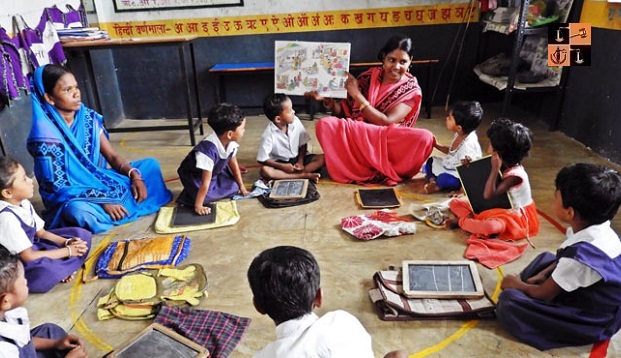
The Supreme Court, in a significant ruling has held that Aanganwadi Workers and Helpers are entitled to gratuity payment under the Payment of Gratuity Act, 1972.
The Division Bench of Justice Ajay Rastogi and Justice Abhay S Oka observed the above while adjudicating upon appeals filed against a judgment of the Gujarat High Court.
The appellants herein were Anganwadi workers and/or their organisations. The Controlling Authority under the 1972 Act held that they are entitled to gratuity which was affirmed by a single bench of the Gujarat High Court. However, the division bench set aside the single bench ruling in appeals filed by respondent-District Development Officer.
In the impugned judgement, it was held that AWWs and AWHs could not be said to be employees as per Section 2(e) of the 1972 Act, and the ICDS project cannot be said to be an industry. It was held that as the remuneration or honorarium paid to them cannot be treated as wages within the meaning of Section 2(s) of the 1972 Act and thus they aren't entitled to payment of gratuity.
[Concurrent Judgement by Justice Ajay Rastogi]
Gratuity as Social Security
According to Justice Rastogi who wrote a concurrent judgement the moot moot question raised in the instant appeals is a question which may not only determine the rights of the contesting appellants working as Anganwadi workers/helpers who are discharging a pivotal role in the society at the grassroot level and are the role model of the ICDS scheme which is one of the extended arm of the Ministry of Women and Child Development, at the given time, it may also give a thought process to the Legislature to consider as to whether the applicability of gratuity being a social security measure, be extended to the employees who served the establishment in an organized or unorganized sector and, in one way or the other, contributing in the sustainable development of the nation.
He stated that 'gratuity' is a gesture to appreciate the efforts of a person towards the betterment, development and prosperity of an establishment and that is the reason for which gratuity is considered to be a social security, and with passage of time, it has become a statutory obligation on the part of employers. Thus, gratuity, as a social welfare legislation, its effective implementation is of paramount importance to fulfil the legitimate expectation of the employees. So far as the unorganized sectors are concerned, these Acts have been pillars in social security and laid the foundation for improvement in standards of living of the employees, he added.
Stating that when social security legislations are being interpretated, it always has to be interpreted liberally with a beneficial interpretation and has to be given the widest possible meaning which the language permits, known as Beneficial Interpretation, he stressed that a statute is meant for the benefit of a particular class and if a word in the statute is capable of two meanings, i.e., one which would preserve the benefits and one which would not, then the former is to be adopted.
Role of Anganwadi Workers
The Court noted that the role of Anganwadi workers (AWW) and Anganwadi helpers ( AWH) is not only at war against malnutrition but have played a pivotal and significant role during the Covid-19 pandemic which was the unprecedented health war faced by the nation in responding to the various challenges posed. These frontline women workers are the backbone of the ICDS.
It described that ICDS scheme is not just a welfare scheme but a means of protecting the rights of children under six- including their right to nutrition, health and joyful learning and rights of pregnant and lactating mothers. As a holistic view of the matter, extending social security to the early child care and development of millions of children of this country, health and nutrition services to children is a good investment, the Court added.
The Court then went on to discuss in detail, the fundamental rights and rights of children under six years, significance of child-care and development in realizing the goal of national progress. It observed:
"The mission and mandate of the scheme of ICDS is to promote social and economic empowerment of women through cross-cutting policies and programmes, mainstreaming gender concerns, creating awareness about their rights and facilitating institutional and legislative support for enabling them to realize their human rights and develop to their full potential. The second is to ensure development, care and protection of children through cross-cutting policies and programmes, spreading awareness about their rights and facilitating access to learning, nutrition, institutional and legislative support for enabling them to grow and develop to their full potential."
Noting that ICDS Scheme is one of the flagship programmes of the Government of India and represents one of the world’s largest and unique programmes for early childhood care and development, the Court emphasised that the role of Anganwadi workers/helpers, in the context of community support and participation, they have played a significant role in facilitating child nutrition.
"A conjoint reading of Sections 3, 4, 5, 6 & 7 of the National Food Security Act, 2013 would unerringly point to the fact that effective implementation of the aforementioned provisions of the Act largely depends on the Anganwadis, which are run by Anganwadi workers/helpers, etc., who are village level workers/ward level workers and in charge for delivery of the various services envisaged under the Act."
Citing that their daily tasks include taking responsibility for pre-school activities for children in the age group of 3-6 years, arranging supplementary nutritional food for children of age group 6 months to 6 years and expectant and nursing mothers, giving health and nutrition education to mothers, making home visits for educating parents, eliciting community support and participation, assisting the Primary Health Centre Staff in implementation of immunization, among others, the Court elaborated that Anganwadi workers/helpers are the key facilitators of child nutrition initiatives at the ground level and involved in performing the work of dissemination, publicity, building awareness, and implementation of various schemes of the Government.
"Anganwadi workers/helpers also function as a bridge between the Government and the targeted beneficiaries in delivering a bouquet of services stipulated under the NFSA. They work in proximate quarters with the beneficiaries and their services are utilized by the respective State Governments for a wide range of activities - be it survey, 10 promotion of small savings, providing health care, group insurance, or non-formal education."
Problems plaguing the Anganwadi workers/helpers
The Court pointed out that first and foremost, they are not holders of civil posts due to which they are deprived of a regular salary and other benefits that are available to employees of the State and instead of a salary, they get only a so called paltry ‘honorarium’ (much lower than the minimum wages) on the specious ground that they are part-time voluntary workers, working only for about 4 hours a day.
On arguement that denying them parity with other employees is that their work is stated to be of a community participation and their names are neither sponsored from the employment exchange nor they are bound by the code of conduct and that posts have been filled up without advertisement and there is no requirement to comply with any statutory recruitment rules, the Court observed that that the contribution of Anganwadi workers/helpers at the grassroot level under the ICDS scheme is being well acknowledged by the Government of India, Ministry of Women and Child Development and in the last few years, it has also witnessed not only an exponential increase in the Anganwadi centres/workers but also significant specific efforts aimed at ensuring quality in the delivery of services and community participation.
"Indeed, the responsibilities of the Anganwadi workers/helpers have tremendously increased which now require to perform multiple tasks ranging from delivery of vital services, involving Community/women’s groups/Mahila Mandals and for ensuring the effective convergence of various sectoral services. For restructuring and strengthening of ICDS, provisions have been made for rationalization of appointment of Anganwadi workers as Supervisors which is a cadre post under the Government."
The Court brought into light the composite scheme of Government of Gujarat wherein it vide its Resolution dated 25th November, 2019 laid down the procedure according to which selections shall be made through a transparent procedure to be followed laying down the eligibility criteria (including academic qualification) according to which the merit list of the candidates who had participated in the selection process for post of Anganwadi workers/helpers shall be made and if any participant/applicant is dissatisfied or aggrieved by the process of selection held by the authorities, can prefer an appeal to the Committee constituted for the said purpose. Those who are finally selected and appointed as Anganwadi workers/helpers shall be governed by the Code of Conduct and they could also to be terminated, if any misconduct being committed in discharge of duties or on attaining the age of superannuation.
It hailed the scheme as in-built transparent procedure resulting in effective functioning of the Anganwadi workers/helpers.
On State's arguement of honorarium being paid to them for services rendered, the Court noted:
"Honorarium is basically the quantum of money offered/conferred to somebody who is especially a professional or a well honoured person for providing services. It is a voluntary process. However, what is being paid to Anganwadi workers/helpers with a nomenclature used by the respondents in projecting the term ‘honorarium’, is in fact the ‘wages’ that has been paid for the services rendered at the end of the month. It is the form of emoluments which is being earned on discharge of duty in accordance with the terms of employment defined under Section 2( s) of the Act 1972."
The Court also analysed State of Karnataka & Ors Vs. Ameerbi & Ors, 2006 Latest Caselaw 858 SC on which major reliance was placed by the High Court while passing the impugned judgement. It clarified that the question raised in the present case is different from this case and is limited to the extent as to whether those who are working as Anganwadi workers/helpers are eligible to claim gratuity under the provisions of the Act, 1972.
In Ameerbi it was held that Anganwadi Workers/ Helpers are not holders of civil posts and protection of Article 311 of the Constitution is not available and that was the reason for which the application which was filed at the behest of Anganwadi workers/helpers under Section 15 of the Administrative Tribunal Act, 1985 was held to be not maintainable.
Justice Rastogi, on parting note remarked that time has come when the Central Government/State Governments has to collectively consider as to whether looking to the nature of work and exponential increase in the Anganwadi centers and to ensure quality in the delivery of services and community participation and calling upon Anganwadi workers/helpers to perform multiple tasks ranging from delivery of vital services to the effective convergence of various sectoral services, the existing working conditions of Anganwadi workers/helpers coupled with lack of job security which albeit results in lack of motivation to serve in disadvantaged areas with limited sensitivity towards the delivery of services to such underprivileged groups, still being the backbone of the scheme introduced by ICDS, time has come to find out modalities in providing better service conditions of the voiceless commensurate to the nature of job discharged by them.
[Main Judgement by Justice Abhay S. Oka]
The Court noted that it is the duty of the State to improve the level of nutrition which is one of the best methods to improve public health. Apart from Article 47, India is a signatory to the Universal Declaration of Human Rights and the International Covenant on Economic, Social, and Cultural Rights.
The said convention casts responsibilities on all States to recognize the right of citizens to adequate food. As provided in the Statement of Objects and Reasons of the National Food Security Act, 2013, one of its objectives is to improve the nutritional status of women and children. The object of the National Food Security Act, 2013 was to bring about a shift in addressing the issue of food security. The approach was changed from the welfare approach to the rights-based approach. The role of Anganwadi centres finds a place in paragraph 7 of the Statement of Objects and Reasons of the 2013 Act, it added.
The Court observed that Anganwadi centres have been entrusted with the onerous responsibility of implementing some of the most important and innovative provisions of the National Food Security Act, 2013. It can be said that Anganwadi centres perform a pivotal role in discharging the statutory obligation of the State to provide nutritional support to pregnant women, lactating mothers and children in the age group of 6 months to 6 years.
Applicability of the provisions of the 1972 Act to AWWs AND AWHs
Clause (b) of Section 1(3) applies to every shop or establishment within the meaning of any law for the time being in force in relation to the shops and establishments in a State in which ten or more persons are employed or were employed on any day of the preceding twelve months
The Court concluded that ‘establishments’ contemplated by clause (b) of the Act can be establishments within the meaning of any law for the time being in force in a State in relation to establishments.
It further noted that Contract Labour (Regulation and Abolition) Act, 1970 is applicable to establishments as provided in sub-section (4)(a) of Section 1. Under the new Rules of the Gujarat Govt, now the selection and appointments of AWWs and AWHs are being made by it. An officer of the Guajarat Government is empowered to issue an order of termination of employment of AWWs and AWHs.
It thus stated that Anganwadi centres have become an extended arm of the Government and operates as an establishment or a wing of the Government.
"The remuneration to AWWs and AWHs is paid by the State Government. However, the State Government gets contributions from the Central Government. Moreover, it can always be said that occupation is carried out in the establishments of Anganwadi centres. Hence, Anganwadi Centre is an establishment within the meaning of clause (e) of Section 2 of the Contract Labour Act."
The Court also looked into the meaning of 'establishment' under Code of Wages, 2019 and Social Security, 2020.
"It is not the case of the State Government that every Anganwadi centre is a separate entity. Anganwadi centres and Mini Anganwadi centres are a part of the Anganwadi establishment of the State Government. The Anganwadi centres have been employing ten or more AWWs and AWHs in the State. Therefore, I have no manner of doubt that Anganwadi centres are establishments contemplated by clause (b) of sub-section (3) of Section 1 of the 1972 Act."
Noting that definition of ‘wages’ is very wide which means all emoluments which are earned by an employee on duty, the Court oberved that, the honorarium paid to AWWs and AWHs will also be covered by the definition of wages.
"As AWWs and AWHs are employed by the State Government for wages in the establishments to which the 1972 Act applies, the AWWs and AWHs are employees within the meaning of the 1972 Act. In view of the said Rules of the Gujarat Government, the Anganwadi centres are not under the control of the Central Government. Therefore, the State Government will be an appropriate Government within the meaning of clause (a) of Section 2 of the 1972 Act. Accordingly, a person or authority appointed by the appropriate Government for the supervision and control of AWWs and AWHs will be the employer within the meaning of clause (f) of Section 2."
The Court mentioned that Government of India by a notification dated 3 rd April 1997 has notified educational institutions as establishments under clause (c) of sub-section (3) of Section 1 of the 1972 Act.
"In the Anganwadi centres, the activity of running a preschool for the children in the age group of 3 to 6 years is being conducted. It is purely an educational activity. The job of teaching is done by AWWs and AWHs. The State Government is running preschools in Anganwadi centres in accordance with Section 11 of the RTE Act."
The Court came to conclusion that undoubtedly the Payment of Gratuity Act, 1972. will apply to Anganwadi centres and in turn to AWWs and AWHs.
Case Title: MANIBEN MAGANBHAI BHARIYA v. DISTRICT DEVELOPMENT OFFICER DAHOD & ORS.
Case Details: CIVIL APPEAL NO(S). 3153 OF 2022
Coram: Justice Ajay Rastogi and Justice Abhay S Oka
Read Judgement Here:
Share this Document :Picture Source :