









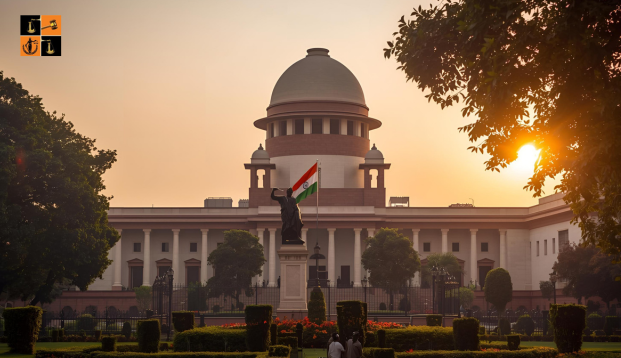
Recently, the Supreme Court was called upon to examine the legality of interim directions issued by the Allahabad High Court while dealing with petitions seeking quashing of a criminal case. Although the High Court declined to quash the FIR, it granted protection from arrest to the accused and directed that the investigation be completed within a fixed period. The State of Uttar Pradesh challenged these directions, arguing that such relief, granted without quashing the FIR, was contrary to settled principles governing criminal investigations and the exercise of writ jurisdiction.
Brief Facts:
The case arose from a common FIR registered at Police Station Nai Ki Mandi, Agra, for offences under Sections 420, 467, 468 and 471 of the Indian Penal Code, 1860 and Sections 3, 25 and 30 of the Arms Act, 1959. The FIR was lodged pursuant to an inquiry conducted by the Special Task Force, Uttar Pradesh, which was initiated on the basis of an anonymous complaint. During the inquiry, it was alleged that certain individuals had procured multiple arms licences by submitting forged documents and false affidavits. The investigation revealed discrepancies in dates of birth recorded in official documents, use of forged identity proofs such as Aadhaar cards, PAN cards and driving licences, and the alleged involvement of an arms clerk in the office of the Additional District Magistrate in facilitating the issuance of licences by concealing material facts. Aggrieved by the registration of the FIR, the accused approached the Allahabad High Court under Article 226 of the Constitution seeking quashing of the criminal proceedings and protection from arrest. While the High Court refused to quash the FIR, it directed that the investigation be completed within 90 days and granted interim protection from arrest till cognizance was taken.
Contentions of the State:
The State contended that the High Court had exceeded its jurisdiction by granting protection from arrest despite refusing to quash the FIR. The counsel argued that such an order effectively amounted to granting anticipatory bail without satisfying the statutory conditions prescribed under the Code of Criminal Procedure. The State further submitted that the direction to complete the investigation within a fixed timeframe interfered with the investigative process, particularly in cases involving serious allegations of forgery and misuse of arms licences. According to the Appellant, the High Court had mechanically relied on the decision in Shobhit Nehra v. State of U.P. without examining whether the factual circumstances of the present case justified similar relief, thereby acting in disregard of binding Supreme Court precedents.
Contentions of the Respondents:
The counsel for the Respondents defended the High Court’s order by asserting that the writ court was well within its constitutional powers to safeguard personal liberty under Article 21 of the Constitution. The counsel argued that the protection from arrest was necessary to prevent unnecessary harassment and abuse of process during the pendency of the investigation. The Respondents also submitted that directing a time-bound investigation ensured fairness and prevented prolonged uncertainty, which could otherwise cause irreparable harm to their reputation and liberty. It was further contended that the High Court had adopted a balanced approach by neither quashing the FIR nor stalling the investigation, while simultaneously protecting the accused from coercive action during the investigative stage.
Observation of the Court:
The Supreme Court observed that while the right to a speedy investigation forms part of Article 21, courts must exercise restraint in fixing rigid timelines for the completion of the investigation. The Court noted that investigation is influenced by multiple unpredictable factors and judicially imposed timelines can interfere with its natural course. It clarified that such directions can be issued only where there is clear material showing undue delay or stagnation. In this context, the Court held, “Timelines are imposed reactively and not prophylactically,” and found no justification for the High Court’s direction to complete the investigation within 90 days in the present case.
On the issue of protection from arrest, the Court held that granting such relief while refusing to quash the FIR is impermissible in law. It reiterated that such directions amount to granting anticipatory bail without complying with the statutory framework. The Court emphatically observed, “It is absolutely inconceivable and unthinkable to pass an order directing the police not to arrest till the investigation is completed while declining to interfere with the quashing petition.”
The Court further criticised the High Court for mechanically relying on Shobhit Nehra v. State of U.P. without examining the factual matrix of the case. Emphasising the correct use of precedent, the Court observed that “every judgment must be read as applicable to the particular facts proved,” and that general observations in a judgment cannot be applied divorced from their factual context
The decision of the Court:
The Supreme Court allowed the State’s appeals and quashed the High Court’s directions granting protection from arrest and fixing a time-bound investigation. It held that such orders were legally unsustainable. Interim protection was continued for two weeks, after which proceedings may continue as per law
Case Title: State Of U.P. & Anr. V. Mohd Arshad Khan & Anr.
Case No.: Cr. Appeal @ SLP (Crl.) No. 17272 of 2025
Coram: Hon’ble Mr Justice Sanjay Karol and Hon’ble Mr Justice Nongmeikapam Kotiswar Singh
Counsel for the Appellant: AOR Ruchira Goel
Counsel for the Respondent: Sr. Adv. Pradeep Kumar Rai, Adv. Farhat Naim, Adv. Rajshree Rai, Adv. Vinay Kumar Rai, Adv. Modoyia Kayina, Adv. Shreyansh Singh, Adv. Paras Chauhan, Adv. Parimal Rai, Adv. Ujjwal Singh Parmar, Adv. Neha Raj Singh, Adv. Virendra Singh, Adv. Harish Gupta, AOR R And R Law Associates, AOR Anil Kumar, Adv. Gaurav Kumar, Adv. Sudip Patra, Adv. Santosh, Adv. Nikhil Kumar, Adv. Yogesh Kumar Goel, Adv. Prashant Singh, Adv. Amrita Srivastava, Adv. Kameshwar Srivastava, Adv. Abhishek Babbar, Adv. Suvarna Swain, AOR Yashwant Singh.
Read Judgement @LatestLaws.com
Picture Source :




















