









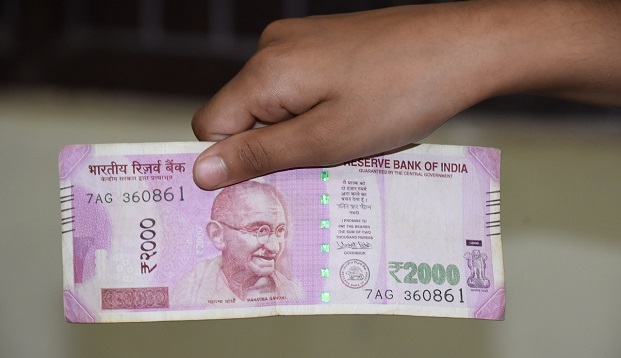
The Delhi High Court comprising Hon'ble Mr. Chief Justice Satish Chandra Sharma and Hon'ble Mr. Justice Subramonium Prasad acknowledged the principle of limited court interference in the government's economic policy decisions. The Court emphasised that court intervention should be reserved for cases where the government's orders are deemed arbitrary or unreasonable.
Brief Facts of the Case:
A Petition was filed before the High Court challenging the impugned order of the SBI and RBI. The orders in question allowed the exchange of Rs.2000 denomination banknotes without the requirement of a requisition slip or identity proof. The petitioner argued that such orders were in contradiction to Article 14 of the Constitution of India.
Contentions of the Petitioner:
Claiming that the total value of Rs. 2000 banknotes in circulation amounted to Rs.3.62 lakh crores, it was contended that these banknotes were not commonly used for transactions. He argued that these banknotes, predominantly regarded as black money, had been hoarded by separatists, terrorists, Maoists, drug smugglers, mining mafias, and corrupt individuals.
It was also asserted that the population of India was approximately 142 crores, with 130 crores possessing Aadhar Cards, indicating that each family held 3-4 Aadhar Cards. Additionally, out of the total 225 crores bank accounts, 48 crores belonged to individuals below the poverty line and were Jan Dhan accounts. It was maintained that the Government's decision to allow the exchange of Rs.2000 banknotes without requiring any form of identification actually promoted activities such as Benami transactions, money laundering, and drug trafficking.
Observations of the Court:
The Bench examined the Notification issued by the RBI and observed that Rs.2000 denomination banknotes were introduced in November 2016 to swiftly meet the currency demand following the withdrawal of legal tender status for Rs.500 and Rs.1000 banknotes in circulation at that time. The objective of introducing Rs.2000 banknotes was achieved once banknotes of other denominations became adequately available. The Notification also reveals that approximately 89% of the Rs.2000 denomination banknotes were issued before March 2017 and are now reaching the end of their estimated lifespan of 4-5 years. Rs.2000 denomination banknotes worth Rs.3.62 lakh crores are in circulation, but they are not commonly used for transactions. Consequently, the Government has decided to withdraw these Rs.2000 denomination banknotes from circulation.
It was further highlighted that to ensure a smooth transition, banks have provided facilities for converting these banknotes into other denominations. For this purpose, the Government decided not to require identity proof for the exchange of Rs.2000 banknotes so that anyone can exchange them for other denominations. Therefore, it could not be argued that the Government's decision is arbitrary or encourages black money, money laundering, profiteering, or corruption.
It was expounded that it is well established that Courts generally refrain from interfering with the Government's decisions concerning economic policies unless the Government's decision is manifestly arbitrary.
The decision of the Court:
Accordingly, the Delhi High Court dismissed the petition.
Case Title: Ashwini Kumar Upadhyay v Union of India & Ors
Case No.: Writ Petition Civil No. 7129 of 2023
Coram: Hon'ble Mr. Chief Justice Satish Chandra Sharma and Hon'ble Mr. Justice Subramonium Prasad
Advocates for Respondent: Advs. Mr. Chetan Sharma, Mr. Apoorv Kurup, , Mr. Amit Gupta Mr. Saurabh Tripathi, Mr. Aakansh Srivastava, Mr. Vikramaditya Singh, Ms. Apoorva Jha, Mr. Parag P. Tripath, Mr. Ramesh Babu, Ms. Nisha Sharma, Ms. Tanya Chowdhary, Ms. Vashundhara Bakhru, Mr. Rajiv Kapur, Mr. Akshit Kapur and Mr. Tushar Bagga
Read Judgement @LatestLaws.com:
Picture Source :




















