









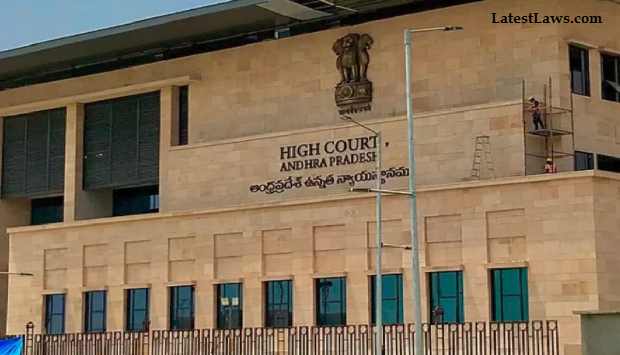
The single judge bench of the Andhra Pradesh High Court held that the disciplinary proceedings are independent of the criminal cases and the sweep and scope of a disciplinary proceeding is much wider.
Brief facts
The factual matrix of the case is that the Petitioner joined as an attendee and later on, was promoted as line inspector. While he was working as a line inspector, he was put on suspension. on the ground that the petitioner took Rs.40,000/- for providing an unauthorized power connection to the agricultural field motor. Similarly, he was charged for collecting an amount of Rs.12,000/- and Rs.13,500/-. Furthermore, a charge sheet was issued and out of three charges, the first charge was proved and the other charges were partially proved. Based on the enquiry report, the disciplinary proceedings were initiated. The disciplinary authority imposed the punishment of a reduction of five ranks in the seniority of the line inspector cadre. The Petitioner filed an appeal before the appellate court and the same was rejected. The Petitioner again made a representation to the 2nd Respondent and the same was also rejected.
Contentions of the Petitioner
The Petitioner contended that the enquiry was committed without providing ample opportunities to the Petitioner and the same resulted in the violation of principles of natural justice. It was furthermore contended that no reasons assigned in the order which can justify the punishment imposed on the Petitioner. Also, the Petitioner was acquitted by the Additional Session Judge.
Contentions of the Respondent
The Respondents contended that the disciplinary proceedings are independent of the criminal proceedings. It was furthermore contended that adequate opportunity was provided to the Petitioner to cross-examine the witnesses. As such, a blanket statement that the enquiry was conducted without following principles of natural justice cannot be justified.
Observations of the court
The Hon’ble Court observed that it is well settled law that the disciplinary proceedings are conducted independently of the criminal cases, and they have a far larger scope.
The court noted that the acquittal of the Petitioner in a criminal case can’t have any impact on the outcome of merits in the writ petition. As it is clear from the Judgment passed by the learned Sessions Judge that the acquittal of the petitioner is on account of the non-examination of the concerned witnesses.
Based on these considerations, the court refused to interfere with the punishment under challenge.
The decision of the court
With the above direction, the court dismissed the Petition.
Case Title: P.Balachandramouli V. The Andhra Pradesh Southern Power Distribution Company Limited
Coram: Hon’ble Mr. Justice Harinath. N
Case No.: WRIT PETITION No.7339 OF 2009
Advocate for the Petitioner: Ms.A V S LAXMI
Advocate for the Respondent: . Sri. P R BALARAMI REDDY(SC FOR AP TRANSCO) 2. Sri. V R REDDY KOVVURI(SC FOR APSPDCL)
Read Judgment @Latestlaws.com
Picture Source :



















