









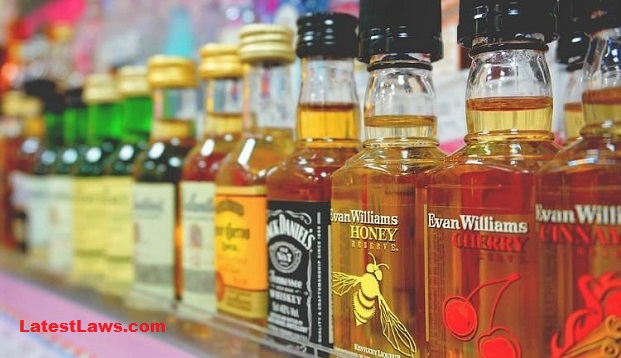
The Supreme Court has observed that States cannot levvy excise duty on alcoholic liquor not for human consumption, as it is Centre's discretion.
The Division Bench comprising of Justice L. Nageswara Rao and Justice BR Gavai noted that Alcoholic liquors other than for human consumption have been left to the Central Legislature for levy of duty of excise.
In the present writ petition, the State has challenged the Calcutta High Court order quashing its Demand Notices.
The Company in question had installed Extra Natural Alcohol Column which resulted in generation of certain weak spirit, which was not potable, and since the rules did not provide for allowing such a waste product, a representation was made by the respondentCompany to the State.
The Committee constituted by the State for the examination of the issue found tha though there were provisions in the Boards’ Excise Rules, 1965 for loss of spirit during transit, during storage, and during bottling, there was no provision for loss of spirit during redistillation. The Committee found that the loss of spirit during the process of redistillation was allowed in different States. In Maharashtra, a loss of 2%; in Bihar, a loss of 1.5%; in Andhra Pradesh, a loss of 2%; and in Karnataka, a loss of 3% spirit was allowed during redistillation. Accordingly, the Committee recommended allowing 2% loss of spirit during the process of redistillation in the State of Orissa.
In reply to the Notice issued, the respondent-Company made a representation to the appellants, stating therein that the wastage generated during rectification process was an impure spirit/weak spirit, which was not fit for human consumption. It was, therefore, contended that the State Government has no authority to impose excise duty on the weak spirit.
The Counsel for the Respondent relied on State of U.P. & ANR Vs. M/S. Synthetics And Chemicals Ltd. & ANR, 1991 Latest Caselaw 160 SC to further submit that the State Legislature had no authority to levy duty or tax on industrial alcohol, which is not fit for human consumption as that could only be levied by the Centre.
The Court accepted the contention and held that the Notices issued bear no legal encumbrance.
"It could thus be seen that the Constitution Bench has held that the Constitution makers distributed the term ‘alcohol liquor’ into two heads, viz., (a) for human consumption; and (b) other than for human consumption. It has been held that the alcoholic liquors, which are for human consumption, are put in Entry 51 List II authorizing the State Legislature to levy tax on them, whereas alcoholic liquors other than for human consumption have been left to the Central Legislature under Entry 84 for levy of duty of excise. It has been held that what has been excluded in Entry 84 has specifically been put within the authority of the State for purposes of taxation. The Constitution Bench clearly held that the State Legislature had no authority to levy duty or tax on alcohol, which is not for human consumption as that could be levied only by the Centre."
Power of the State Government to levy excise duty on wastage of liquor after distillation
The Court mentioned in which the issue was taken into consideration and noted that the State was only empowered to levy excise duty on alcoholic liquor for human consumption and has no power to levy excise duty on wastage of liquor after distillation.
The Court also analysed the Act to this regard and remarked that even under the relevant statute, the State has power to levy excise duty only in respect of the alcoholic liquor for human consumption.
Read Judgement Here:
Share this Document :Picture Source :



















