









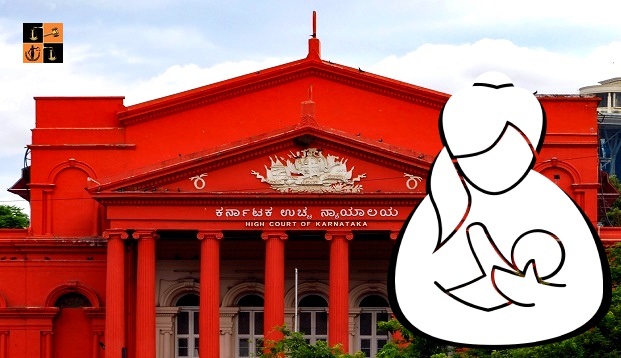
The Karnataka High Court has held that breastfeeding is an inalienable right of lactating mothers and this important attribute of motherhood, is protected under the umbrella of Fundamental Rights guaranteed under Article 21 of the Constitution of India.
The Karnataka High Justice Krishna S Dixit in the case titled Husna Banu v. State of Karnataka give his views on breastfeeding as a fundamental right of a lactating mother.
Facts of the Case:
The Court was hearing a custody case of a child between a genetic mother and a foster mother.
Submissions of the Foster Mother:
The Counsel of the Foster Mother has submitted that she had fostered the child all these months abundant with love, affection & care should retain & rear it; that the genetic mother already has two children whereas the foster mother has none; a child well fostered for long cannot be parted away to the genetic mother without causing enormous violence to it; in matters of custody, the interest of the child is paramount and therefore the claims founded on genealogy, per se, do not merit favour; in support of his submission he cites episodes from Bhaagavatam and mentions about Devaki, i.e., the genetic mother of Lord Krishna, permitting Yashoda, i.e., the foster mother to retain custody of Infant Krishna.
Submissions of the Genetic Mother:
The Counsel of the Genetic Mother has submitted that as between a genetic mother and a foster one, the claim of the latter should yield to that of the former; he also notifies to the Court the agony which the genetic parents of the child have undergone since a year or so; he also highlights the difficulties of a lactating mother from whom the suckling infant is kept away.
High Court’s observation and Judgment:
After hearing both the parties, the High Court has held that the custody of the minor child needs to be given to the genetic mother as the child in question took birth in a maternity home in Bengaluru city in the last summer and thus it is only a toddler as yet; this child having been lifted from the cradle of the hospital allegedly by some unscrupulous persons, ultimately landed on the lap of foster mother, is not in dispute; shorn of the pleadings, it is submitted at the Bar that the foster mother is only an innocent victim of circumstances; that was her case too; whatever be the epicenter of the lis, the undisputed fact remains that Smt. Husna Banu is the DNA-tested genetic mother of the child; as between the genetic mother and the foster mother, the claim of the former should have priority over the latter, subject to all just exceptions, into which argued case of the foster mother is not shown to fall; this augers well with reason, with the law and with justice.
The High Court also held that breastfeeding is the best way to give babies all the necessary nutrients & antibodies, which provide a vital shield of protection.
“The modern Medical Science says that breastfeeding is the best way to give babies all the necessary nutrients & antibodies, which provide a vital shield of protection; the experts in the field of neo-natal science are of a considered opinion that the interaction between the lactating mother and the suckling infant involves a world of messages, which is essential for the intellectual & emotional development of the child.”
The High Court in the light of domestic law and international law also held that breastfeeding needs to be recognised as an inalienable right of a lactating mothers.
“Breastfeeding needs to be recognized as an inalienable right of lactating mother; similarly, the right of the suckling infant for being breastfed too, has to be assimilated with mother’s right; arguably, it is a case of concurrent rights; this important attribute of motherhood, is protected under the umbrella of Fundamental Rights guaranteed under Article 21 of the Constitution of India; it is unfortunate that this pretty child for no fault remained un-breastfed, its lactating mother having had no access to it till now; in a civilized society such things should never happen.”
The Court also held that the contention of counsel for the foster mother that she of their numerical abundance; the principle of distributive does not have any children whereas the genetic mother has already two at home and therefore, the custody of this child should be allowed to continue with his client, is ludicrous; children are not chattel for being apportioned between their genetic mother and a stranger, on the basis justice which intends to bridge the gap between “haves and have nots” is not invocable, atleast in this case; it is a matter of common knowledge consistent without experience that a genetic mother treats all her children as being an integral part of her body & soul, regardless of what the children do to her; this contention of the foster mother is abhorrent to the very notion of motherhood.
Case Name: Husna Banu v. State of Karnataka
Single Bench: Justice Krishna S Dixit
Counsel of the Appellant: Advocate Sri. Sirajuddin Ahmed
Counsel of the Respondent: Advocate Sri. Vinod Kumar
Advocate Sri. S. Subramanya
Read Order
Share this Document :Picture Source :


















