









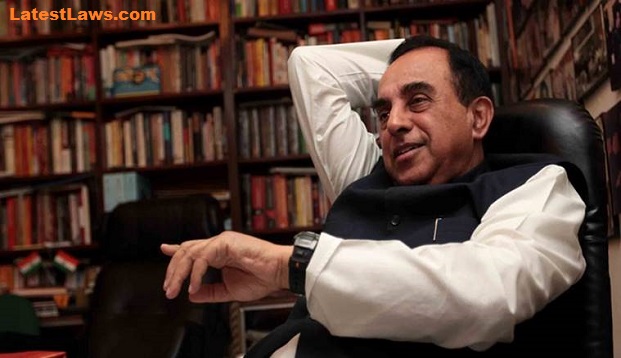
The Gauhati High Court recently comprising of a bench of Justice Manish Choudhury quashed all orders pertaining to an alleged hate speech case registered against Rajya Sabha MP Dr Subramanian Swamy at the Additional Chief Judicial Magistrate's Court in Karimganj in 2015.(Dr Subramanian Swamy v. State of Assam)
The bench passed the order in a petition filed by Swamy seeking to quash all criminal proceedings connected with the case. The High Court on November 11 had reserved the judgment in the case after hearing both parties.
The Court quashed the orders which had allowed for the issuance of criminal proceedings and a non-bailable warrant against Swamy and accordingly observed, "As the complaint does not make out any offence either under Section 153, IPC or under Section 298, IPC the criminal proceeding to that extent is also quashed. As the criminal prosecution against the petitioner for the offences under Section 153A and Section 295A of the Penal Code has been launched without any sanction under Section 196[1] of the Code, such criminal prosecution is held to be illegal. The continuance of the criminal proceeding ... would amount to abuse of the process of the Court."
Facts of the case
In the complaint filed before the Chief Judicial Magistrate at Karimganj on March 17, 2015 it was stated that the accused was an influential leader of the Bharatiya Janata Party (BJP), and religiously intolerant.
On March 14, 2015 Swamy had allegedly while interacting with the press, made some "derogatory, unconstitutional and provocative" remarks against Islam. He had allegedly stated that 'mosque is not a place of worship for Muslim people' and that 'if mosques were demolished the same could not be a ground to object'. It was contended that he had attempted to hurt the feelings of the people of Muslim religion by passing such remarks.
The complaint had further alleged that Dr Swamy had "attempted to hurt the feelings of the people of Muslim religion. Such provocative remarks had disturbed the peaceful religious scenario in the State of Assam" and had "given rise to serious apprehension in the minds of the people from Muslim faith residing in the State."
Contention of the Parties
The counsel for the petitioner submitted that no cognizance of the offence punishable under Section 153A, IPC and Section 295A, IPC can be taken by a Court without previous sanction of the Central Government or of the State Government. In the absence of such sanction, the order dated 18.03.2015 whereby cognizance of the offences under Section 153A, IPC and Section 295A, IPC was taken is ex-facie illegal and unsustainable in law. Moreover, he has submitted that even if the allegations made in the complaint are accepted in its entirety, they do not disclose commission of any of the offences defined under Section 153 or Section 153A or Section 295A or Section 298 of the Penal Code. He has further submitted that the manner in which non-bailable warrant of arrest [NBWA] was issued by the learned Additional Chief Judicial Magistrate, Karimganj against him is unsustainable in law. It is his further submission that since the initial order of taking cognizance and issuance of process is bad and illegal, all other consequential orders are also liable to be set aside and quashed. In essence, the petitioner has challenged the criminal prosecution launched against him in its entirety.
The learned senior counsel appearing for the respondent no. 2 – complainant has submitted that the complainant had filed the complaint being aggrieved by the comments made by the accused before media persons and the same were objectionable and provocative in nature. The learned trial court had taken cognizance after going through the contents of the complaint and the original copies of the four newspapers which the complainant had annexed with the complaint. The accused is in the habit of making such kind of remarks in a motivated manner which has the tendency to incite violence. The comments made by him in respect of which the complaint had been filed, were communally coloured. Even if the bar contained in the Code is taken into consideration, it is not sufficient to quash the entire criminal proceeding initiated by the complaint.
Court's observations and Judgment
The court at the outset pursuant to a perusal of the rival submissions, observed that pursuant to Section 202 of the CrPC, there is an obligation on the magistrate to conduct an inquiry or direct investigation before the issuance of process.
The Court further observed, "This Court is of the unhesitant view that due to failure on the part of the learned Magistrate to follow the mandatory procedure as envisaged in Section 202 of the Code the order dated 18.03.2015 issuing summons to the accused had suffered from infirmity and the same is liable to be set aside and quashed".
The Court furthermore held that since the complainant is by no means a public servant, the examination of such a complainant on oath cannot be dispensed with without reducing the substance of such examination to writing under the provisions of Section 200 of the CrPC.
The Court further observed, "The mandatory provision requiring 4 of time in relation to the complaint, could not have been dispensed with by the learned Magistrate before issuing the process against the accused. On this ground also, the impugned order dated 18.03.2015 has suffered from infirmity and is liable to be set aside and quashed".
The Court further noted that for an offence under Section 153 of the IPC to apply, the act has to be done malignantly or wantonly with an intention of causing riots. However, in the instant case, the Court observed that the complainant had himself not heard the utterances alleged and accordingly remarked, "The complainant had only taken the help of newspaper reports to allege that the accused person had made the alleged comments before the media persons, that too, without entering himself into the witness box to depose in order to support his such accusations...As no offence under Section 298 of the Penal Code is made out, the criminal proceeding against the accused in so far as the said offence is concerned, is liable to be set aside and quashed."
It further held that the Magistrate could not have taken judicial notice of the facts stated in those newspaper reports without any other supporting materials.
The Court accordingly set aside and quashed all criminal proceedings in the matter. The Court observed, "In the said fact situation, it is apparent that there was no legal evidence before the learned trial court when it took cognizance on the complaint...continuance of the criminal proceeding would amount to an abuse of the process of the Court."
Read Judgment @Latestlaws.com
Picture Source :




















