









The Authors, Aditya Talpade and Pratik Karande are practising lawyers at the Bombay High Court.
“False words are not only evil in themselves, but they infect the soul with evil” - Socrates
In India a criminal trial does not begin until a competent court has framed charges against the accused; and charges can be framed only after the police have concluded their investigation and have filed the investigation report (popularly known as a charge-sheet) before the court[1]. But from the perspective of an ordinary citizen our experience indicates that it would be fair to state that an accused is exposed to the criminal justice system the moment he or she is ‘allegedly’ accused of committing a crime i.e. a criminal complaint is made to the police or any other law enforcement agencies that has the power to prosecute. So far as the lives of ordinary law abiding citizen are concerned, being accused of a crime is an extremely important and perhaps also extremely distressing event in his or her life.[2]
Right to fair trial and investigation is part of Article 14 and 21 of the Constitution of India and every citizen enjoys these rights. The same has been rightly reiterated in Zahira Habibullah Sheikh v. State of Gujarat[3]. This right is usually hampered by media trials. It is a basic principle of criminal jurisprudence that “every accused is presumed to be innocent unless the guilt is proved”[4]. However, the manner in which people accused of crimes are portrayed in popular media, and the consequences that these people have to suffer thereafter, in almost all cases notwithstanding the final verdict of the court of law, is and always been, a matter of concern for all democratic, republican systems based on a written constitution and rule of law.[5]
Recently the country has seen an uproar and shown it’s grave concern in the sensational case of the late actor, Sushant Singh Rajput on the issue pertaining to the Investigation and alleged mishandling of the latter’s unnatural death.
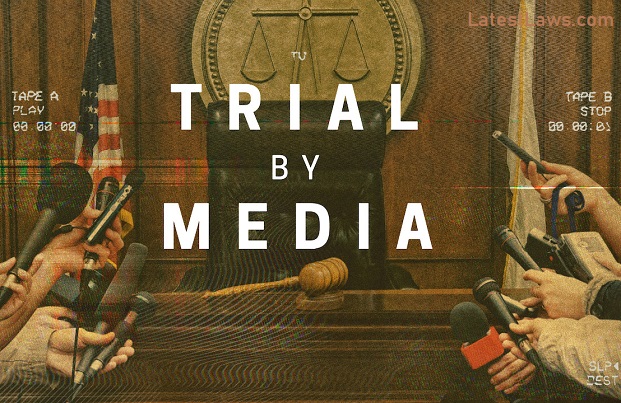
The media has narrated the entire story of the late actors death in a manner so to induce the general public to believe in the complicity of the person indicted. The media has gone a step further and published information based on mere assumptions and suspicion about the line of investigation by the official agencies to vigorously report on the issue on a day to day basis and comment on the evidence without ascertaining the factual matric. Such reporting has brought an undue pressure in the course of fair investigation and trial. The media in this manner is conducting a parallel investigation and trial; and has already foretold its decision thereby, creating a pressure on the investigation agencies.
The freedom of press and media is not an absolute freedom and is subject to certain limitations contained in Article 19 (2) of the Constitution of India. The Supreme Court[6] has rightly held that, “absolute, unlimited and unfettered freedom of press at all times and in all circumstances would lead to disorder and anarchy.” The media should be careful and should adhere to the norms and regulations prescribed by the Press Council of India and should also keep in mind the principles of natural justice and fair investigation in any case.
In the recent case of late actors death at his Mumbai residence, the Mumbai Police registered an Accidental Death Report (ADR) and commenced inquiry u/s. 174 of the Criminal Procedure Code, 1973 to ascertain the cause of death and also to determine whether the death was result of some criminal act committed by some persons. In course of the inquiry, the statements of various persons were recorded and other evidence such as Post Mortem Report, Forensic report, etc were collected. If the inquiry discloses commission of a cognizable offence, the Mumbai Police will register an FIR.
Subsequently, the father of the deceased had filed a complaint at Patna, leveling serious allegations against Rhea Chakraborty and her family members following which an FIR was registered on 25.7.2020 u/s. 341, 342, 380, 406, 306, 506 and 120B of the Indian Penal Code at Rajeev Nagar Police Station, Patna against Rhea Chakraborty and her family members.
The accused person filed a transfer petition[7] in the Supreme Court and it was held that “u/s. 406 CrPC, only cases and appeals (not investigation) can be transferred. Patna Police committed no illegality in registering the Complaint and looking at the nature of the allegations in the Complaint, which also relates to misappropriation and breach of trust, the exercise of jurisdiction by the Bihar Police appears to be in order and at the stage of investigation, they were not required to transfer the FIR to Mumbai Police. For the same reasons, the Bihar government was competent to give consent for entrustment of Investigation to the CBI and as such the ongoing investigation by the CBI is held to be lawful. In the event a new case is registered at Mumbai on the same issue, it would be appropriate if the latter case too gets investigated by the same agency, on the strength of this court’s order.”
In the due course, the Media channels are examining and cross-examining all witnesses in the case. The media has already convicted the Accused even before foul play is established. The Press Council of India on 28th August 2020 had issued an advisory that media should adhere to the Norms of Journalism conduct in covering cases under Investigation. The Council has noted with distress that coverage of the alleged suicide by the late film actor by many media outlets is in violation of the Norms of Journalistic Conduct and therefore, advises the media to adhere the norms framed by the Press Council of India.
The investigating authorities should be allowed to their job fairly and an accused person should not be targeted. The media has acted in a similar negligent way in the past as well, while reporting the case of Arushi Talwar, Priyadarshini Matto, and Jessica Lal and Tehelka case.
CONCLUSION
A democratic society’s basic essence also lies in free speech prevailing ones ideas, propagating information and knowledge, debating on topics, expressing their views. Restraining individuals from expressing their social, economic and political views would be a bane to their fundamental right to express and speak. Undoubtedly, free speech is the foundation of a democratic society. A free exchange of ideas, dissemination of information without restraints, dissemination of knowledge, airing of differing viewpoints, debating and forming one shown views and expressing them, are the basic indicia of a free society.[8]
However, Media should restrain from forming an opinion by conducting its own parallel investigation and trial. Furthermore, the reporting of the alleged suicide of the actor by some of the newspapers is also in violation of the norms formulated by the Council for reporting on suicide. The norm prohibits publishing stories about suicide prominently and advises the media not to unduly repeat such stories[9].
The Hon'ble Supreme Court of India in Sahara India Real Estate Corp. Ltd. v. Securities & Exchange Board of India [10] while deciding the issue whether the court can frame guidelines for the visual media, observed that deferment of publication of such matters pending trial can be ordered. Even in the said decision also, the Hon'ble Supreme Court of India has declined to pass orders as to the framing of guidelines for the visual media. This is the need of the hour for certain guidelines to be framed for reporting of visual media.
In cases of trial by media, justice is often not only denied but also derailed by reducing a tragedy into a sensational drama. Individuals generally rely on media to provide information, as they cannot get sufficient information on their own to make informed decisions on public matters. Media is the cornerstone of our Indian democracy, which operates for the greater interest of society but legal process, should not be hindered by the media coverage of a matter.
References:
[1] Union of India v.Prafulla Kumar Samal, (1979) 3 SCC 4.
[2] Tara Singh v. State of Punjab, AIR 1951 SC 441
[3] Zahira Habibullah Sheikh v. State of Gujarat (2004) 4 SCC 158
[4] Babu v. State of Kerala, (2010) 9 SCC 189 : (2010) 3 SCC (Cri) 1179
[5] ‘A Comparative Survey of the Law of Bail in India and Canada’ by Khagesh Gautam & Sebastien Lafrance in the book titled “Taking Bail Seriously- The State of Bail Jurisprudence in India.”
[6] In re: Harijai Singh, (1996) 6 SCC 466 (para 10): AIR 1997 SC 73
[7] Rhea Chakraborty v. State of Bihar & Ors., Transfer Petition (Crl.) No. 225 of 2020.
[8] Union of India v. Motion Picture Association (AIR 1999 SC 2334)
[9] Press council of India, Norms of Journalistic Conduct, edition 2019
[10] Sahara India Real Estate Corp. Ltd. v. Securities & Exchange Board of India (2012) 6 MLJ 772
Picture Source :




















