









The Author, Philip Oommen is a 3rd year student of Rajiv Gandhi National Law University.
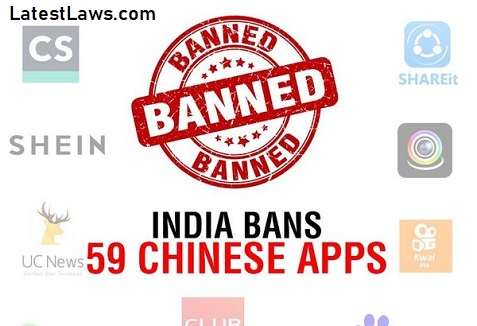
The Ministry of Electronics & Information Technology has blocked 59 Apps, mostly Chinese, by invoking Section 69A of the Information Technology Act, 2000 ( hereinafter referred to as “IT Act”) read with the relevant provisions of Information Technology (Procedure and Safeguards for Blocking of Access of Information by Public) Rules 2009 (hereinafter referred to as “IT Rules”). A brief analysis regarding the legality of the ban is put forth below.
THE RELEVANT TERMS THAT ONE NEEDS TO KNOW
- Intermediary- As defined in Section 2 (1) (w) of the IT Act, the Intermediary is a platform that publishes or circulates the information provided by the Original Creators of Content (a.k.a. Originator). Examples include Facebook, Instagram, Apple Store, PlayStore, Google etc.
- Originator- As defined in Section 2(1) (za) of the IT Act, the originator is a person or an organization which actually creates the content. An example can be that of ByteDance, which controls TikTok.
Examples- In the case of TikTok, ByteDance might be the Originator and PlayStore or Apple Store are the Intermediaries.
WHAT DO THE RELEVANT LAWS STATE?
Clause 1 of Section 69 A of the IT Act grants powers to the Central Government to enable the blocking of certain information generated, transmitted, received, stored or hosted in any computer resource, for reasons such as (1) interest of sovereignty and integrity of India (2) defence of India (3)security of the state, (4)friendly relations with foreign states (5) public order, (6) for preventing incitement to the commission of any cognizable offence relating to above.
Clause 2 of Section 69A of the IT Act states that the act of blocking has to be in accordance with the procedure and safeguards laid down therein i.e. the provisions contained in IT Rules.
WHAT DO THE RELEVANT RULES STATE?
The procedure laid down in IT Rules provides for an institutional framework which is in place to enable the central government to act upon the complaints and requests received from the general public regarding blocking certain computer sources. As per the procedure, the relevant complaints and requests have to be forwarded to the Designated Officer, who is to be duly appointed by the Central Government under Rule 3 of IT Rules. The Procedure to be followed can be classified into two i.e. The Usual Procedure and the Emergency Procedure.
The Usual Procedure
The request for blocking a computer source is to be examined by a Committee formed under Rule 7 of the IT Rules, chaired by the Designated Officer. Thereafter, the request shall be considered by the committee as per the guidelines in Rule 8 of IT Rules. The Designated Officer shall put in reasonable efforts to identify the intermediary and concerned other persons and issue notices (via letter, fax or e-mail) to them for appearing and submitting the replies before the committee at specified date and time (not to be less than forty-eight hours from the time of receipt of such notice by such person or intermediary). After the consideration of all the relevant materials at hand, the committee shall give a “specific recommendation” in writing regarding the ban. The recommendation of the committee will be sent to the Secretary of the Department of Information Technology. On approval by the secretary, the designated officer shall proceed with the decision of blocking and do the needful.
The Emergency Procedure
In case of an emergency, for which no delay is acceptable, Rule 9 of IT Rules states that the Designated Officer shall examine whether the complaint is within the scope of grounds mentioned in Sec.69 (1) of IT Act and shall submit the request with “specific recommendations” to the Secretary, Department of Information Technology. The Secretary, if satisfied, may proceed with the blocking of the computer source after recording reasons in writing for the Interim Order effecting the same. This can be done without affording an opportunity of hearing to the Intermediary or the Originator.
However, within 48 hours from issuing of the interim order, the Designated Officer has to refer the complaint to the Committee (formed under Rule 7 of IT Rules) for approval. Now, the Committee shall function according to the manner followed in the Usual Procedure (issuance of notice to intermediaries and persons concerned, hearing the parties, considering the relevant material).
The Committee, after considering all the relevant facts, shall give a specific recommendation to the Secretary, DoIT. If approved, the Secretary shall pass a Final Order confirming the Interim Order. If not approved, the Secretary shall revoke the Interim Order passed earlier and the blocked computer source shall be restored to status quo ante.
HOW WAS THE RECENT BAN ON 59 APPS BROUGHT ABOUT?
On 29th June 2020, The Secretary of Ministry of Electronics & Information Technology, through an interim order, has banned 59 Apps. The Emergency Procedure was invoked for the blocking of apps, the nature of emergency may be attributed to the rising levels of tensions between India and China. Further, the interim order invoked section 69A of the IT Act citing threat to (1) Sovereignty and Integrity, (2) Security and (3) Defence of India.
THE STATUTORY SAFEGUARDS
In Shreya Singhal v. UOI,[i] the constitutionality of Sec. 69A of IT Act, as well as the IT Rules formed thereunder, was challenged. The Supreme Court upheld the constitutionality citing the safeguards provided by the statute and the rules. The Safeguards are as follows:
- Reasons MUST Be Provided In Writing
The Order blocking the computer source must be supported by reasons for the same. The Supreme Court held this to be very important as the Order invoking Section 69A can be challenged under Article 226 of the Indian Constitution, based on the reasons (as stated in the order) being violative of the Fundamental Rights.
- Pre-Decisional Hearing
Pre-Decisional Hearing is an essential safeguard that disallows the misuse of governmental powers and affords the affected parties an opportunity to be heard before a decision regarding their rights is reached. Even when the Emergency Procedure is adopted, the parties are entitled to the issuance of a notice and a hearing before the committee formed under Rule 7 of IT Rules.
WHAT ARE LIES AHEAD?
The Absence Of The Order
The Order supposedly passed by the Secretary, IT Department, on 29th June 2020, stating the reasons and other important parameters that were relied upon for the confirmation of the nature of emergency, as of 5th July 2020, has not been made available in the public domain by the Government of India. The only source of information with regards the order is a press release by the Press Information Bureau. It is a matter of grave concern as 59 apps, with an enormous mass following, have been blocked and the order stating the same has not been released yet. As mandated by the rules, detailed reasons for the blocking of 59 apps, each belonging to diverse areas of application, must be present in the order. However, in the instant case, the order itself has not been released. This has resulted in a wholly unprecedented legal scenario, if not a dangerous precedent.
The Clout Of Secrecy: Rule 16
In regard to the Requests and Complaints received based on which the interim ban on 59 apps was initiated, Rule 16 states unequivocally that “Strict Confidentiality shall be maintained regarding all the requests and complaints received thereof”. Hence, the ministry is not required to disclose any of the contents of the complaints, which form the fundamental basis of the Ban. This might result in a scenario where the affected parties may not be able to ascertain the veracity of claims made against them.
The Socio-Legal Effects Of The Ban On Indian Society
While a 50% rise in TikTok’s Ad revenues might be a concern, the crux of the issue remains that Millions of Indian Users will also be adversely affected. According to a report, Indians spent 5.5 Billion Hours on TikTok in 2019 alone, which reflects upon the enormous popularity of the app and, in turn, the ban’s horrifying effects on Indian users. Considering the fact that the Corona Pandemic has resulted in rising suicidal tendencies amongst Indians, banning a platform, which was a source of livelihood and entertainment for millions, can prove to be provocative for those having suicidal tendencies. Further, the ban will result in an increased reliance on the American Apps and might result in an American Monopoly in several fields where the banned Chinese apps were major competitors.
How Will The Interim Ban Be Enforced?
As of 1st July morning, all the 59 apps that were blocked were available for download in the Google Playstore and Apple Store. To take them down, the concerned ministry will have to send legal notices to Google and Apple for removing the said apps, in furtherance of the Interim Order by the Ministry of IT. At this stage, Google and Apple may request for a copy of the Interim Order, which is not available in the public domain otherwise, in which case, the notice will have to be accompanied by the order.
Even after the removal of the apps from the aforesaid platforms, the apps might be available for download elsewhere or maybe functioning in phones where the apps have already been downloaded. To halt the functioning of the apps completely within the country, Internet Service Providers (ISPs) and Telecom operators shall be informed of the Interim Order and will be asked to stop the data traffic of these applications, which will disable the functioning of the applications within India. This will result in complete blocking of the apps.
How Should The Originators of The Apps Respond?
As already stated, the instant ban is via an Interim Order and the same is set to become final after the hearing of parties and consideration of all relevant materials by the committee in pursuance of Rules 7 and 8 of IT Rules. The apps should ideally respond by demanding the original copy of the Interim Order, if it has not already been made available to them, in order to understand the detailed reasons for blocking them. During the hearing, apps must voice their concerns and arguments as to why the ban is unnecessary.
Recommendation Of The Committee MAY NOT Pan Out For The Apps
As per Rule 7 of IT Rules, the committee chaired by the Designated Officer shall consist of representatives from Ministries of Law and Justice, Home Affairs, Information and Broadcasting and the Indian Computer Emergency Response Team (CERT-IN). It is highly unlikely that the apps will be getting a fair hearing owing to the chances of bias. The probability of the bias might be attributed to the fact that as per the press release, the ban was initiated based on representations and recommendations received from the Ministry of Home Affairs and the CERT-IN. Hence, it is likely that the recommendation which is to be provided by the committee shall also fall in line with the interim order, resulting in the issuance of a final order blocking the apps permanently.
The Legal Options Available For The 59 Apps
In Shreya Singhal,[ii] The Supreme Court had emphasized the importance of Originators being given a pre-decisional hearing and if the same is not provided then the parties have the right to appropriate relief. The Supreme Court had also stated that “reasons have to be recorded in writing in such blocking order so that they may be assailed in a writ petition under Article 226”[iii]. Thus, the Final Order, if passed, is open to challenge under Article 226 of the Indian Constitution as confirmed the Supreme Court.
What Could Have Been Other Alternative Approaches Adopted By The Indian Government?
As Ms Mishi Choudhary, a noted technology lawyer and civil liberties activist pointed out, India must have a robust cyber peace or war policy that addresses our national security concerns, which adequately safeguard the rights of individuals and organizations, in sharp contrast to an authoritarian regime like China. Further, Elliot Alderson, a French Cybersecurity Expert, criticizing the ban said that ‘education is the key, not repression’ and further stated the importance of the banned apps for Young Indians. Hence, instead of blocking the apps under the present Information Technology Regime, the establishment of a more elaborate regime ought to be considered.
THE CONCLUSION
As IAMAI stated last year, arbitrary blocking of social media platforms will impede Foreign Direct Investment in India. Presently, concerns of data misuse have prompted the Indian Government to cite the sovereignty, defence and security of India and block these apps. However, if the government fails to substantiate its claims before a court of law in future then it might deal a major blow to its reputation internationally. What is more concerning is the fact that such actions may even be taken against Indian Companies and Individuals as well. Hence, allowing such an action to continue unabated is a dangerous precedent and is liable to be challenged for the violation of the relevant clauses of Article 19 of the Indian Constitution. For now, the least the government can do is to make available in public domain, the Interim Order stating detailed reasons to enable the vast number of Indian Citizens associated with the apps to know the rationale behind the ban. Lastly, a fair opportunity of being heard ought to be provided to the representatives of the apps for the instant issue to stand the legal scrutiny in the courts of law.
Picture Source :



















