









April 10,2019:
The Authors, Shivam Garg and Tushar Varshney are students of 3rd Year, BA.LLB (H), Faculty of Law, Aligarh Muslim University, Aligarh (U.P.). They are currently interning with LatestLaws.com.
- When did the National Food Security Act, 2013 come into force? What are the objects behind its enactment?
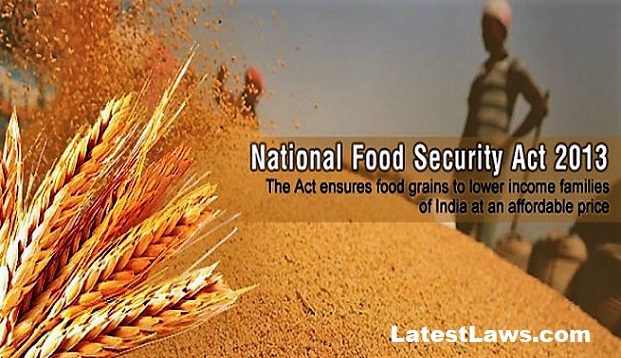
The National Food Security Bill, 2011(now National Food Security Act, 2013 or NFSA, 2013) was passed by Lok Sabha on 26 August, 2013 and was passed by Rajya Sabha on 2 September, 2013. It received the assent of President on 10 September, 2013 and became an Act. But it came into force retrospectively. Sec 1(3)of the Act provides the date of its enforcement -5 July, 2013.
The NFSA, 2013 aims to fight against the hunger and to protect the right of people to food. The objective of the NFSA is to provide not only food but nutritious food to a large section of the Indian population. The Act provides that its objective is to provide for food and nutritional security by ensuring the adequate quantity of the quality food to the entitled beneficiaries at affordable prices so that they can live a life with dignity. It aims to ameliorate the conditions of the poor and the food insecure population by providing legal rights and entitlements to persons belonging to eligible household to receive food grains per person at subsidized price.
- Who are the entitled beneficiaries and what are the entitlements for the food grain under the Act?
Sec. 3(i), CHAPTER II PROVISIONS FOR FOOD SECURITY- Every person belongs to the eligible households identified under sub-section (1) of section 10 such as-:
- Households cover under the Antyodaya Anna Yojana” (AAY); and
- Households cover as the priority households under the Targeted Public Distribution System (TPDS).
Sec. 2(3) defines eligible households means households which are covered under the priority households as well as Antyodaya Anna Yojana referred to in sub-section(1) of section 3 are the entitled beneficiaries under this code.
Identified households are entitled to receive 5 Kg of food grains per person per month at subsidized prices under TPDS. The households under Antyodaya Anna Yojana (AAY), which constitute the poorest of the poor, will continue to receive 35 Kg of food grains per household per month.
- What are the entitlements for food grains and at what price these will be provided to entitled beneficiaries?
Sec 3 (1), CHAPTER II- PROVISIONS FOR FOOD SECURITY, of the Act provides that each priority household indentified as per the provisions of Sec 10(1) of the Act, shall be entitled to 5 kg of food grains (rice, wheat or coarse grain- Sec 2(5)) per person per month from State Government at the price mentioned in Schedule I, which provides the price as Rs. 3, 2 and 1 per kg for rice, wheat and coarse grains respectively for three years from the date of commencement of the Act and thereafter, at such prices fixed by the Central Government not exceeding MSP (Minimum Support Price) of such grains. Also, Sec 3(3) provides that State Government can provide wheat flour in lieu of the entitled quantity of food grains in accordance with the guidelines of Central Government.
- Besides entitlement of food grains, what are the other entitlements for food security?
The NFSA, 2013 also focuses on nutritional support of pregnant women, lactating woman and children. Sec 4 of the Act provides that every woman and lactating mother shall be entitled to (a) free meal during pregnancy and 6 months after the child birth through local anganwadi and (b) maternity benefit of not less than Rs. 6000, however woman in regular public employment or receiving similar benefits under any other law are not entitled to benefits specified in clause (b). (Proviso to Sec 4). Further, for the nutritional support of children, Sec 5 of the Act provides for (a) age appropriate free meal in case of children between 6months- 6 years of age, through local anganwadi; (b) a free mid-day meal to children upto 8th class or within the age of 6-14 years in all schools run by local bodies, Government or Government aided schools. Also, Sec 6 of the Act imposes duty on State Government to indentify and provide free meals to the children who suffer from malnutrition with the help of local anganwadi. Further, the NFSA, 2013 through Sec 13 provides for women empowerment as it makes women of eighteen of age or above to be the head of household for the purpose of issue of ration card.
- Who possess the responsibility for delivering of entitlements to the beneficiaries?
Sec. 22(1), CHAPTER VIII, IX OBLIGATION OF CENTRAL GOVERNMENT, STATE GOVERNMENT FOR FOOD SECURITY-The Central Government has main responsibility to allocate required quantity of food grains to the government of states under TPDS and in respect of other entitlements from the central pool. It also possesses responsibility to transfer food grains as per the allocation to the depots designated by the Central Government in each state. State Government has the responsibility to take delivery from designated depots set by Central Government and make intra-state allocation for delivery of food grains at the doorstep of each fair price shop and ensure the supply of such food grains to entitled persons under TPDS. Similarly entitlement for meals to women and children, the State Government has the responsibility to take delivery from designated depots and ensure that the beneficiaries are getting benefits from delivery of those food grains.
- What is the role of local authorities in implementation of NFSA, 2013?
Sec.25, CHAPTER X OBLIGATIONS OF LOCAL AUTHORITIES- The local authorities like panchayats, municipal authorities etc. shall be responsible for proper implementation of the Act in their respective assigned areas and by notification the State Government may assign additional responsibilities to such local authorities for implementation of the TPDS to the local authority.
- How much percentage of population is covered under this Act in India? Is this percentage uniformly applicable to all states and union territories? How the eligible households under National Food Security Act, 2013 are identified?
The entitlements for food grains to entitled beneficiaries at subsidized prices under NFSA shall be extended utpo the 75% of the rural population and 50% of the urban population [Sec 3(2)]. This percentage coverage is at all India level and is not uniformly applied to all states and UTs. Sec 9 of the Act provides that percentage coverage under TPDS for each state shall be determined by the Central Government which shall be calculated on the basis of population estimates as per the census of which the relevant figures have been published. Sec 10 of the Act provides that within the numbers of person identified under Sec 9, the State Government identify (a) the households covered under AAY and (b) priority household under TPDS within the period of not more than 365 days of the commencement of the Act. The State Government shall update such list in accordance with the guidelines framed under Sec 10(1) [Sec 10(2)] and shall place such list of identified eligible households in the public domain [Sec11].
- What are the protections provided under this Act for the lower allocation of food grains to state/ union territories than their existing allocation under TDPS?
Sec 22(1) of the Act provides that the Central Government shall allocate required quantity of food grains to the State Government to ensure the regular supply of food grains to eligible households under TDPS. However, in case of lower allocation of food grains proviso II to Sec 3(1) provides that if the annual allocation of food grains to a state is less than the average annual offtake of food grains for last 3 years under normal TDPS, the same shall be protected at prices as may be determined by the Central Government and the State shall be allocated foodgrains as specified in Schedule IV. [SCHEDULE IV- STATE-WISE ALLOCATION OF FOOD GRAINS].
- What is the protection provided under NFSA, 2013 for non-supply of entitled quantity of food grain or meals to beneficiaries?
Sec 8, CHAPTER III- FOOD SECURITY ALLOWANCE, of the NFSA, 2013 protect the right of entitled beneficiaries in case of non-supply of food grains or meals. It entitles a person to receive food security allowance from concerned State Government in case of non-supply of the quantities of food grains or meals to which he is entitled under CHAPTER II, within such time and manner as may be prescribed by the Central Government.
- What is the grievances redressal mechanism under the NFSA, 2013?
CHAPTER- VII of the NFSA, 2013 provides for GRIEVANCES REDRESSAL MECHANISM. Sec 14 of the Chapter provides that State Government shall put an internal redressal mechanism which may include call centers; helplines, designation of nodal officer, or such other mechanism as may be prescribed. The Act under Sec 15 provides that State Government shall appoint a District Grievances Redressal Officer in each district for expeditious and effective redressal of grievances. Sec 15(5) provides that such officer shall hear complaint regarding non-supply of the entitled foodgrains or meals and matters relating thereto, and take necessary action whereas, Sec 15(6) provides for the appeal to State Commission in case of non-satisfaction from the order of such officer.
Every State Government shall, under Sec 16(1), constitute a State Food Commission which shall consist of (a) a Chairperson; (b) five other Members; and (c) a Member-Secretary, who shall be an officer of the State Government not below the rank of Joint Secretary to that Government [Sec 16(2)] of which there shall be two women and one person from SCs and one person from STs [Proviso to Sec 16(2)]. This State Food Commission shall (a) monitor and evaluate the implementation of the Act; (b) give advice to State Government; (c) inquire into violations either suo moto or on complaint; (d) hear appeals against the order of DGRO and (e) prepare annual report [Sec 16(6)]. There can also be a Joint State Food Commission for two or more states [Sec 19].
- What are the penalties for not complying with the provisions of the Act?
Sec.33 CHAPTER XIII MISCELLANEOUS- The Act provides penalties to be imposed on the public servant or authority for willfully ignoring the recommendation, not exceeding 5000 rupees by the State Food Commission, if fails to comply with the relief recommended by the District Grievance Redressal Officer. The public servant and authority shall be given a reasonable opportunity of being heard before the imposition of penalty on them.
Picture Source :



















