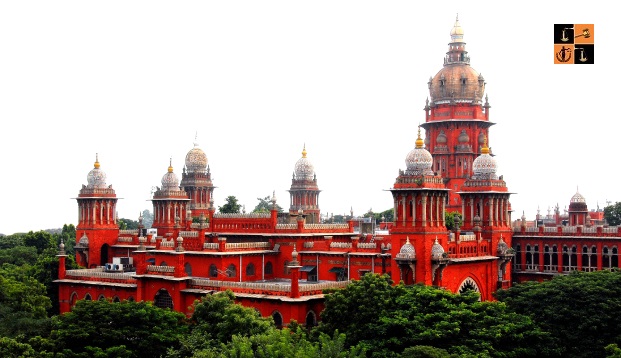
Recently, the Madras High Court refused to ban the Tamil film Karuppu, holding that depiction of corruption in an imaginary court setting cannot by itself justify censorship or amount to criminal contempt of court. The Division Bench of Justice G.R. Swaminathan and Justice V. Lakshminarayanan observed that courts and judges are not beyond criticism and significantly remarked that, “Judges need not be treated as holy cows.”
Brief facts:
The case arose from a writ petition filed under Article 226 of the Constitution seeking directions to ban or regulate the screening of the Tamil film Karuppu in theatres and OTT platforms on the ground that it portrayed the judiciary in a scandalous and derogatory manner. The Petitioner alleged that the movie depicted a corrupt presiding officer functioning in collusion with an unethical advocate in a fictional court, thereby lowering public confidence in the judicial system and attracting criminal contempt under Section 2(c) of the Contempt of Courts Act, 1971. Since the film had already received certification from the Central Board of Film Certification under the Cinematograph Act, 1952, the issue before the High Court was whether judicial interference was warranted despite statutory clearance being granted to the film.
Contentions of the Petitioner:
The Petitioner contended that the film portrayed the judiciary in a derogatory manner by depicting a corrupt judge acting in collusion with an unethical lawyer, thereby scandalising courts and attracting criminal contempt under Section 2(c) of the Contempt of Courts Act, 1971. The Counsel argued that unrestricted screening of the film would erode public confidence in the judicial system, and therefore directions were sought against its exhibition in theatres and OTT platforms.
Contentions of the Respondent:
The Respondents, however, argued that the film was a fictional cinematic work protected under Article 19(1)(a) of the Constitution. The Counsel submitted that the movie merely contained exaggerated fictional elements common in commercial cinema and did not portray the judiciary as entirely corrupt. The Respondents further contended that once certification had been granted by the CBFC under the Cinematograph Act, judicial interference through a public interest litigation was unwarranted, particularly in matters involving artistic freedom and free speech.
Observation of the Court:
The Division Bench of Justice G.R. Swaminathan and Justice V. Lakshminarayanan observed, “Judges need not be treated as holy cows. Justice is not a cloistered virtue; she must be allowed to suffer the scrutiny and respectful even though outspoken comments of ordinary men (Lord Atkin). But the lack of respect in the movie dialogues would not make any difference to us. In Sheela Barse -vs- Union of India (1988) 4 SCC 226, it was observed that criticism of judicial functioning is a healthy aid for introspection and improvement and that it is the privileged right of the Indian citizens to believe what he considers to be true and to speak out his mind, though not, perhaps, with the best of tastes; and speak perhaps, with greater courage than care for exactitude. Judiciary is not exempt from criticism. Judicial institutions are, and should be made of stronger stuff. Debates of public issues should be uninhibited, robust and wide open.”
The Bench observed that the Petitioner’s demand for banning the film proceeded on an incorrect assumption that criticism of judicial functioning is impermissible in law. While acknowledging that the judiciary is a respected institution, the Court candidly remarked, “None can deny there is corruption in the Judiciary. There were and are corrupt Judges.”
The Court further noted that the judicial system itself possesses mechanisms to identify and remove such “black sheep,” and therefore, the depiction of isolated corruption cannot automatically be treated as an attack on the institution as a whole. The Bench also held that the film merely portrayed a fictional narrative involving “the unholy alliance between an unethical lawyer and a corrupt Judge,” which by itself could not justify censorship or judicial interference.
The Bench observed that cinematic works enjoy constitutional protection under Article 19(1)(a), and artistic freedom cannot be curtailed merely because a section of viewers finds the content uncomfortable or critical. Emphasising the exaggerated nature of commercial cinema, the Bench observed, “Everything is melodramatic in Tamil cinema. Therefore, ‘Karuppu’ should also be taken as one of a piece.” Stressing artistic liberty, the Court held that “an artist is entitled to present in his own way” and that “artistic licence... should be placed on a high pedestal.” Relying on several Supreme Court decisions, the Court reiterated that free speech protects not only agreeable opinions but also expression “that we do not want to hear.”
The Bench also rejected the contention that the film amounted to criminal contempt under Section 2(c) of the Contempt of Courts Act, 1971. The Court held that contempt jurisdiction must be interpreted narrowly when freedom of speech is involved, particularly since the movie was set in an imaginary court called “Seven Wells Court.” Clarifying that no real court was portrayed in the film, the Bench observed, “There is no Court called ‘Seven Wells Court’. It is an imaginary one, just as Malgudi is a fictional village in R.K.Narayan’s works.”
The decision of the Court:
The Court ultimately dismissed the writ petition and declined to issue any direction banning or regulating the screening of Karuppu. The Court held that once the CBFC had certified the film for public exhibition, the writ court could not interfere merely because certain sections found the portrayal objectionable. The Bench further ruled that depiction of corruption in a fictional court setting does not amount to criminal contempt and reaffirmed that artistic freedom and freedom of speech under Article 19(1)(a) must receive robust constitutional protection unless the expression clearly falls within the restrictions recognised under Article 19(2) of the Constitution.
Case Title: R.S.Tamilvendan Vs. The Secretary to the State of Tamil Nadu & Ors.
Case No.: WP No. 20286 of 2026
Coram: Hon'ble Mr. Justice G. R. Swaminathan, Hon'ble Mr. Justice V. Lakshminarayanan
Advocate for the Petitioner: Adv. M.Senthilkumar
Advocate for the Respondent: GA M.Murali, Adv. K.Srinivasamoorthy
Read Judgment @Latestlaws.com