The Author, Vishal Sharma is a law student at Amity Law School, Noida.
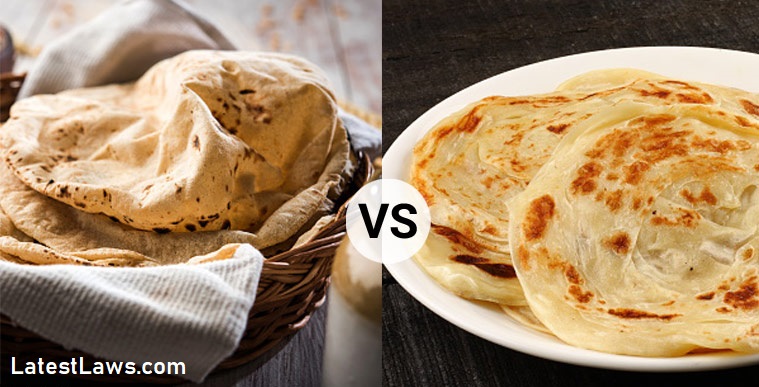
On June 12 2020, the Karnataka Authority for Advanced Ruling (AAR) gave its verdict that “parotas” cannot be put in the same GST tax slab as rotis. While parotas shall be taxed at 18% GST, rotis shall be taxed at 5%.
There is a clear huge variation in the tax that is levied on both the eatables while the process of making them remains the same. The applicant (ID Fresh Food) is a company indulged in making ready to eat and fresh food products for its customers and the question that the authority was dwelling into was whether the Malabar parotas made by the company be classified under tariff heading 1905 and GST rate of 5% be levied or not.
The contention put forward by the applicant in the aforesaid case was that their product of whole-wheat parotas and malabar parotas are in similarity to rotis and the process of making/manufacturing them are similar, description of the product is also similar to that of khakra, chapatti or roti which come under entry 99A of schedule 1of amended CGST rates of goods and are levied 5% GST and that is why same shall be levied to their product and not the higher tax slab.
Tariff Heading 1905
The products classification under tariff heading 1905 includes the description of bread, pastry, cakes, biscuits, etc. which are completely cooked food and are for immediate consumption. The product of the applicant has not been classified or described in the tariff heading 1905 and the products that are classified in this heading are for straight consumption that is ready to eat and no further cooking is required.
Parotas do not fall under the tariff heading 1905 because the applicant’s product is not ready to eat like the other products described above and require further heating for consumption and hence fail to fall under this category.
The Authority for Advanced Ruling (AAR) to deal with the matter differentiated between “ready to eat” and “heat and eat” which also helped in answering the question before them. While rotis and khakra fall under minimum tax slab are ready to eat on the other hand parota is a heat and eat product and falls under the category of processed food as per the manufacturing of ID Fresh Food. The applicant even in their application had admitted that their product had to be heated on pan or tawa to make it fir for human consumption. Hence, falling under the category of heat and eat.
Absence of the word “parota” in any section, chapter or heading makes the product fall in the tariff heading of 2106 and not 1905. Hence, parota was classified as product under the heading that requires preparation or processing for human consumption.
Ruling:
For the product to fall in 5% GST category it has two condition to fulfil -1) classified under heading 1905 or 2106 and 2) they must be either khakhra, plain chappati or roti. While first condition is fulfilled since the product falls under heading 2106, the second condition is not fulfilled due to the reasoning of “heat and eat” before human consumption. Hence, parota is not classified under entry no.99A of schedule I. Therefore, 18% GST shall be levied.
Conclusion:
According to me the variation of tax rate might seem a lot between roti and parota but in this instant case the reasoning for taxing the product at 18% is because it is processed and frozen food which till date is not a product or goods that is necessary for an individual on a daily basis but contrarily roti on the other hand is and going by the laws formulated the product by ID Fresh Food do not fall fit under the entry 99A of schedule I and hence 5% GST cannot be levied.
Read the Order @LatestLaws.com:
Pic Source: Indian Express