The Author, Kuldeep Garg is a student of 4th year, B.A.LLB at Rajiv Gandhi National University of Law, Patiala.
Time and again, judicial courts in India have stood for the right to dignity of dead persons. In a recent judgment, Karnataka High Court has directed the state government to ensure that the dignity of the dead must be respected. The right of dignity flows from Article 21 of the constitution which is the most progressive right in our living constitution. By various judgment of the Supreme Court, the right has been extended even to dead persons.
Judicial Precedents
However, this is not the first time that such rights have been recognized by courts. Firstly, in P. Rathinam v. Union of India, the ambit of article 21 was widened to include the dignity of a person. It emphasized the right to life means a meaningful life and not merely animal existence. Further, this right to dignity was expanded to a dead person. In the case of Parmanand Katara v. Union of India, the Supreme Court highlighted the importance of conferring dignity to dead persons. Again, it was reiterated by Apex Court in the case of Ashray Adhikar Abhiyan v. Union of India that dignity of the dead must be maintained and respected. Moreover, it expanded the right to have a decent burial according to the religious customs to which one belongs. It also established a corresponding duty on the state to ensure that decent burial is served to a person. Even after setting the precedents various times, it was not strictly enforced. Thus, the case of S. Sethu Raju v. Chief Secretary was filed in Madras High court to bring in the notice of the High Court, the stand taken by Supreme Court in Ashray Adhikar Abhiyan v. Union of India. Considering the case, the High court directed the authorities to bring the dead body from Malaysia, so thus, burial can take place according to traditions and customs.
Rights of Dead Persons under Indian Laws
Besides, rights conferred over a dead person by judicial precedents, Indian Penal Code,1860 also confer some rights upon dead persons. Section 297 prohibits trespass in any place set apart from the performance of funeral rites or as a depository for the remains of the dead. Further, it penalizes any person, who offers indignity to the human corpse and also who disturbs the assembly gathered for the performance of the funeral ceremony. This provision was recently revoked by Madras High Court, in the case where large assembly of people opposed the burial ceremony of a doctor. Section 404 penalizes criminal misappropriation with the property possessed by the deceased person at the time of his death. However, it excuses those who are legally entitled to such possessions. Section 499 makes defamation a crime. The explanation I widen the scope of defamation and provides that defamation of deceased person is a crime too if it is intended to hurt the feeling of family or relatives. Section 503 of the IPC which defines criminal intimidation, includes threatening a person with injuring the reputation of a dead person dear to him, as an offence.
Latest Developments
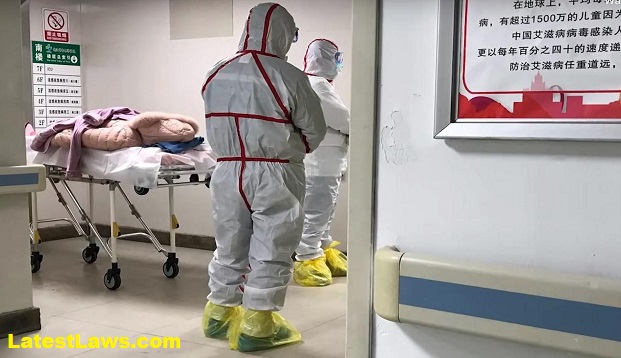
The issue of the dignity of dead and decent burial is again in news, due to the Covid-19 pandemic. Family members and relatives refrain from coming in contact with such persons due to the easy transmission of disease from one body to another. Several incidents have taken place in this global pandemic and various authorities have intervened to curb the menace. Government lockdown orders have nowhere banned cremation ceremonies. It has merely restricted the number of people allowed in such ceremonies. Further, it has laid down some guidelines, which are for the welfare of the public. Similar guidelines have been laid down by World Health Organization (WHO). Further, WHO has claimed that there exists no such evidence that Covid-19 can be transmitted from a dead body. Both WHO and the Indian government has also emphasized the dignity of the dead, including decent burial according to religious customs. Despite these guidelines, there have been rampant violations of the dignity of dead persons which is indicative of the state of affairs in the country.
Various High Courts have highlighted the importance of providing decent burial to dead persons amidst this pandemic. But still, the internet and newspapers are flooded with such news. Recently, Former Law Minister of India, Ashwini Kumar has written to the Apex court to take suo-motu cognizance of the matter. Kumar tried to direct the attention of the court on its duty to enforce what it has laid down in previous judgment, that have been discussed above.
Conclusion
Even if the matter is resolved and the Apex court gives some directions to state authorities, still there can be no assurance that the burial ceremony is conducted as per the tradition and religious customs of the person. Here, society needs to be extra sensitive to assure that adequate decency is maintained in burial. Society ought to trust WHO and government, who have claimed that there is no evidence that a person has been infected by the disease from a dead person. The government should also take the initiative to educate family members and relatives to use precautionary measures while attending funeral ceremonies as the menace is not just limited at the individual level, it shows the state of affairs in a country.