The Author, Simant Tyagi is a 4th year Law Student from the Institute of Law, Nirma University.
As per estimates for the year 2021, the market for unmanned aerial vehicles (UAVs, or simply drones) would have a capitalization of 127 billion US dollars, making it a unique business sector. Additionally, between 2018 and 2024, the size of the worldwide equipment market will increase from 14 billion to 43 billion US dollars. As a result, it is anticipated that more than 100,000 fresh jobs would be created globally. Before this, data gathering and monitoring had been the major focus of unmanned aerial vehicle development. Technology advancements today are concentrating on active interventions. Innovative use cases of UAVs are being developed with the assistance of new solutions, which will help to reduce traffic congestion and link other negative consequences of road travel.
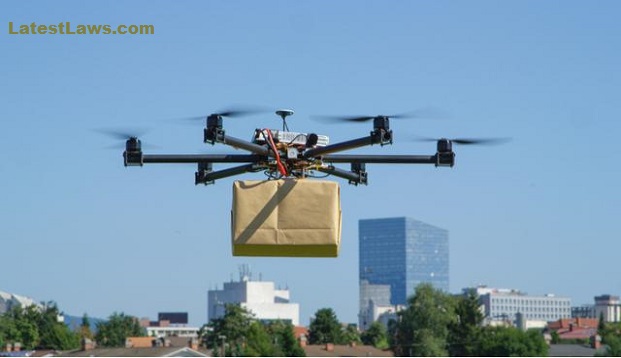
Prescription medications, packages of food items, meals, and various other medical supplies are all delivered by drone. These drone delivery operations are playing a bigger role in last-mile delivery, thanks to their accuracy, environmentally friendly operations, speedier scheduling of deliveries, and lower operating expenses compared to traditional delivery methods. According to analysts, operational costs for the usage of drones are 40% to 70% less expensive than those for a delivery service model based on vehicles. The COVID-19 pandemic has increased the demand for additional, secure, and contactless methods of delivery. As a result, there is a greater need for drone deliveries worldwide.
EVOLUTION OF DRONE DELIVERY SYSTEMS
Technology advances and a rising interest in using unmanned aerial vehicles (UAVs) for logistics have played a vital role in developing drone delivery systems. It has evolved from a sci-fi notion to a practical reality in several regions of the world.
The initial drone delivery experiments date back to the early 2010s when corporations like Google and Amazon began to examine the viability of utilising drones to carry items. These preliminary testing were concentrated on regulated small-scale delivery. They did, however, lay the groundwork for the later buildup of more complex systems.
Several businesses and organisations have effectively expanded the use of drone delivery systems in recent years. For instance, they have run pilot projects and trials in nations including the United States, Australia, and China to examine the practicality of employing drones for commercial deliveries. The advantages of drone delivery, including quicker delivery times, lower prices, and improved accessibility to rural places, have been demonstrated by these programmes.
The development of regulatory frameworks has gone hand in hand with the emergence of drone delivery systems. The necessity for rules and regulations to ensure the safe and responsible usage of drones has been acknowledged by governments all over the world. Through the application of particular laws and limits, they have addressed issues surrounding the management of airspace, privacy, security, as well as safety.
POTENTIAL BENEFITS OF DRONE DELIVERY IN INDIA
Drone delivery systems can significantly improve India's logistics sector, and can possibly have the following benefits:
- Faster and Efficient Delivery: Drones can get through congested traffic and make it to their destinations more quickly than conventional delivery techniques. They can get beyond the limits of the road system, allowing for speedier and more effective transportation of commodities, especially in highly populated metropolitan areas.
- Last-Mile connectivity: Drone deliveries can close the last-mile connection gap, particularly in India's distant and rural areas. Access to basic goods and healthcare services in these places is frequently difficult. They can get to remote regions and quickly deliver essential supplies despite geographic limitations.
- Cost Cutting: The use of drone delivery systems might result in considerable savings on transportation expenses. Drones eliminate the need for big vehicle fleets and vast distribution networks. It may cut down on fuel expenditures, maintenance costs, and labour needs, making it a financially sound choice for logistics firms.
- Environmental Benefits: Compared to traditional delivery systems that depend on fossil fuel-powered vehicles, drones run on electric power, which lowers carbon emissions. India can aid in lowering air pollution and degradation of the environment by using drones for deliveries.
- Creative Business Models: Drone delivery creates new business prospects and creative business models. Startups could look into the possibilities of delivery services using drones, providing specialised solutions for particular market segments or sectors.
CURRENT REGULATORY FRAMEWORK IN INDIA
The main set of legislation which governed the manufacturing, ownership, usage, operation, sale, import, and export of aircraft—including unmanned aircraft systems, or drones in layman's terms—was the Aircraft Act of 1934. By the Act's directive, the government also drafted the Aircraft Rules, 1937, which established a comprehensive regulatory framework for aircraft operating on Indian soil. As a result of the heightened risk associated with operating aircraft, the Aircraft Rules included strict regulations governing registration and operation. But if these strict rules were to be applied to drones or other unmanned aircraft, it would be undesirable since it would have prevented developments in the field.
A prolonged period of ambiguity and misunderstanding about drone governance resulted from the pre-independence legislation and norms' failure to recognise drones independently, despite periodic amendments. Additionally, remotely operated drones differ significantly from manned aircraft, necessitating the development of a more sophisticated legal framework for the governance of the drone industry.
The Unmanned Aircraft System Rules, 2021 (the "UAS Rules") were thereafter notified by the Ministry of Civil Aviation. However, these Rules were extremely restrictive for other persons since they were exclusively focused on resolving national security problems by toughening the licences and approval standards. As a result, these Rules drew a lot of criticism from those in academia, start-ups, end users, and other stakeholders who viewed them as being overly restrictive. In July 2021, the government released guidelines to allay the worries of different stakeholders and invited feedback. After considering all feedback and proposals, the Ministry of Civil Aviation, acting within the authority granted by the Aircraft Act of 1934, published the Drone Rules, 2021, which replaced the UAS Rules/
Given the benefits of employing drones for different services, the Indian government has given private businesses free rein to utilise drones for deliveries as long as they abide by the Drone Rules 2021. This is because a few years before, the government had used drones for a variety of purposes, including the distribution of vaccines, an inspection of oil pipelines and power lines, anti-locust operations, agricultural spraying, mine surveys, and land surveying.
To promote domestic production, the Indian government has also authorised the Production-Linked Incentive (PLI) scheme for drones and its components. The Ministry of Civil Aviation estimates that 15 million dollars will be given to producers as part of this programme over the course of three financial years. The government is also promoting projects like "Drone Shakti," which supports drone entrepreneurs, and "Drone as a Service (DrAAS)." By October 2022, a web-based tool known as "Digital Sky" also became operational, managing numerous drone-related operations around the nation.
LEGAL CHALLENGES OF DRONE DELIVERY
Despite several government-led attempts, several legal issues still need to be resolved before drone delivery systems can be widely adopted in India.
- Regulatory Framework: The creation of a thorough regulatory framework that is especially suited to the operation of drones and delivery systems is one of the main issues. The unique characteristics of drone delivery may not be sufficiently covered by the current legislation, necessitating the creation of particular standards and regulations.
- Airspace Management: Safe drone formation into the current aviation ecosystem depends on effective airspace management. To prevent confrontations with human aircraft, rules for drone flying lanes, height limitations, and cooperation with air traffic control systems must be established.
- Privacy and Data Protection: Concerns about privacy and data protection have been brought up by the usage of drones for delivery. Drones using cameras and sensors can gather private information about individuals and property. To guarantee that privacy rights are upheld and that data obtained by drones is handled and secured properly, clear rules must be developed.
- Liability and Insurance: It can be challenging legally to determine who is responsible for drone-related mishaps, property damage, or injuries. To safeguard the interests of all parties, precise responsibility frameworks and insurance standards for drone delivery operations must be established.
- Urban Environment Challenges: Delivering products in crowded urban settings presents unique difficulties, including navigating challenging airspace, avoiding obstructions like buildings and electrical lines, and protecting people and property on the ground as well. A careful balance between the operating capabilities of drones and the urban infrastructure is necessary to meet these problems.
CONCLUSION
It seems inevitable that delivery services will embrace drone technology. It will soon be used by many companies to innovate their business sectors, including last-mile deliveries. Since 2005, e-commerce giants have been placed in charge of drone technology research, development, and patent applications. They remain committed to this market and are concentrated on lowering last-mile delivery operating costs, speeding up delivery, and combining the use of drones with smartphone apps to enhance user experience.
The use of drones for delivery will continue to increase in the coming years, and businesses will need to keep funding technology improvements and drone delivery projects to experience operational development and financial gains. Despite the challenges, several companies are utilising drones for delivery. The drone and drone component manufacturing sector in India, which now has over 200 companies, is expected to receive over $626 million in investment over the course of the next three years, as per the Ministry of Civil Aviation. It may not completely replace conventional delivery techniques, but they can revolutionize logistics processes by offering quicker, more effective, and environmentally friendly delivery solutions, which will ultimately increase consumer satisfaction.