









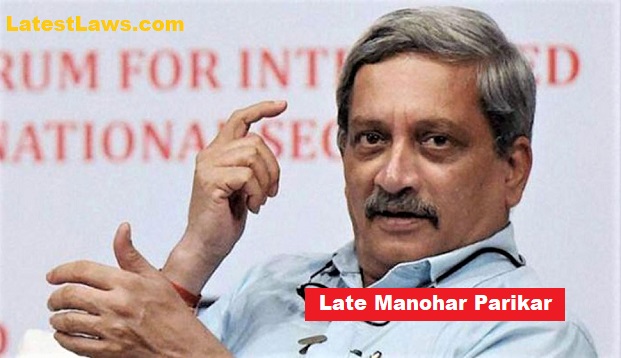
March 17, 2019:
Manohar Gopalkrishna Prabhu Parrikar, was from IIT-Mumbai.
It must have been one of those muggy Goan afternoons, when an ambitious son of a small-town grocer, Manohar Gopalkrishna Prabhu Parrikar, fresh from his stint at IIT-Mumbai, decided to scour a marketplace in Goa sniffing an opportunity to manufacture & sell jute gunny sacks.
The imagery of a trained metallurgist seeking a fortune in a coarse cloth, may not appear to laden with logic, but Parrikar went ahead with his endeavour nevertheless. And in a mere three months, made good the loan borrowed from his mother, with promised returns.
His penchant, evident at a young age, for the un-obvious approach & an independent style backed with swift decision-making, which was to define his political journey, is what made Subash Velingkar, his mentor & RSS guru, handpick him as the future face of the BJP in Goa.
In immediate years, he ditched a business partnership with a relative, & later, only when the opportune period surfaced, set up a hydraulics factory with a native Muslim, proving very early, he knew how to separate business, from personal & politics.
While on the one hand Parrikar, who had set his mind on establishing his business at the time, & was reluctant to take the political plunge, three decades later Velingkar is left with regret for his nurturing of the man who would be Chief Minister of Goa on four occasions & the first Goan to serve as Defence Minister of India. And, till his last breath — refused to resign, retire or relinquish his stake to the highest administrative chair in the state.
Velingkar’s regret is moored to the fact that, except for his trademark lone wolf style of administration, everything about him changed after his romping to unprecedented power in Goa in 2012. Parrikar in power became a contradiction to all that he represented & stood during his swift march to the top. He became a political paradox, who betrayed everything; his charismatic appeal, his native swagger, his ground appeal & governance.
Riding on the hopes of people across communities who looked up to him, for all the commitments he made while in Opposition, from ensuring sustainable development to encouraging reforms & policies to ensure status to Goan state & its identity; towards the end, he was reduced to mere blustering caricature by fellow Goans.
In New Delhi, if he famously announced breaking nexus between middlemen, arms agents & defence Ministry as NDA’s biggest achievement, his Goa stints since 2012 saw him buffered against green activists and non-BJP vote bank, by an influential caste affluent coterie of Gaud Saraswat Brahmins, even as he defected his promises on wiping clean the casinos, illegal mining & sanctions to illegal real estate projects.
His repeated threats since 2010, never to contest elections or be reduced to a ballot summary, remained a mere sound byte, even as he coarsely exhibited his omnipotence desperately from hospital beds, in Mumbai, New York, New Delhi & Goa.
The vacuum of the leadership was felt even more pronounced with neither Parrikar nor the BJP having groomed a deputy, with only his death bringing the reality stark in the open.
If the Parrikar before 2012, was someone who could be trusted with the daily concerns of the state, the Parrikar post 2012, political observers say, was a man weighed down by the debts of his state after the mining ban, & being pushed to bend to a strong migrant capitalist lobby who started investing in casinos & in investment projects across pristine forest & agriculture land.
In the last year & half, his reluctance to delegate administrative affairs to ministerial colleagues, resulted in Parrikar amassing all important portfolios and running the state using a select group of administrators, whose questionable decisions more of than not would be dragged to court.
But, with all the contradictions, the man with a simple lifestyle, who always took blessings of his mother and his favourite deity, Goddess Mahalakshmi, & who was sometimes seen eating ros (chicken gravy) omelettes off the street, and who could remember the names and villages of every voter, “including their nine year old grandsons” if they crossed the street, will always remain the state’s most popular political export; having helmed the country’s defence portfolio when the army crossed the border & gave India’s neighbours a fitting reply with ‘surgical strike’, long since chanted a slogan by the BJP.
In all public events since Parrikar claimed, the set of surgical strikes was in a way, a liberated Goa returning its debt to the Indian army.
Known for his modest sartorial style, he will also go down as the only minister who chose 13, his birth date, as his lucky number, with his convoy never shying putting the orthodox number as his number plates.
Such is the irony — that his government had the strength of 13 BJP MLAs in 2000 when he first staked claim to chief ministership, while till the evening of March 16, 2019, he was the 13th man standing from BJP in the coalition government. With his death, BJP is reduced to 12 in the assembly.
Much before he became a popular name in Delhi’s political circles, Parrikar, the blue-eyed lad of his New Era English High School, was a Sangh boy, following instructions “like an obedient student” & given the task to expand its reach in Goa. His lobbying skills to get most tourist-friendly festivals to Goa, be it IFFI or Serendipity also earned him fans.
It’s to his charismatic appeal and credit, that the Church which supported his leadership, and the Qureshi community which still walked to him to resolve the issue of beef ban in the state, never felt it important to ponder the journey he took years ago to Ayodhya to the Babri Masjid demolition as an RSS karyakarta.
Months before his death, it was ten maulanas who reached the BJP headquarters to read the Koran Khawani for him, with the state’s archbishop Filipe Neri Ferao himself also appealing the Catholic community to raise fervent prayers for him. Such was his pull, till the end, and he is one of the few BJP leaders known to at least have secured a secular image.
In 2000, when he first became the chief minister of a coalition government. — heralding BJP inside the assembly complex for the first time with the support of 13 BJP MLAs & one Maharashtrawadi Gomantak Party (MGP), people still recall the dramatic convoy, with Parrikar sitting in the navigator’s seat as the car drove to the Adil Shah Palace, then the state secretariat to stake a claim.
A sight new to Goans & officialdom, Parrikar left no doubt on who was navigating the party’s fortunes in the state. The former mukhya shikshak who later became RSS Pracharak, had a decade’s efforts behind that journey.
Former Union Law Minister & Congress Leader Ramakant Khalap recalls Parrikar’s induction to BJP, first change his friends’ circle from native Goans to men from Maharashtra, like Gopinath Munde & Pramod Mahajan. BJP those years prior to the coalition were yet to make inroads in the state politics, & the trio lost no time in looking for allies with “Hindutva sentiments in a cosmopolitan Goa”.
“I recall seeing something new then. It wasn’t snatched, but even those who won from MGP then were with a different ideology. Unknown to us, BJP had already infiltrated in our party, and while they collectively revelled, we knew that only one man pulled that coup and it was Parrikar,” recalls Khalap of the next general election in 1994. Soon MGP which had a huge Bahujan and Hindu base disintegrated after Parrikar and his friends started using the “Ram Ticket. And no can compete with Ram in this country, and we were sent off,” recalls Khalap.
In the days since his rank as the Chief Minister in the latest 2017 assembly elections, all his allies have threatened they are with the BJP only till Parrikar remains a chief minister. Even as BJP continues to poach opposition MLAs, and infighting continues within his cabinet, there is no one who knows the boon of political visibility better than Parrikar. In 2000 he had used the “golden hours” when the then chief minister Francisco Sardinha travelled abroad on a weekend to stake claim to the government.
In the last few months, whether it’s announcing a budget, or inspecting a bridge promised by the party, or attending a booth meeting where he asked Goans to vote for BJP, Parrikar visibly weak & ferried in a wheelchair by his doctor continued to show his presence in the state, routinely also releasing photographs of chairing cabinet meets from his residence.
So strategic were his appearances & his tweets that they never failed to tease an opposition which continued to hold public meets demanding his resignation, cheekily even asking Goans “How is the Josh”, during the launch of the Atal Setu bridge, the memory of the surgical strike always in most of his public conversations.
In the villages of Parra—where his ancestors come from—a story now will be repeated. Parra, known for its watermelons once saw a tiff between a father a son, both farmers. While the father allowed boys, including Parrikar, then a young boy, to chew on the melons & spit the seeds around, the son found it a waste of good produce, forcing the father to stop & send the melons for export.
In 2017, back as a defence minister, Parrikar who spoke about being lonely in New Delhi, is believed to have recalled this story. Source Link
Picture Source :




















