









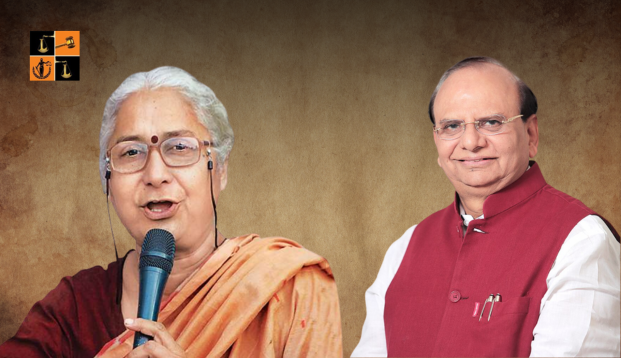
The Supreme Court has declined to interfere with the conviction of Narmada Bachao Andolan leader Medha Patkar in a criminal defamation case instituted over two decades ago by Vinai Kumar Saxena, now Lieutenant Governor of Delhi, but has set aside the monetary penalty imposed by the trial court.
The Division Bench of Justice M.M. Sundresh and Justice N. Kotiswar Singh, while maintaining the finding of guilt under Section 500 of the Indian Penal Code,1860, modified the probation terms by removing the requirement for periodic appearances before the trial court and permitting her to furnish bonds instead. The trial court had earlier granted her the benefit of probation in lieu of a custodial sentence but directed payment of ₹1 lakh as a penalty.
The case stemmed from a press note issued by Patkar in November 2000, under the heading “true face of patriot”. In the statement, she accused Saxena of involvement in hawala transactions, alleged that a cheque for ₹40,000 given to the Narmada Bachao Andolan had bounced due to a non-existent account, and described him as “a coward” and “not a patriot.” In April 2025, the trial court found the statements to be deliberate and malicious, intended to harm Saxena’s reputation and credibility, holding them to be defamatory per se. The sentence was suspended by the Delhi High Court in the same month, which released her on a personal bond of ₹25,000.
Medha Patkar's challenge to the conviction and sentence before the High Court, along with her plea to summon an additional witness in her own defamation case against Saxena, was dismissed in July 2025. The High Court held that there was no illegality or procedural irregularity in the trial court’s decision, and declined to interfere with the sentence, save for modifying the probation condition to allow appearances through video conference or via counsel.
Senior Advocate Sanjay Parikh, representing Patkar, argued that the conviction was unsustainable as the appellate court had disbelieved two key prosecution witnesses and the email relied upon as central evidence lacked certification under Section 65B of the Indian Evidence Act, 1872, rendering it inadmissible. The Bench, however, expressed unwillingness to revisit the conviction, though it agreed to annul the penalty order. Senior Advocate Maninder Singh, appearing for Saxena, urged that a token penalty be maintained.
With the Supreme Court’s latest ruling, the conviction stands undisturbed, though the financial penalty has been removed and the probation requirements eased.
Picture Source :




















