









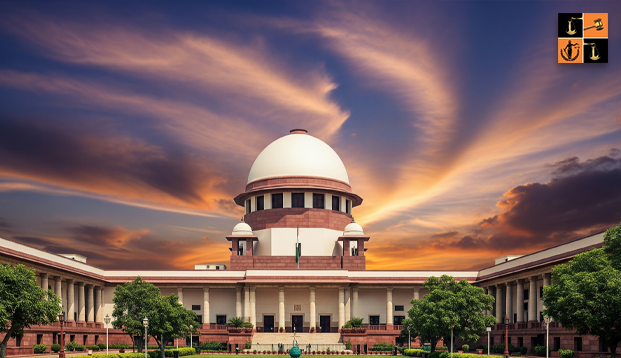
Recently, the Supreme Court has upheld a Madras High Court order directing the removal of permanent flagpoles erected by political parties, communal bodies, and other organisations in public places, including national highways and government land. The Court dismissed the challenge, reiterating that government land cannot be used for political purposes.
The Division Bench of Justice J.K. Maheshwari and Justice Vijay Bishnoi questioned the very premise of the challenge, asking, “How can you use government land for political benefits?” The Bench also emphasised the breadth of the High Court’s powers under Article 226 of the Constitution, which permitted it to issue wide-ranging directions in the public interest.
The case originated from a petition by Kathiravan, who had challenged the rejection of his request to install an AIADMK party flagpole in Madurai city. The Madras High Court, through Justice G.K. Ilanthiraiyan, dismissed the plea, holding that no statutory provision authorised the issuance of licences for permanent flagpoles in public spaces. It further noted that police and revenue authorities lacked jurisdiction to grant No-Objection Certificates for such purposes.
The order went beyond the confines of the individual dispute, directing that all permanent flagpoles in public places across the State be removed within twelve weeks. It further empowered the authorities to recover the cost of such removal from parties failing to comply, after providing them with due notice.
The High Court observed that permanent flagpoles in public spaces often caused inconvenience to commuters and disrupted traffic. However, it clarified that political parties could install flagpoles on private patta land for events such as campaigns, protests, and public meetings, provided they complied with applicable rules and removed the structures promptly after use. The order went beyond the confines of the individual dispute, directing that all permanent flagpoles in public places across the State be removed within twelve weeks. It further empowered the authorities to recover the cost of such removal from parties failing to comply, after providing them with due notice. It also directed organisers to restore the site to its original condition after removing the flagpoles and instructed the State to frame regulations governing the installation of flagpoles on private property.
While dismissing the appeal, the Apex Court upheld the reasoning adopted by the High Court, emphasising that the directions were issued in the larger public interest. With this, the Madras High Court’s mandate remains in full force, obligating political parties and organisations across Tamil Nadu to comply and ensuring that public spaces are kept free from unauthorised flagpoles and other permanent structures.
Picture Source :




















