









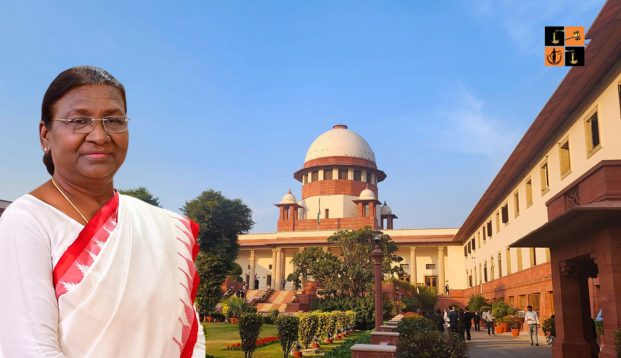
The Supreme Court concluded arguments on the presidential reference filed by President Droupadi Murmu under Article 143 of the Constitution, seeking clarification on the Court’s April ruling concerning deadlines for Governors to act on bills passed by State legislatures. The Constitution Bench, led by Chief Justice B.R. Gavai and Justice Surya Kant, Justice Vikram Nath, Justice P.S. Narasimha, and Justice A.S. Chandurkar, had commenced the hearings on August 19 and reserved its verdict after an extensive 10-day deliberation. The judgment is expected in the next two months, prior to CJI Gavai’s retirement on November 23.
The reference followed the Apex Court’s April 11 decision in State of Tamil Nadu v. Governor of Tamil Nadu & Anr., which held that Governors must act within a reasonable time and that constitutional silence could not be used to delay the democratic process. President Murmu, exercising powers under Article 143(1), submitted fourteen questions to the Court, seeking clarity on whether judicial timelines could be imposed on the discretionary powers of Governors and the President under Articles 200 and 201. The President’s concerns centered on whether imposing time limits could encroach upon constitutionally granted discretion or whether procedural guidance could be provided by the Court in areas where the Constitution is silent.
During the final day of arguments, CJI Gavai highlighted the delicate balance between judicial intervention and democratic autonomy, stating, “I am a strong believer in the doctrine of separation of powers. While judicial activism has its place, it must not become judicial adventurism. Yet, if one wing of democracy fails in its duty, can the Court, as custodian of the Constitution, remain powerless?”.
Solicitor General Tushar Mehta, representing the Centre, countered that both the executive and legislature are also constitutional custodians, and that issuing a mandamus to a Governor or the President, in areas of discretionary function, would infringe upon the separation of powers. Mehta stressed that Governors may withhold assent in exceptional cases, such as if a bill threatens constitutional integrity, citing hypothetical scenarios like a State attempting to secede from the Union. He further contended that recent litigations challenging Governors’ inaction were limited, and that mandating timelines could disrupt the constitutional framework.
Attorney General R. Venkataramani submitted that Article 200 envisions independent evaluation by the Governor, and that judicial interference should not alter the structural design of the Constitution. The AG emphasized that while courts can read rights into provisions, the Governor’s discretion under Article 200 is a deliberate feature of the constitutional scheme.
The Bench had earlier raised concerns during hearings on whether prolonged inaction by a Governor could paralyse the functioning of a democratically elected State government and noted the potential consequences if Governors and the President fail to follow prescribed timelines. States including Tamil Nadu, Kerala, Karnataka, West Bengal, and Himachal Pradesh intervened to argue that enforcing judicial timelines could disrupt the balance of federal powers and undermine the role of constitutional functionaries.
The Top Court’s forthcoming judgment is anticipated to provide critical guidance on the interplay between constitutional discretion, timelines for assent, and the broader doctrine of separation of powers, potentially shaping the framework for gubernatorial and presidential functions across India.
Picture Source :



















