









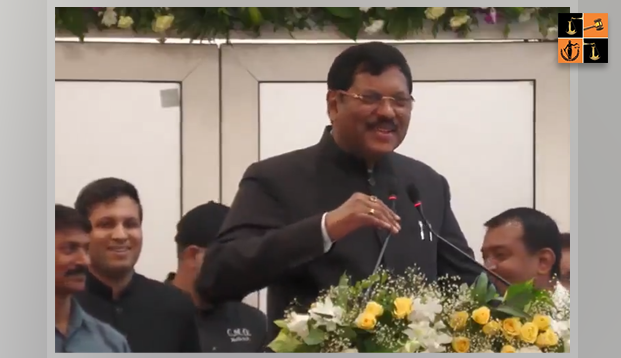
On Thursday, Chief Justice of India B. R. Gavai publicly affirmed that he will vacate his official residence before the time limit prescribed under the Supreme Court Judges Rules, despite personal constraints in arranging alternate accommodation before his retirement on November 24.
Addressing a farewell function organised by the Supreme Court Advocates-on-Record Association (SCAORA) for Justice Sudhanshu Dhulia, who retires on August 9, the CJI remarked, “Till 24th of November, I will not find time to find a suitable house. But I can assure you that whatever time is permissible as per the rules, I will be shifting before that.”
While commending Justice Dhulia for promptly vacating his official residence, CJI Gavai said, “After retirement, he will be in Delhi and will be among the rare judges who vacate their house immediately on the very next day. I wish I could do the same. Justice Dhulia has set a very good example, and I am sure many of us will follow it.”
As per Rule 4 of the Supreme Court Judges Rules, 1959, a judge is entitled to retain a government residence rent-free for one month after retirement. Rule 3B, introduced in 2022, allows a retired Chief Justice to stay for six months in a Type VII government accommodation in Delhi, but not in the Type VIII bungalow reserved for the serving CJI.
CJI Gavai’s remarks come against the backdrop of an unusual episode in which the Supreme Court administration formally requested the Union Ministry of Housing and Urban Affairs to take back the CJI’s official residence from former Chief Justice D.Y. Chandrachud. Having retired on November 10, 2024, Justice Chandrachud continued to occupy the Krishna Menon Marg bungalow for nearly eight months, vacating it only on August 1, 2025.
In a communication dated July 1, 2025, the Court’s administration pointed out that the six-month period permitted under Rule 3B had ended on May 10, 2025, and that even the special extension granted had expired on May 31, 2025. It called upon the government to take possession “without any further delay.”
Justice Chandrachud attributed the delay to renovation works, halted earlier due to construction restrictions under the GRAP-IV pollution control measures, and to personal reasons, including the special medical needs of his two daughters, who suffer from nemaline myopathy, a rare neuromuscular disorder. He said he had been allotted rental accommodation and shifted “the very next day the house was ready.”
By pledging to vacate before the permissible deadline, CJI Gavai reinforces the principle that judicial officeholders must observe the same statutory obligations they are entrusted to uphold.
Picture Source :




















