









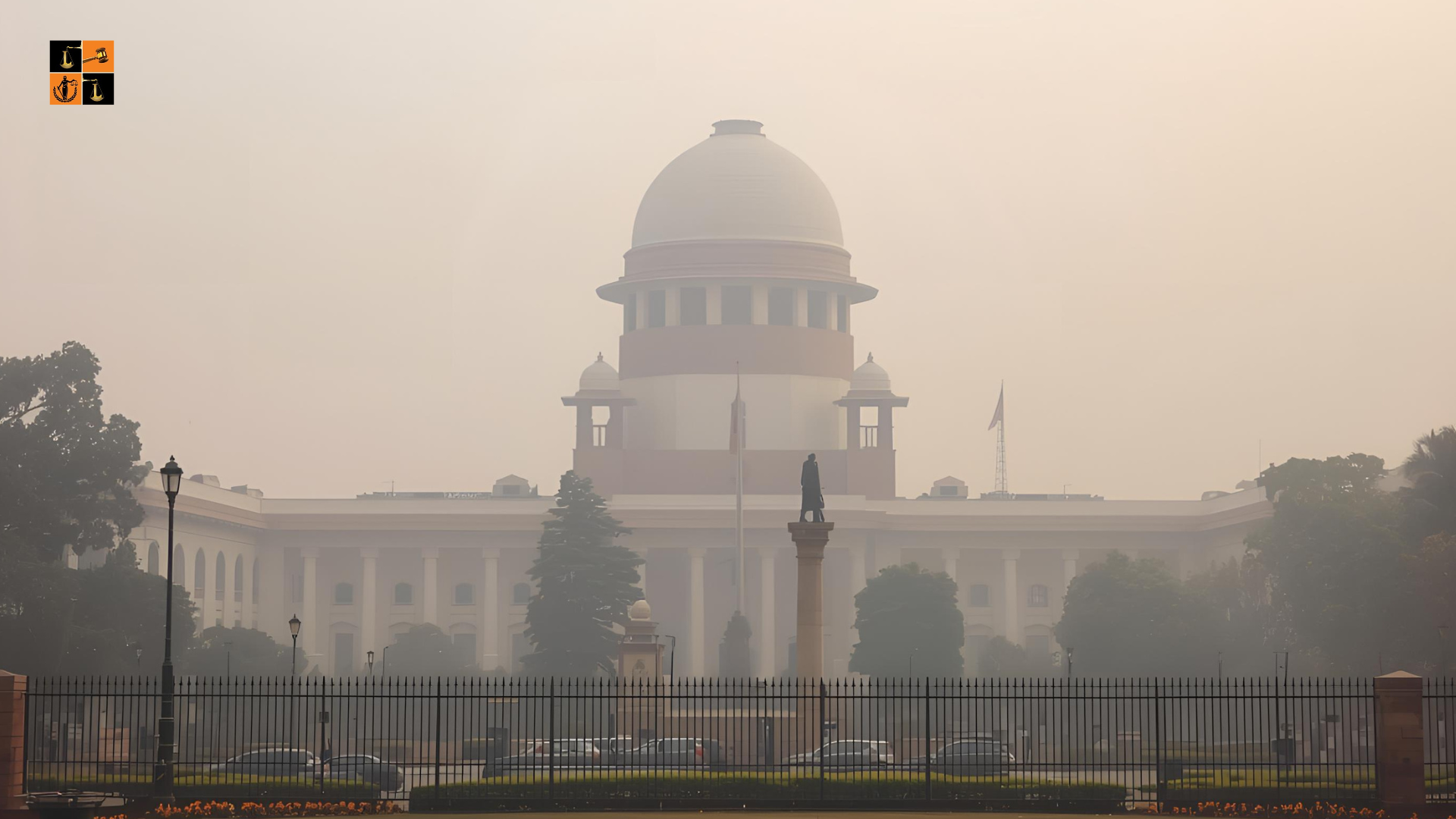
Recently, a Public Interest Litigation has been filed before the Supreme Court seeking urgent judicial intervention to address what the petitioner terms as an “unfolding public health emergency” caused by persistent air pollution across India.
Filed by Luke Christopher Countinho, a wellness expert associated with the Prime Minister’s Fit India Movement, the plea contends that air pollution levels across India have reached “alarming and irreversible” proportions, endangering citizens’ fundamental right to life and health guaranteed under Article 21 of the Constitution. The petition, filed through Advocate-on-Record Rooh-e-Hina Dua, seeks a declaration of a “National Public Health Emergency”, along with binding statutory directions to strengthen enforcement mechanisms under existing environmental laws.
The Petitioner alleges that despite an elaborate statutory regime under the Air (Prevention and Control of Pollution) Act, 1981, and the National Clean Air Programme (NCAP), the ambient air quality in most Indian cities remains far below acceptable limits. It is submitted that “over 1.4 billion citizens are compelled to inhale toxic air every day,” while the institutional response continues to be “persistent and systemic in its failure.”
Citing recent studies, the petition asserts that “2.2 million schoolchildren in Delhi have already suffered irreversible lung damage.” It points to alarming statistics, annual averages of PM₂.₅ and PM₁₀ levels in cities such as Delhi (≈105 μg/m³), Patna (≈131 AQI equivalent), and Lucknow (≈90 μg/m³), which far exceed both national standards and the World Health Organization’s Air Quality Guidelines (2021).
The plea argues that the National Clean Air Programme (NCAP) has failed to achieve its modest goals. “As of July 2025, official data reveals that only 25 of the 130 designated cities have achieved a 40 percent reduction in PM₁₀ levels from the 2017 baseline, while 25 other cities have in fact seen an increase.” The petitioner also criticizes the government’s overreliance on temporary and “symbolic” measures such as mist sprayers and artificial rain trials, arguing that these fail to address emission sources.
The plea identifies several structural deficiencies in air quality governance. It highlights that monitoring mechanisms remain inadequate and urban-centric, noting, “Experts estimate that at least 4,000 stations – 2,800 in urban areas and 1,200 in rural areas – are required to capture real trends, yet NCAP has consistently fallen short of its targets.” This, the petitioner argues, has created “data shadows” that obscure the true scale of rural and peri-urban exposure.
The regulatory environment, the petitioner contends, has also been weakened by lax enforcement and the outsourcing of compliance checks. “Independent assessments of Bharat Stage VI vehicles in the National Capital Region revealed nitrogen oxide emissions many times higher than the permissible limits... Yet, despite these violations, no systemic enforcement action was taken. Indeed, in 2019, not a single criminal case was filed under the Air Act in Delhi, despite it being one of the most polluted cities globally.”
The petitioner seeks a series of wide-ranging directions, including:
- Declaration of air pollution as a National Public Health Emergency, with a time-bound national action plan by the Union Government.
- Making NCAP targets legally binding, with statutory backing and clear accountability mechanisms.
- Establishment of a National Task Force on Air Quality and Public Health, chaired by an independent environmental health expert.
- Immediate measures to curb stubble burning, including incentive mechanisms and in-situ management alternatives for farmers.
- Enforcement of industrial emission standards and operationalization of vehicle scrappage and e-mobility policies to phase out high-emitting vehicles.
The petition emphasises that a sustained, legally enforceable national response is essential to protect public health, emphasizing that existing initiatives have “neither curbed emissions effectively nor safeguarded the constitutional right to clean air.”
The matter is expected to come up for hearing before the Supreme Court in due course.
Picture Source :




















