









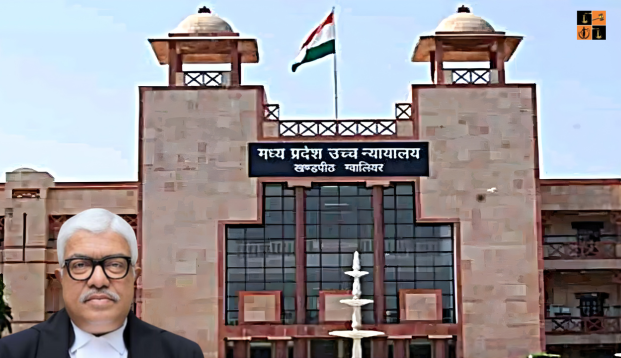
Today, in a farewell that blended grace, gratitude, and quiet candour, Justice Atul Sreedharan bid adieu to the Madhya Pradesh High Court, marking the end of his second tenure before assuming office at the Allahabad High Court. Known for his forthright judgments and independent judicial outlook, Justice Sreedharan’s parting words struck both poetic and philosophical chords, reflecting on the transient nature of power and the permanence of integrity.
Speaking at the farewell reference held in Jabalpur, Justice Sreedharan quoted celebrated Urdu poet Rahat Indori, remarking, “Jo aaj sahib-e-masnad hai kal nahi honge, kiraaye daar hain zaati makaan thodi hai”, loosely translated as, “Those who sit on the throne today will not be there tomorrow; they are merely tenants, not owners.” He added, “The only thing permanent in the universe is impermanence,” using poetry to subtly convey acceptance of judicial transfers as “an incident of service.”
Justice Sreedharan’s transfer to the Allahabad High Court follows the Supreme Court Collegium’s decision on October 18 to modify its earlier recommendation transferring him to the Chhattisgarh High Court, after the Central government reportedly requested reconsideration. The move, and the surrounding executive involvement, drew considerable attention within judicial circles.
In his address, Justice Sreedharan extended heartfelt thanks to Chief Justice Sanjeev Sachdeva and fellow judges for a “peaceful” tenure, describing the Chief Justice as one who “embodies the very notion of a people’s judge, learned yet humble, polite yet firm, accommodative yet resolute.” Expressing affection for the Bar, he remarked with humour and humility, “I thank the Bar for tolerating my second innings with such grace and compassion.”
Acknowledging his formative years at the Bar, Justice Sreedharan credited Senior Advocates Gopal Subramanium and Satyendra Kumar Vyas for shaping his legal and ethical grounding. “I am what I am as a judge because of my two gurus,” he said, adding that “the Bar is the most powerful sentinel for the Bench.”
However, his farewell also became a moment for reflection on judicial independence. Several members of the Bar voiced concern over the frequency of his transfers and the broader implications for institutional autonomy.
Sanjay Agrawal, President of the High Court Advocates’ Bar Association (Jabalpur), observed that such frequent transfers “inevitably disrupt the continuity of justice and the building of a stable judicial environment,” noting that they can “slow down the natural process of growth that comes from a settled bench.” He further cautioned that “the sanctity of transfer of judges of the High Court must remain free from any executive interference.”
Similarly, Pawan Pathak, President of the High Court Bar Association (Gwalior), remarked that Justice Sreedharan’s repeated transfers appeared to suggest “unwanted pressure,” and expressed the Association’s support for “the independence of the judiciary and its fearless functioning.”
Justice Sreedharan, who began his legal career in 1992 in the chambers of Gopal Subramanium in Delhi, went on to serve as a Government Advocate and Panel Counsel for the State of Madhya Pradesh before his elevation as a Judge in 2016. He was made a permanent Judge in 2018 and briefly served at the Jammu & Kashmir and Ladakh High Court before returning to Madhya Pradesh earlier this year.
Disclaimer: This news/ article includes information received via a syndicated news feed. The original rights remain with the respective publisher.
Picture Source :




















