









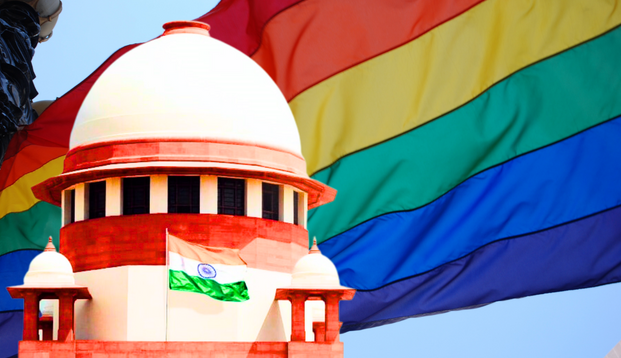
In a momentous and precedent-setting verdict issued on October 17, 2023, the Supreme Court of India provided a judgment addressing the realm of same-sex marriage in India, thereby catalyzing a transformation within India's legal framework governing matrimonial unions, adoption, and the realm of personal rights and liberties.
The ruling highlights the naturalness of queerness in India, dispelling misconceptions about its exclusivity to only ‘urban or elite’ circles of India.
Fundamental Right to Marry:
While acknowledging the constitutional significance of marriage, CJI DY Chandrachud made a crucial observation that the Indian Constitution does not explicitly recognize the fundamental right to marry, “there is no universal conception of the institution of marriage…marriage has attained significance as a legal institution largely because of regulation by the State.” He did, however, highlight that many facets of the marital relationship inherently align with constitutional values. This alignment includes the right to human dignity, life, and personal liberty, “The Constitution does not expressly recognise the fundamental right to marry; an institution cannot be elevated to the realm of a fundamental right.”
Despite these reflections on constitutional values, it was pointed out that the Supreme Court had institutional constraints owing to separation of power, which limited its authority to strike down the constitutional validity of the Special Marriage Act, 1954 (SMA) or to modify the legislation.
Ultimately, a five-judge Constitution Bench, presided over by Chief Justice DY Chandrachud and including Justices SK Kaul, SR Bhat, Hima Kohli, and PS Narasimha, rejected the constitutional validity of same-sex marriage in India. Furthermore, the bench concluded that amending the SMA to permit same-sex marriage through the utilization of gender-neutral language was not a viable option.
Importantly, the judgment clarified that transgender persons in heterosexual relationships have the right to marry under existing laws, including personal laws that regulate marriage.
Right to Enter into a Civil Union:
Chief Justice Chandrachud placed a strong emphasis on the protection of freedom for all individuals, including queer couples, to enter into a union, “the decision in K.S. Puttaswamy recognises the right of the queer couple to exercise the right to enter into a union”. Such protection is explicitly guaranteed by Part III of the Constitution. The Supreme Court stressed that the State's failure to acknowledge the entitlements stemming from these unions would disproportionately impact queer couples who cannot marry under the current legal framework. The Supreme Court underlined that restrictions based on sexual orientation would be a violation of Article 15, regardless of an individual's gender identity or sexual orientation, “In Article 15 (1), the word ‘sex’ must be read to include sexual orientation. The right to enter into a union cannot be restricted based on sexual orientation; such a restriction would be violative of Article 15 regardless of gender identity and sexual orientation…”
Right To Adopt:
The CJI raised concerns regarding the Central Adoption Resource Authority (CARA) guidelines for adoption, asserting that they are violative of the rights of the queer community. He pointed out that CARA Regulation 5(3) discriminates against partners in queer unions, disproportionately affecting non-heterosexual couples. This discrimination allows unmarried heterosexual couples to adopt, while the same opportunity is denied to queer couples. The CJI emphasized that the law should not make unfounded assumptions about the quality of parenting, as this perpetuates the stereotype that only heterosexual individuals can be considered as suitable parents. Consequently, the regulation has been held to be in violation of the rights of the queer community.
Furthermore, it was pointed out that CARA had exceeded its authority by prohibiting unmarried couples from adopting. CJI Chandrachud stated that, “It cannot be assumed that unmarried couples are not serious about their relationship. There is no material on record to prove that only a married heterosexual couple can provide stability to a child.”
However, despite these arguments, the Supreme Court declined to grant the right of adoption to queer couples by a 3:2 majority. CJI DY Chandrachud and Justice Kaul maintained that CARA had overstepped its jurisdiction by excluding unmarried and queer couples from the adoption process.
Justices Bhat, Kohli, and Narasimha upheld the CARA regulations, which exclude queer and unmarried couples from adoption, as constitutionally sound. Justice Bhat noted that this should not be misconstrued as an assertion that unmarried or non-heterosexual couples cannot be good parents. According to her, given the objective of section 57, the State, acting as parens patriae, must explore all avenues to ensure that all children in need of stable homes receive the benefits they require.
In an important affirmation, Chief Justice Chandrachud recognized the right of queer persons to be free from coercion by their natal families and state agencies, including the police. The judgment also extends progressive provisions for unmarried couples, including queer couples, who can now jointly adopt a child. Regulation 5(3) of the adoption regulations has been read down, effectively removing the word 'marital.' Consequently, the reference to a couple in Regulation 5 now encompasses both married and unmarried couples, as well as queer couples.
The ruling sheds light on the importance of recognizing the rights of transgender and intersex persons to marry. This legal recognition carries profound implications for the legal landscape and individual rights in India. The judgment reaffirms that individual rights cannot be withheld based on gender identity, and it emphasizes the state's duty to facilitate the exercise of these constitutional rights, “The freedom of all persons including, queer couples, to enter into a union is protected by Part III of the Constitution; The failure of the state to recognise the bouquet of entitlements which flow from the union would result in a disparate impact on queer couples who cannot marry under the current legal regime…”
The Supreme Court held that "Transgender persons in heterosexual relationships have the right to marry under existing laws, including personal laws that regulate marriage" and similarly, "Intersex persons who identify as either male or female have the right to marry under existing laws, including personal laws that regulate marriage; the state must enable the LGBTQ community to exercise its rights under the Constitution."
This verdict marks a substantial step towards recognizing and upholding the rights of transgender and intersex individuals in the context of marriage and relationships. While the judgment makes no changes to the fundamental understanding of marriage for other queer people, it clearly asserts the state's obligation to ensure inclusivity, equality, and protection of rights for all individuals, irrespective of gender identity or sexual orientation
Read Judgment @LatestLaws.com:
Picture Source :




















