









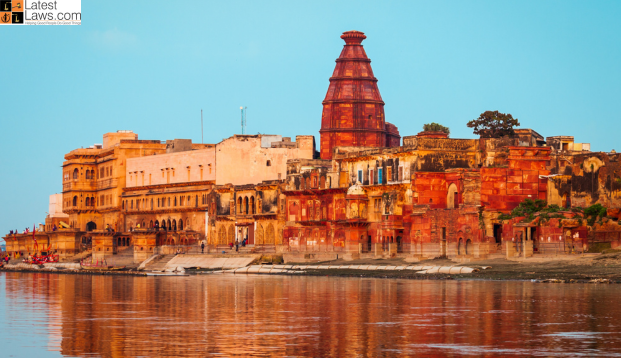
In a recent development concerning the Krishna Janmabhoomi dispute, the Supreme Court of India on January 22, 2025, extended its interim stay on the Allahabad High Court's order that had permitted a court-monitored survey of the Shahi Idgah Mosque complex in Mathura. The mosque, located near the revered Krishna Janmabhoomi temple, has been at the center of a contentious legal battle.
The bench comprising Chief Justice Sanjiv Khanna, Justice Sanjay Kumar, and Justice K.V. Viswanathan was hearing the appeal filed by the Committee of Management of Trust Shahi Masjid Idgah, which challenged the High Court’s directive for a survey overseen by a court-appointed commissioner. The case has gained nationwide attention due to its religious and historical significance, with the Hindu litigants claiming that the site was originally the birthplace of Lord Krishna and that the mosque was built over an ancient temple.
In the January 22 order, the Supreme Court stated that it would defer the hearing of the case until the week beginning April 1, 2025. Importantly, the court noted, "List in the week commencing 1st April 2025, interim order to continue." This means that the stay on the survey will remain in place until then.
The controversy traces back to the Shahi Idgah Mosque, which dates back to the Mughal era. The Hindu parties allege that the mosque was constructed after the destruction of a temple, which is believed to be the birthplace of Lord Krishna. However, the mosque's management and Muslim parties involved in the case argue that the matter is settled under the provisions of the Places of Worship (Special Provisions) Act, 1991, which prohibits any alteration in the religious character of a place of worship as it stood on August 15, 1947, except for the Ram Janmabhoomi-Babri Masjid dispute.
The case also involves the legal validity of a 1968 compromise agreement between the Shri Krishna Janmasthan Seva Sansthan (the temple management authority) and the Trust Shahi Masjid Eidgah, which allowed the coexistence of both places of worship. However, this agreement has been challenged by Hindu litigants in recent suits, alleging it was made fraudulently.
The High Court's earlier order in December 2023 had permitted a court-monitored survey of the Shahi Idgah mosque, and a court commissioner was appointed to oversee this exercise. However, the Supreme Court intervened in January 2024, staying the order, and has since extended that stay.
The Supreme Court's ruling also touches upon broader issues, including the constitutional validity of the Places of Worship Act. In response to ongoing petitions, the CJI noted, "the issue of an intra-court appeal (against consolidation of lawsuits filed by the Hindu litigants), the other one is the Act (challenge to the Places of Worship (Special Provisions) Act, 1991) itself." The Court is expected to take up these issues for detailed hearings later this year.
Picture Source :




















