









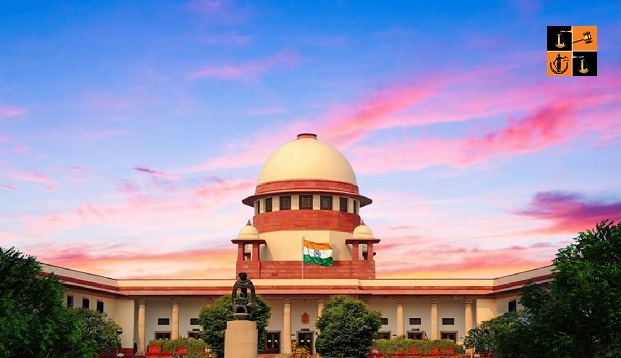
Recently, the Supreme Court examined a legal dispute over land ownership between the Plaintiffs and the State of Haryana involving claims of adverse possession. The Plaintiffs sought possession of the land based on revenue records, while the defendants argued their continuous possession since 1879. The Court held that “the plaintiffs had established their ownership through valid evidence and ruled that the State could not claim adverse possession over private property”.
Brief Facts:
The case involves a land dispute in Bahadurgarh, Haryana, over 18 Biswas Pukhta located on both sides of National Highway No. 10. The Plaintiffs, Shri Amin Lal and Shri Ashok Kumar, filed a suit in 1981 for possession, asserting ownership based on revenue records and claiming the defendants, i.e. the State of Haryana and PWD, unlawfully occupied the land. The defendants argued they had been in continuous possession since 1879-80, acquiring ownership through adverse possession. The Trial Court ruled in favour of the plaintiffs, but the First Appellate Court overturned the decision, favouring the defendants. The High Court, however, ruled in favour of the plaintiffs, stating that the defendant's claim of adverse possession implied an acknowledgement of the plaintiffs' title. Hence, the present SLP was filed.
Contentions of the Petitioner:
The petitioners contended that the High Court erred in overturning the well-reasoned judgment of the First Appellate Court, which had dismissed the plaintiffs' suit. Their arguments included several points. Firstly, they highlighted that the plaintiffs failed to provide sale deeds or title documents to prove ownership, with reliance on revenue records alone deemed insufficient to establish title. The petitioners also argued that the High Court wrongly shifted the burden of proof onto the defendants, emphasizing that in a possession suit, the plaintiffs must prove their title. Additionally, they pointed out that the petitioners had been in continuous possession of the land since 1879, which raised a presumption of ownership and rendered the plaintiffs' suit barred by limitation under Article 65 of the Limitation Act. The petitioners further argued that the plaintiffs should have sought a declaration of title before filing for possession, as ownership was disputed. Finally, they noted that the First Appellate Court had labeled the plaintiffs as "land grabbers" manipulating revenue records, but the High Court failed to address this critical observation.
Contentions of the Respondent:
The respondent put forward several arguments in defense of the plaintiffs' position. They argued that the appellants’ plea of adverse possession implicitly acknowledged the plaintiffs’ title, as the appellants did not deny ownership in their written statement. The respondent further asserted that the State cannot claim adverse possession against its citizens, as such a claim would violate constitutional rights. Additionally, they contended that the appellants' possession was permissive, not adverse, pointing to the conditional Misal Hakiyat and acts like placing bitumen drums or constructing temporary structures, which they argued do not qualify as adverse possession. The respondent also emphasized that the plaintiffs' ownership was established through continuous revenue records (jamabandis) and valid sale deeds with sanctioned mutations.
Observation of the Court:
The Court noted that the appellants did not specifically deny the plaintiffs' ownership but relied on the plea of adverse possession. According to Order VIII Rule 5 of the Code of Civil Procedure, such an assertion implied an admission of the plaintiffs' title. As the Court stated, "By asserting adverse possession, the appellants have impliedly admitted the plaintiffs' title."The Court also accepted the plaintiffs' reliance on jamabandi entries, which are public records carrying a presumption of correctness under Section 35 of the Indian Evidence Act, 1872. The plaintiffs had further supported their ownership claim with registered sale deeds and mutation records, establishing a clear chain of title.
The appellants' claim of adverse possession was dismissed, particularly as it involved the State. The Court reaffirmed that the State cannot claim adverse possession over the property of its own citizens, referencing the Vidya Devi v. State of H.P. case, the Court stated, " The State being a welfare State, cannot be permitted to take the plea of adverse possession, which allows a trespasser i.e. a person guilty of a tort, or even a crime, to gain legal title over such property for over 12 years. The State cannot be permitted to perfect its title over the land by invoking the doctrine of adverse possession to grab the property of its own citizens."
The Court maintained the High Court's exercise of jurisdiction under Section 100 of the Code of Civil Procedure. The High Court had framed substantial questions of law regarding adverse possession and the admission of plaintiffs' title, and found that the First Appellate Court had ignored key evidence, justifying its intervention. The Court concluded that “the High Court found that the First Appellate Court had ignored material evidence and legal principles, leading to a perverse judgment."
The decision of the Court:
The Court found the First Appellate Court's judgment flawed for several reasons and it wrongly placed the burden of proving ownership on the plaintiffs, disregarded relevant revenue records, and based its conclusion that the plaintiffs were ‘land grabbers’ on conjecture. The Court stated, "The court's conclusion that the plaintiffs are 'land grabbers' is not supported by evidence and appears to be based on conjecture."
The High Court's judgment was upheld, as it was based on sound legal principles and correct appreciation of evidence. The plaintiffs had proven their ownership, and the State cannot claim adverse possession over its own citizens. The appeal was therefore dismissed.
Case Title: The State of Haryana & Anr. v. Amin Lal (Since Deceased) Through His Lrs & Ors.
Citation: 2024 Latest Caselaw 713 SC
Case No: Special Leave Petition (Civil) No. 25213 of 2024
Coram: Hon’ble Mr. Justice Vikram Nath and Hon’ble Mr. Justice Prasanna B. Varale
Advocate for Petitioner: Sr. Adv. Mr. Vikramjeet Banarjee, A.S.G., Dr. Hemant Gupta, A.A.G., Mr. Samar Vijay Singh, AOR, Mr. Shivang Jain, Adv., Mr. Varun Goel, Adv., Ms. Nitikaa Guptha, Adv., Mr. Saurabh Gupta, Adv., Ms. Sabarni Som, Adv., Ms. Kanika, Adv., Mr. Fateh Singh, Adv.
Advocate for Respondent: Adv. Santosh Paul, Sr. Adv., Mr. Sriharsh Nahush Bundela, AOR Mr. Amaan Khan, Adv. Mr. Harikesh Singh, Adv. Mr. R.D. Jatain, Adv. Mr. Sandeep Sinhmar, Adv. Mr. Satyendra Kumar, AOR.
Read Judgment @LatestLaws.com
Picture Source :




















