









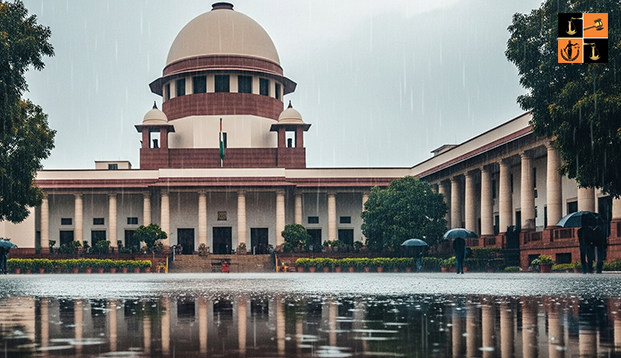
On Monday, the Supreme Court allowed Jyoti Sharma’s appeal in a decades-old landlord-tenant dispute, ordering eviction of the defendants and recovery of rent arrears while clarifying that tenants cannot challenge the landlord’s ownership where possession was taken under a valid rent deed.
The case arose from a 1953 rent deed executed by Ramji Das in favour of the defendant’s father, Kishan Lal, for a shop room used for a grocery business. Following Ramji Das’s death in 1999, he bequeathed the premises to the plaintiff through a Will. Jyoti Sharma, seeking possession, aimed to expand her husband’s adjoining sweets and savouries business, in which their children were also involved.
The defendants contested the ownership, claiming the property belonged to Ramji Das’s uncle, Sua Lal (deceased 1984), and questioning the Will’s authenticity. However, they admitted to paying rent under the original rent deed and to Ramji Das’s family after his death.
The trial court dismissed the suit, citing lack of attornment, non-communication of the bequest, and suspicion over the Will’s authenticity. A first appellate court initially ruled in favour of the plaintiff but later set aside the order on consent for remand. Post-remand, the appeal was dismissed, and the High Court declined to admit a probate order filed in 2018, terming it belated.
Justice J.K. Maheshwari and Justice K. Vinod Chandran, while granting leave and allowing the appeal, held that the lower courts had “disregarded material evidence” and reached perverse conclusions.
On the issue of title and estoppel, the Court observed, “The tenant having come into possession of the tenanted premises by a rent deed executed by the earlier landlord, cannot turn around and challenge his ownership.” The Bench relied on a 1953 relinquishment deed by Sua Lal in Ramji Das’s favour and undisputed rent payments spanning over five decades, noting, “It is also an admitted fact that from 1953, the predecessor of the defendants and the defendants, after their father’s death had been paying rent to the said Ramji Das. The dispute regarding the title of Ramji Das could not have been raised by the tenant who had come into the premises by virtue of a deed executed by Ramji Das to whom, for more than half a century, the tenants were also paying rent.”
Regarding the Will, the Court rejected the trial court’s suspicion arising from non-provision for Ramji Das’s wife, “The finding of the trial court that it is not natural that a person would not keep in mind the interest of his own wife, according to us, is not a valid ground to suspect the intentions of the testator or the probity of the bequest made.” The probate order conferred “legal sanctity” on the plaintiff’s claim, which “could not have been brushed aside by the High Court.” The Bench clarified that in eviction suits, “the proof of ownership of the tenanted premises is not to be strictly looked at as in a suit for declaration of title.”
On attornment and arrears, the Court noted that the plaintiff’s husband had collected rent post-1999, with no payments received from January 2000. It relied on prior notices and postal receipts, invoking the presumption of service in the absence of acknowledgement.
The Court also upheld bona fide need, observing, “There is no dispute as to the business carried on; of sweets and savouries, in the adjacent shop room. There is also no dispute on the sons of the plaintiff also having joined the business and the plaintiff’s intention to participate in the business, thus expanding it to the tenanted premises. The bona fide need hence stands established.”
The Supreme Court decreed the suit for arrears and eviction but granted the defendants six months to vacate the premises, provided they file an undertaking to pay arrears within one month and hand over possession within six months. The Court clarified, “If no undertaking is filed the plaintiff would be entitled to seek summary eviction of the tenants from the premises.”
Case Title: Jyoti Sharma Vs. Vishnu Goyal & Anr.
Case No: Special Leave Petition (C) No.29500 of 2024
Coram: Justice J.K. Maheshwari and Justice K. Vinod Chandran
Advocate for Appellant: Sr. Adv. Puneet Jain
Advocate for Respondent: Sr. Adv. N.K. Mody
Read Judgment @Latestlaws.com
Picture Source :



















