









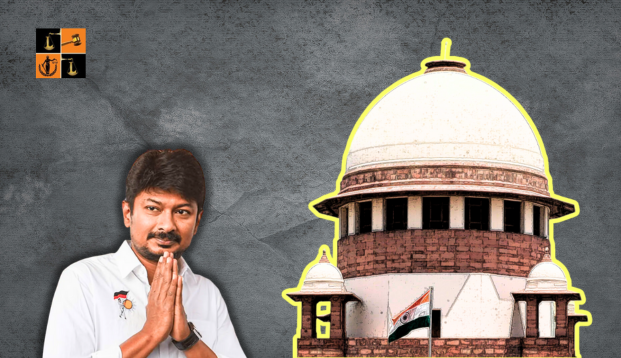
On Thursday, the Supreme Court barred the registration of new criminal cases against Tamil Nadu Minister and DMK leader Udhayanidhi Stalin over his remarks on Sanatana Dharma without its prior approval. The interim order was issued in a plea to consolidate multiple FIRs filed nationwide, extending to any newly registered cases on the same issue.
The case arises from remarks made by Udhayanidhi Stalin in September 2023 at a conference organised by the Tamil Nadu Progressive Writers and Artists Association in Chennai. During his speech, he compared Sanatana Dharma to diseases like dengue, malaria, and coronavirus, suggesting that it needed to be eradicated. Following this, multiple FIRs were lodged against him in different states, leading him to approach the Supreme Court for clubbing all cases into a single proceeding.
Senior Advocate Dr. AM Singhvi, appearing for Stalin, contended that similar remarks by other individuals had not led to such extensive legal action. He cited instances where other public figures, including Arnab Goswami and Nupur Sharma, had made contentious statements but were granted relief by the Court. He argued that Stalin’s speech was intended for a specific audience that shared an ideological stance on caste discrimination and should be interpreted in that context.
Solicitor General Tushar Mehta, representing the Maharashtra government, opposed the plea, asserting that Stalin’s remarks were made at a conference explicitly aimed at the eradication of Sanatana Dharma. He questioned the implications of such statements, drawing a hypothetical comparison: “What if a Chief Minister of another state had stated that a particular religion must be eradicated?” He emphasized that merely because the affected community did not react violently, the gravity of the statement should not be diminished.
The Apex Court took a cautious approach in assessing the issue. The Bench, led by Chief Justice of India Sanjiv Khanna, initially remarked that Stalin’s statements potentially overstepped the bounds of Article 19(1)(a) (freedom of speech and expression) and Article 25 (freedom of conscience and religious practice). However, it refrained from making any substantive comments on the speech itself, noting that such observations could affect future legal proceedings.
During the hearing, when Senior Advocate P Wilson, also representing Stalin, attempted to engage in a debate with the Solicitor General, the Bench intervened to maintain decorum. The CJI remarked, “As an apex court, we will not comment. It will impact the trial.”
The Supreme Court issued an interim order restraining the registration of any further FIRs against Stalin on the same cause without prior permission from the Court. The matter has been scheduled for a further hearing in April 2025, with the interim relief extended to newly filed cases as well.
Picture Source :




















