









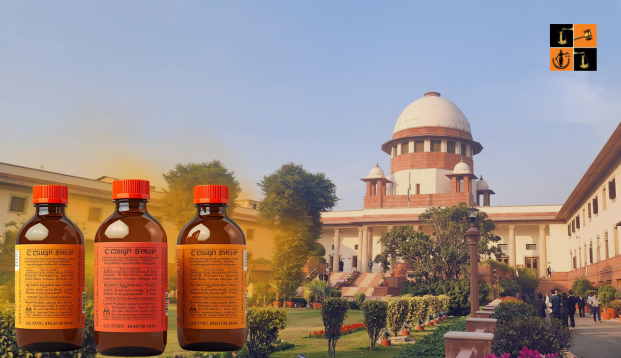
The Supreme Court dismissed a Public Interest Litigation (PIL) seeking a Central Bureau of Investigation (CBI) probe into the tragic deaths of children in Madhya Pradesh and Rajasthan allegedly caused by contaminated cough syrups. The bench comprising Chief Justice B.R. Gavai and Justice K. Vinod Chandran observed that the States are competent to investigate the matter and are already taking appropriate steps.
The PIL, filed by Advocate Vishal Tiwari, had requested the constitution of a National Judicial Commission or an Expert Committee headed by a retired Supreme Court judge to examine the production, quality control, and distribution of cough syrups containing toxic substances such as Diethylene Glycol (DEG) and Ethylene Glycol (EG), compounds previously linked to fatal outcomes.
Solicitor General of India, Tushar Mehta, opposed the plea, stating that the matter falls squarely within the jurisdiction of the State authorities, who are actively conducting investigations. He also highlighted that the petitioner frequently approaches the Supreme Court with PILs based solely on media reports. When questioned by the Chief Justice about the number of PILs filed, Advocate Tiwari reportedly replied, “Eight or nine.”
The petitioner had further sought that all pending FIRs and investigations relating to child deaths from toxic cough syrups across multiple States be transferred to the CBI under the supervision of a retired Supreme Court judge, to ensure a unified and impartial investigation. The plea argued that state-level probes have led to fragmented accountability, allowing the continued distribution of dangerous pharmaceutical products.
Additionally, the PIL requested immediate seizure and recall of all batches of ColdRif Cough Syrup and other medicines manufactured by Sresan Pharma Pvt. Ltd. or its affiliated companies, insisting that these products undergo toxicological testing in NABL-accredited laboratories before any further sale or export.
After hearing the arguments, the bench dismissed the petition, emphasizing that there is no need to transfer investigations from the competent State authorities at this stage.
The Top Court’s decision underscores the principle that State authorities retain primary responsibility for investigating public health-related incidents, while also reflecting judicial caution against intervening in matters where competent authorities are already acting.
Picture Source :




















