









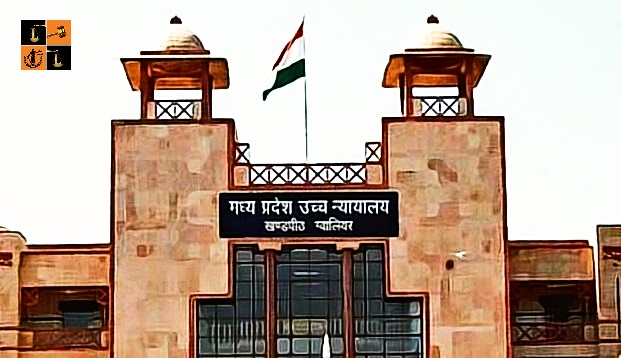
Recently, the Madhya Pradesh High Court found itself examining a striking condition imposed by the Debt Recovery Tribunal, one that effectively tied an individual’s right to travel abroad with an enormous financial requirement. What began as a routine recovery proceeding soon evolved into a deeper constitutional inquiry on liberty and the scope of statutory authority.
The case arose from a challenge filed by a co-guarantor in loan transactions involving a defaulted corporate borrower whose account had been declared NPA. After the DRT issued a recovery certificate in favour of the lending institution, the petitioner secured an overseas employment opportunity and approached the Tribunal seeking permission to travel abroad. Permission was granted but only on the condition that a sum of fifty crore rupees be deposited in the Tribunal’s official account as FDR security, or that immovable property or shares of equivalent value be furnished. The order further stipulated that if the petitioner failed to return, the surety would be invoked immediately. It was this condition that led to the writ petition.
In challenging the order, it was argued that no provision of the Recovery of Debts Due to Banks and Financial Institutions Act or its Rules authorises the DRT to impose conditions that effectively restrain foreign travel. Such an order, it was submitted, violates Articles 19(1)(g) and 21 of the Constitution of India by restricting livelihood and personal liberty. Judicial precedents from the Supreme Court and various High Courts were relied upon to emphasise that the right to travel abroad is a facet of personal liberty and cannot be curtailed except by enacted law.
The lending institution opposed the Petition, contending that a writ was not maintainable and that an alternative remedy of appeal was available. It also asserted that the magnitude of dues created a substantial risk of the Petitioner leaving India and not returning, making the condition necessary for securing effective recovery.
The High Court, while analysing the matter, referred to the Bombay High Court’s ruling where it was held that “The DRT has no power to restrain a citizen from traveling abroad. The provisions of the Act,1993 do not even impliedly confer power.” It also cited the Delhi High Court’s reasoning that if the legislature intended to grant such authority, it would have explicitly done so “If the intention was to confer such power allowing the Tribunal to restrain a person from travelling abroad, it ought to have been so conferred.”
Further reliance was placed on the Gujarat High Court’s observation that “no person can be deprived of his right to travel except according to the procedure established by law. The law would mean 'Enacted Law' or 'State Law'.” thus ruling out any implied or discretionary power of the Tribunal to impose such restrictions.
In this backdrop, the Madhya Pradesh High Court concluded that when the Tribunal lacks authority to prevent a person from travelling abroad, it equally lacks authority to impose conditions so onerous that they effectively achieve the same result. The financial condition imposed by the Recovery Officer was held unsustainable as it amounted to an indirect deprivation of a fundamental right. Despite the argument of alternative remedies, the Court emphasised that when fundamental rights are impacted, writ jurisdiction can be invoked. The impugned condition was accordingly quashed
Case Title: Rajiv Soni V. ICICI Bank
Case No.: Writ Petition No. 40054 Of 2025
Coram: Hon’ble Mr Justice Pranay Verma
Counsel for the Petitioner: Sr. Adv. Ravindra Singh Chhabra with Adv. Raghav Raj Sing
Counsel for the Respondent: Adv. Sanjay Pathak,
Read Judgement @LatestLaws.com
Picture Source :



















