









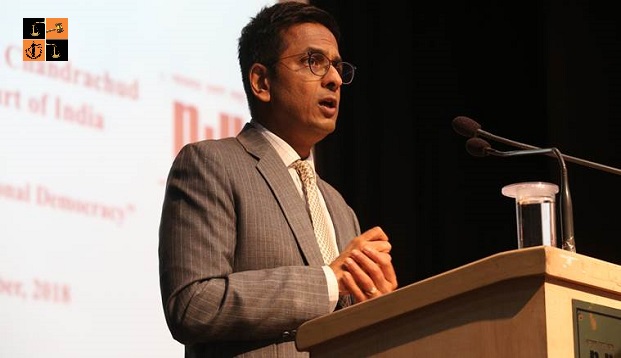
On Sunday, Apex Court Judge D Y Chandrachud said that privacy in the digital age faces challenges from Hackers, Private Companies & Govt, & the Judiciary has to deal with balancing the right to privacy with other rights & supplement existing legislative frameworks. Justice Chandrachud, during a panel discussion on the 'Role of Judiciary in Protecting Privacy of Citizens in the Internet Age', said the challenges from these three "actors" present a range of concerns.
Justice Chandrachud said that "The challenges to privacy are presented by three key actors - (i) hackers; (ii) private companies; & (iii) the government. This presents a range of concerns: First, there is a possibility of serious data breach & the misuse of personal information".
He added that "Second, vast silos of data may be used to profile people & to discriminate against vulnerable groups. Third, there is a chilling effect on free speech & disclosure of information".
The Supreme Court Judge said that the issue is about how "we as judges can preserve autonomy & informational self-determination of individuals in an age where technology governs every aspect of our lives. Or is privacy an illusion?".
Justice Chandrachud said when a person searches for a book or a destination on the internet, the screen is instantly flooded with appealing pop-up advertisements.
He said that "If you search for an idea, a multitude of ideas confront you on the screen. The digital world has been ushered in at a pace which the incremental change of judicial decisions can scarcely match. Our Constitution protects the right to personal freedom, human dignity & liberty".
Justice Chandrachud pointed out that in today's world, every individual identity is viewed in terabytes of information & every individual is viewed as a collection of data represented by activities on the internet like shopping preferences, social media patterns, geographic location & personal biometric information.
"This defines two new horizons: the first is of big data - data aggregation, which like 'death by a thousand cuts', is the collection of unconnected data to map the identity of the individual.
"This has the potential to seriously threaten the rights of individuals to keep their personal & sensitive information private & to control how their information is used," he said.
Justice Chandrachud said the second horizon is of artificial intelligence, which comprehends machine learning analysis of political beliefs, religious affiliation, race, ethnicity, health status, gender & sexual orientation.
"Our individual data is aggregated & disaggregated to sort, score, classify, evaluate & rank people. How comfortable are we with artificial intelligence telling us whether an offender who seeks bail is likely to be a repeat offender?" the Top Court Judge said.
Justice Chandrachud, who is in line to become the Chief Justice of India (CJI) in 2022, said globally good governance is witnessing an increasing reliance on digital technology to aid in the delivery of welfare services with the active support of the citizenry.
Judges needs to see how to apply the standard of proportionality which was formulated in a pre-digital age amid the complexities of a digital age, he said.
He said that "In examining the judicial interface with privacy protection in the digital age, two preliminary points need to be highlighted: The dawn of the digital age is not in itself perilous. It presents avenues for mass improvements in social life. The issue is not the collection of data, but its use & misuse; & how do courts balance the right to privacy with other rights & supplement existing legislative frameworks?"
He referred to a HIgh Court of Kenya verdict that halted the implementation of the national biometric identification system until the Govt implemented a comprehensive data protection framework.
"Chief Justice Bryan Sykes of the Supreme Court of Jamaica was a part of the bench that struck down the Jamaican National Identification & Registration Act & outlined in his opinion the dangers of merging silos of information to create wholly new information," said Justice Chandrachud.
Recalling the 2018 Aadhaar verdict in which a 5-Judge constitution bench had by majority upheld the constitutional validity of the Aadhaar Act, Justice Chandrachud said, "As the lone dissenter in that bench, I draw solace from the recently delivered judgment of Justice Sykes".
Later in his welcome address for President Ram Nath Kovind, Justice Chandrachud said challenges posed by technology, climate change & terrorism, transcend individual jurisdictions.
Highlighting that "justice knows no borders", he said, "Collegiality is at the core of judging."
The Top Court had in a landmark verdict ruled that even the office of its chief justice is subject to a citizen's right to information, he said.
Justice Chandrachud said that "The doors of justice were thrown open, not just for those seeking justice, but also to those seeking to scrutinise the court".
The cross-fertilisation of ideas is evident in the judgments of courts across the world relying upon the affirmation of LGBTQ rights by the Indian Apex Court, Justice Chandrachud said.
Source Link
Picture Source :



















