









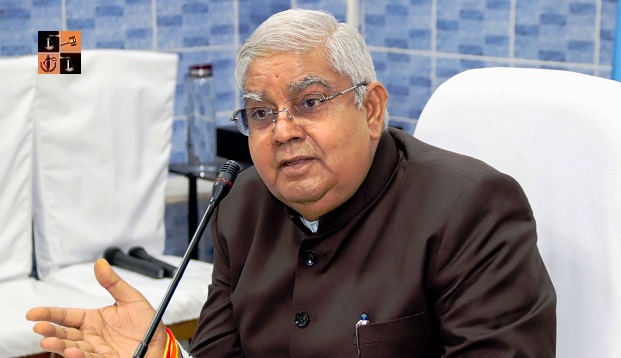
Amid controversy over alleged communal remarks made by Justice Shekhar Kumar Yadav of the Allahabad High Court, Rajya Sabha Chairman Jagdeep Dhankhar clarified that only Parliament holds the constitutional authority to decide on his removal. This statement followed a motion submitted by 55 Opposition MPs seeking Justice Yadav’s removal under Article 124(4) of the Constitution.
In a suo motu statement in the Rajya Sabha, Dhankhar stated, “Hon’ble members, I am seized of an undated notice for motion received on December 13, 2024, bearing 55 purported signatures of members of the Rajya Sabha seeking the removal from office of Justice Shekhar Yadav of the Allahabad High Court under Article 124(4) of the Constitution,” He further directed the Rajya Sabha Secretary-General to share the information with the Supreme Court Secretary-General to ensure transparency and adherence to constitutional procedures.
Justice Shekhar Kumar Yadav came under scrutiny for allegedly making communal remarks at a Vishwa Hindu Parishad (VHP) event in Allahabad last December. In a widely circulated video, he was seen endorsing the Uniform Civil Code (UCC) and allegedly made comments perceived as targeting minority communities.
Following public outcry, the Supreme Court took note of his statements, leading to his appearance before the Supreme Court Collegium, headed by Chief Justice of India Sanjiv Khanna. The incident prompted 55 Opposition MPs to file a motion under the Judges Inquiry Act of 1968, accusing Justice Yadav of breaching judicial ethics and the principles of impartiality.
As Chairman of the Rajya Sabha, Vice President Jagdeep Dhankhar has the authority to either admit or reject the motion. If admitted, a three-member committee comprising a Supreme Court judge, a High Court Chief Justice, and a distinguished jurist will be formed to investigate the allegations against Justice Yadav.
The committee will assess whether sufficient grounds exist to initiate the removal process. If the committee finds the judge guilty of “misbehavior or incapacity,” the motion will then be debated in both Houses of Parliament. To pass the motion, it must receive a majority vote from the total membership and at least two-thirds of the members present and voting in each House.
Reasserting the constitutional principles, Dhankhar emphasized, “The jurisdiction of the stated subject matter constitutionally lies in exclusivity with the Chairman of the Rajya Sabha and in an eventuality with Parliament and the Honourable President.” His remarks underline the exclusive role of Parliament in addressing judicial conduct issues under the Constitution.
Picture Source :




















