









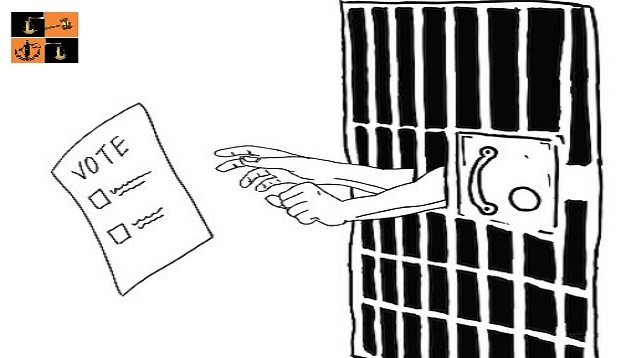
The Delhi High Court has recently delivered judgement clearing air on the Voting Rights of the prisoner.
In this crucial judgement, the Court has upheld the constitutional validity of Section 62(5) of the Representation of the People Act, 1951 and had gone onto reaffirm that the prisoners have no voting rights.
The decision came out in one case titled as PRAVEEN KUMAR CHAUDHARY & ORS vs ELECTION COMMISSION OF INDIA & ORS.
CASE BACKGROUND
The petitioner contended before the Court that Section 62(5) of the Representation Act was violative of the basic structure of the Constitution.
He was of the opinion that there was no valid classification between the persons who are in jail and the persons who are on bail or out of jail in the provision.
He also pointed out in his submission that as per the second provision to subSection (5) of Section 62 of the Act, by reason of prohibition to vote under this subsection, a person whose name has not been entered in the electoral roll shall not cease to be an elector meaning thereby that such person can contest the election but he/she cannot cast his/her vote if he/she is in jail.
He argued that this type of classification is not valid in the eye of Law and is violative of Article 14 and the basic structure of the Constitution of India.
On the other hand, the Election Commission (respondent herein) had discarded the petitioner's argument by saying the issue had already been settled by the Supreme Court of India in Anukul Chandra Pradhan, Advocate Supreme Court vs. Union of India & Ors.
In the judgement, it was stated that Article 14 permits reasonable classification which has a rational nexus with the object of classification. The Court dealing with the question that whether the classification made by sub-section (5) of Section 62 is reasonable or not had held that there are provisions in the election law that are objected to prevent the criminalisation of politics and maintain probity in elections.
Therefore any provision enacted with a view to promoting this object must be welcomed and upheld as subserving the constitutional purpose. Room for the legislature in doing the classification depends on the context and the object for the enactment of the provision.
It was stated:
The other reason provided by the Court to justify the classification was that permitting prisoners to vote will ask for deployment of Police Force and higher security requirements and that will be a crunch of economic resources.
Speaking of the Fundamental Rights of the prisoners, it was settled:
The Court thus, based on the precedent established in the Supreme Court judgement reiterated that the right to vote was neither a fundamental right nor a constitutional right.
it said:
It added that people in and out of the jail are class in themselves, and thus the classification by the legislature is valid.
The Court did mention few other cases to clear its point such as:
* S. Radhakrishnan vs. Union of India & Ors
* Mahendra Kumar Shastri vs. Union of India & Anr
* Manohar Lal Sharma vs. Union of India
The Court thus concluded that Section 62(5) of the Representation of the People Act, 1951 was constitutionally valid and set aside the writ petition. It said:
The Counsels in the case Advocate Sidhant Kumar represented Election Commission. Petitioner appeared in person.
The judgement was delivered by Chief Justice Dhirubhai Naranbhai Patel and Justice C.Hari Shankar on 11-02-2020.
Read Judgement Here:
Share this Document :
Picture Source :




















