









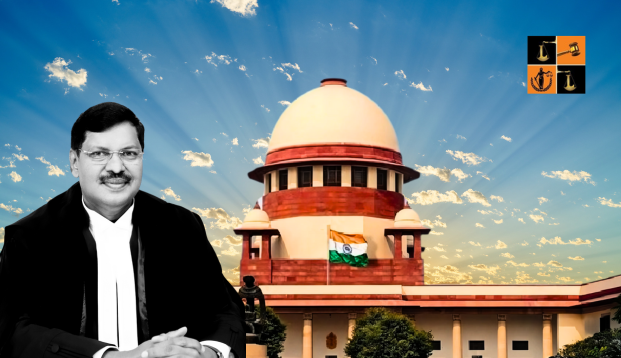
Chief Justice of India (CJI) BR Gavai on August 23 expressed deep concern over the “pathetically low” stipends paid to many junior lawyers by their seniors, observing that such meagre financial support makes survival in the profession extremely challenging.
Delivering the valedictory address at the Golden Jubilee celebrations of V.M. Salgaonkar College of Law in Goa, the CJI emphasised that the Bar must treat the welfare of young practitioners as a priority. “Challenges faced by young lawyers have always been close to my heart. Senior advocates must come forward and extend meaningful financial support to juniors. The stipends currently being paid in several cases are so inadequate that it is nearly impossible for them to sustain themselves,” he remarked.
The Chief Justice also cautioned against attaching undue importance to academic performance, recalling his own unconventional student journey. He shared that during his years at Government Law College, Mumbai, and later Amravati, he rarely attended classes, often relying on friends to mark his attendance and on solved papers for exam preparation. Despite this, he secured the third rank in his law course.
Reflecting on how exam results often fail to predict professional trajectories, the CJI recounted how the top-ranked student from his batch went on to become a criminal lawyer specialising in bail matters, while the second-rank holder, Justice V.L. Achliya, rose to serve as a judge of the High Court. He himself, ranked third, eventually became the Chief Justice of India. “Do not be swayed by ranks or marksheets. Success in law depends on determination, dedication, hard work, and commitment, not merely on academic grades,” he emphasised.
CJI Gavai also spoke about the transformation in legal education, particularly the advent of the integrated five-year law programme, which he described as a paradigm shift enabling students to graduate as “complete lawyers.” While acknowledging the prominent role of National Law Universities (NLUs), he stressed that they represent only a small fraction of the legal education system in India. He pointed out that students from district and taluka-level law colleges have also risen to the highest positions in the profession, underlining that excellence in law is not confined to elite institutions.
Picture Source :



















