









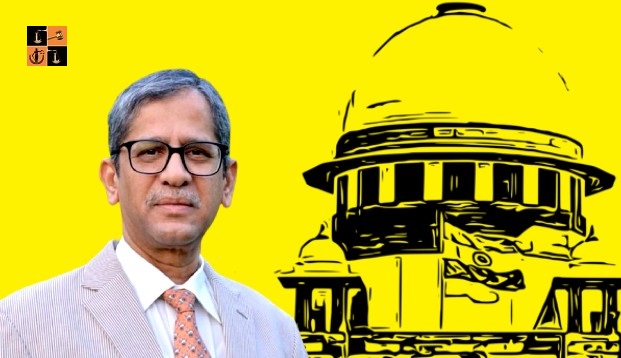
On Monday, CJI N V Ramana said, the impression that “Judges appoint Judges” in India is wrong. It is the Govt which “finally appoints the judges in the name of the President of India, the Head of our State".
The Chief Justice of India was in conversation with U.S. Supreme Court Judge, Justice Stephen Breyer, on the “comparative approaches of the Supreme Courts of the world’s largest & oldest democracies”.
CJI said that “There is an impression that in India judges appoint judges. It is a wrong impression & I want to correct that. The appointment is done through a lengthy consultative process. Many stakeholders are consulted. The Executive is one of the key stakeholders".
He explained how once a proposal was made of a name as an HC Judge, the State Govt, the High Court & the Governor concerned all take measure of the candidate.
The Centre vets the name thoroughly before the file is sent to the Apex Court. Then the top 3 Judges of the Supreme Court would examine the proposal based on the inputs given by all the stakeholders.
They, very importantly, take the opinion of the Consultee Judge — a SC Judge hailing from the State or had earlier worked in the particular HC for which the name was proposed for.
Many people may not be aware of this... Only after taking into account a wide range of opinions from diverse sources, the collegium forms its opinion. Most of the time it is a unanimous opinion. I do not think a selection process can be more democratic than this.
In the webinar, CJI said, “Here, I want to emphasise the fact that it is the government which finally appoints the judges in the name of the President of India, Head of our State".
The CJI said sustaining people’s faith in the judiciary was the guiding principle.
The Chief Justice said 65 years was too young an age for a Supreme Court Judge to retire.
(Only the headline and picture of this report may have been reworked by the LatestLaws staff; the rest of the content is auto-generated from a syndicated feed.)
Source Link
Picture Source :



















