









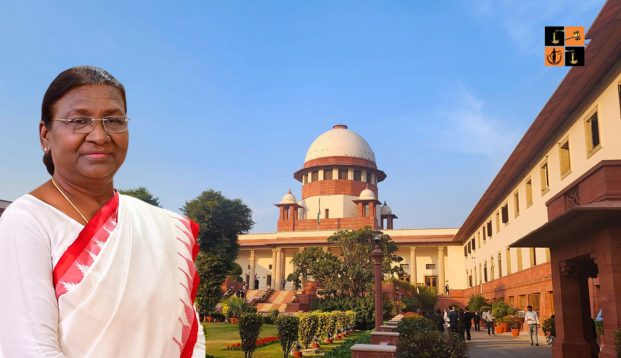
On Thursday, the Supreme Court posed a pointed query to the Union government on whether constitutional courts must remain powerless if constitutional authorities, such as Governors, fail to act on bills duly passed by state legislatures.
A five-judge Constitution Bench led by Chief Justice of India B.R. Gavai raised the concern while hearing a presidential reference under Article 143(1), which seeks clarity on whether courts can prescribe timelines for Governors and the President to decide on bills forwarded by state assemblies. The bench also included Justice Surya Kant, Justice Vikram Nath, Justice P.S. Narasimha and Justice A.S. Chandurkar.
The issue arose after Solicitor General Tushar Mehta, appearing for the Centre, argued that if Governors withhold decisions on bills, state governments should seek political and constitutional remedies rather than judicial intervention. He submitted that the Constitution does not mandate any fixed timeline for the Governor or President to act, except where expressly provided, and urged reliance on political dialogue and statesmanship.
CJI Gavai, however, observed, “If constitutional functionaries do not discharge their duties without justification, can the hands of this Court be tied? If there is a wrong, there must be a remedy. This Court is the custodian of the Constitution.”
Justice Surya Kant added that in cases of prolonged inaction by Governors, judicial review could not be completely ruled out, especially if a state approaches the court seeking redress.
Mehta countered that courts cannot be the answer to every political impasse, noting that disputes are often resolved through consultations between Chief Ministers, Governors, and even the President or Prime Minister. He cautioned against “judicial overreach,” stating, “Every problem may not find a solution in court. Solutions can and should come from within the political system.”
The Solicitor General further contended that while courts may recommend Parliament to consider reforms, they cannot judicially create a timeline where the Constitution is silent.
Justice Narasimha, however, underlined that interpreting constitutional silences is itself a judicial function, “If we adopt an extreme view that the Court has no role, how will the Constitution function?”.
The Bench also revisited its April 8 ruling on the Tamil Nadu Governor’s handling of state bills, which had directed the President to act within three months on matters referred by a Governor. That decision prompted the President to seek the present reference, questioning whether the judiciary can impose binding timelines on constitutional authorities.
During the exchange, Chief Justice Gavai also remarked that while judicial activism has its place, it must not cross into “judicial terrorism” or adventurism, emphasising the Court’s balance between restraint and constitutional duty.
The matter remains under consideration and will continue on the next date of hearing.
Picture Source :




















