









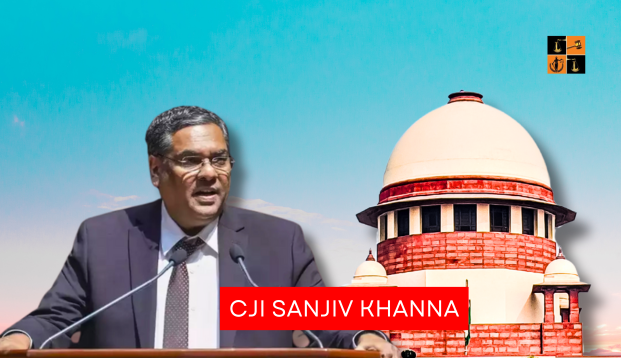
In an emotionally charged farewell address at the Supreme Court Bar Association (SCBA), outgoing Chief Justice of India, Justice Sanjiv Khanna, reflected on his four-decade-long journey in law with humility, gratitude, and a touch of gentle humour stating clearly, “Let me confess, i have no mixed feelings. I am simply happy.”
Chief Justice (Designate) Justice B.R. Gavai, legal luminaries including Attorney General R. Venkataramani, Solicitor General Tushar Mehta, and senior advocate Kapil Sibal were present at the event.
Recalling his humble beginnings and a family steeped in legal tradition, Justice Khanna shared that he had to wait 17 years for "half a chamber" and started practice in a modest room without air conditioning or telephone. He remarked, “That I could accomplish something without having to change myself, is to the credit and strength of the system.”
Reflecting on his early days as a High Court judge, he described the "stormy seas" between 2000 and 2005 and how his heavy board of 75-100 cases a day shaped him. “By the end of the first three months, I had reserved nearly 100 judgments,” he noted.
But it wasn’t just volume that moved him. Justice Khanna became visibly emotional when recounting his role in habeas corpus matters, where young couples defying social norms would find comfort, not in the courtroom, but in conversations over tea in his chambers. “These moments gave me immense hope… not just to resolve disputes, but to drive social change and affirm human dignity,” he said.
As head of NALSA, he emphasized legal aid as a right, not a privilege, and called upon advocates to embrace pro bono work. He also highlighted the evolving nature of the courtroom, “The dynamics are shifting from oratory to subject-matter expertise,” urging younger members of the Bar to focus on domain knowledge and alternate dispute resolution mechanisms.
Justice Khanna also opened up about criticisms of being “by-the-book.” With clarity, he stated that he was never hyper-technical and prided himself on letting fairness, not technicality, guide decisions, especially in criminal and tax matters. “One of my oft-repeated phrases is, 'Let’s not take a hyper-technical view.’”
In perhaps his most powerful message, he warned against a growing “truth deficit” in the legal profession. “A judge, above all, is a seeker of truth… truth is not just a fact , it is a legal force.” He condemned concealment and misstatements as serious impediments to justice.
Ending on a personal and peaceful note, he said, “This morning, as the robe was hung for the final time, the weight lifted… it feels like the beginning of a new life.”
With grace, candour, and quiet strength, Justice Khanna reminded the legal fraternity that beyond statutes and citations, it is truth, dignity, and simplicity that ultimately uphold the soul of justice.
Picture Source :




















