









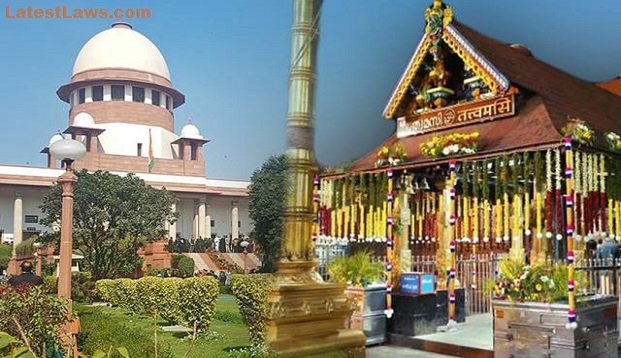
September 28, 2018:
On Friday, the Supreme Court ended a decade-long battle in a Landmark Judgement by lifting the ban on the entry of women into the famous Sabarimala Temple in Kerala.
Apex Court observed that 'physiological' and 'biological' factors can't be given legitimacy if they don't pass the muster of conditionality, which menas women and men are equal.
The Constitution Bench comprised of five-Judges, Chief Justice Dipak Misra, Justice Rohinton Fali Nariman, Justice AM Khanwilkar, Justice DY Chandrachud and Justice Indu Malhotra.
In its verdict, the Bench observed that Article 25, 'the right to practice religion', is applicable to both men and women.
Four verdicts were written, one by Chief Justice Dipak Misra and Justice Khanwilkar, and one each by Justices Chandrachud, Nariman and Malhotra. Justice Indu Malhotra was the only objector in the verdict.
Arguments before the Constitution bench had concluded on August 1 and the bench had reserved the verdict in this case.
Apex Court first observed, "Women are not lesser or inferior to man. Patriarchy of religion cannot be permitted to trump over faith.”
It further added that devotees of Lord Ayyappa don't constitute a separate religion denomination, which was what one petitioners had argued seeking the ban. Right under 25 is equally available to both women and men.
Justice Nariman in his judgement, said that women of all ages are equal worshipers of Lord Ayyappa. Hence, gender cannot be a ground for preventing entry of some into the temple. The ban is not backed by Article 26 of the Constitution. Women have equal right to worship.
Meanwhile Justice DY Chandrachud observed, "To treat women as the children of a lesser God is to blink at the Constitution. The ban says the presence of women deviates from celibacy. This is placing the burden of a men's celibacy on women. It stigmatises them and stereotypes them."
Justice Indu Malhotra in her dissenting judgement said, "Issues of deep religious sentiments should not be ordinarily be interfered by the Court. Religious practices can't be tested solely on the basis of Article 14 (Equality). The shrine and deity are protected by Article 25 of the Constitution.What constitutes essential religious practice is for the relgious community to decide, not for the court. A matter of personal faith. India is a land of diverse faiths. Constitutional morality in a pluralistic society gives freedom to practice even irrational customs."
Rahul Easwar, who petitioned seeking the ban of women in Sabarimala, said he would file a review petition in the first week of October.
Case background
Sabarimala is a temple dedicated to Lord Ayyappa located in the Periyar Tiger Reserve in Pathanamthitta district in Kerala. It is managed by the Travancore Devaswom Board. There are restrictions for the entry of women between 10 and 50 years of age in the temple since it is believed that Lord Ayyappa, who is the presiding deity, is a celibate and menstruating women cannot be allowed inside the temple premises on account of ‘purity’.
In 1991, this ban was first challenged, the Kerala High Court had upheld the ban on the entry of women into the temple. A division bench of the Kerala HC had held that the prohibition imposed by the Travancore Devaswom did not violate Articles 15 (Prohibition of discrimination on grounds of religion, race, caste, sex or place of birth), 25 (Freedom of conscience and free profession, practice and propagation of religion) and 26 (Freedom to manage religious affairs Subject to public order, morality and health) of the Constitution.
It had also observed that this prohibition was not violative of provisions of the Hindu Places of Public Worship (Authorisation of Entry) Act 1965 as the prohibition applied to a section of women and not to all women.
In 2006, Indian Young Lawyers Association filed a petition in the Supreme Court opposing this practice and sought the lifting of the ban. The petition claimed that the custom violated the right to equality granted by the Constitution to all the citizens of India and that it was discrimination based on the gender of the citizens.
Supreme Court then issued notices to all parties and the matter was referred to a three-judge bench. Kerala government in 2007, then led by the LDF, had told the court that it favoured the entry of all women into the temple. However, that was overturned by the Congress-led United Democratic Front government later.
The matter came up for hearing nearly 10 years after the petition was filed, in 2016. As the hearing progressed, activists submitted petitions to the SC questioning how menstruation can be a ground to ban women from entering the temple and at the same time, a group of women devotees also submitted to the court that they do not want to go against traditional customs and restrictions and are willing to wait until they cross the age of 50 and only then enter the temple.
The Supreme Court in February 2016, raised questions on the authenticity of the claims submitted by the Devaswom and the State of Kerala & expressed its inclination to refer the matter to a Constitution bench.
Kerala government in November 2016, informed the Apex Court that it favoured the entry of women of all age groups in the historic Sabarimala temple.
In October 2017, the matter was referred to a Constitution bench the three-judge bench took note of the conflicting arguments between the Kerala government, which supported the entry of all women, and the Travancore Devaswom Board, which strongly opposed it.
In July 2018, just before reserving the verdict in the case, the apex court, after an eight-day hearing, had observed that everyone can enter Sabarimala regardless of their sex.
The Bench observed, “A woman's right to pray was not dependent on any law but is a Constitutional right,” "what applies to a man applies to a woman as well".
Source: The Minute News
Picture Source :




















