









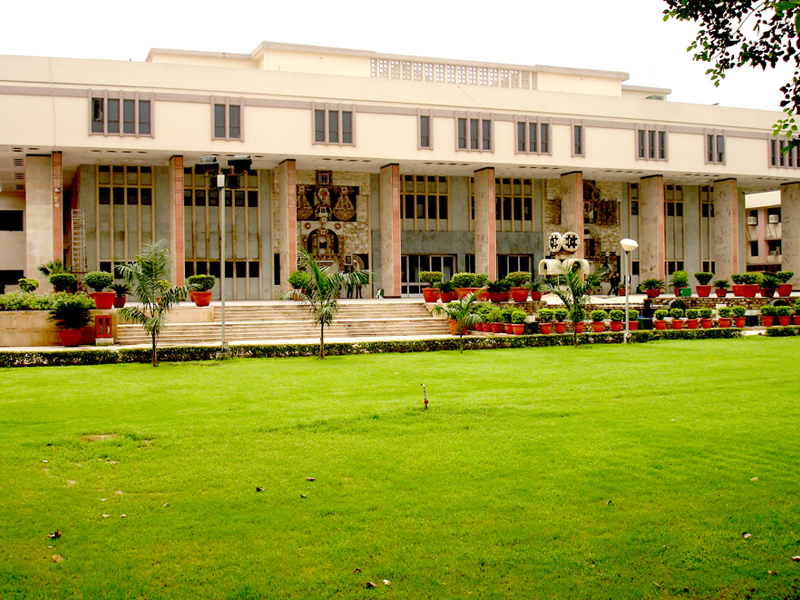
The Delhi High Court on 27.01.2021(Wednesday) comprising of a Single Bench of Justice Vibhu Bakhru reiterated that CFSL reports made by Government experts, which are admissible under Section 293 of the CrPC without examining the author, are required to be tendered into evidence and cannot be relied upon unless the same was exhibited by some witness during the Course of trial.(Chhotu Kumar @ Chote Fauji v. State (Govt. Of NCT of Delhi)
This observation was made by the court while setting aside the conviction of a man who was under Section 307 of IPC for firing bullets upon four police officers, during an alleged encounter.
The bench noted that in the present case two CSFL Reports pertaining to recovery of bullets allegedly fired by the accused, were neither tendered in evidence nor exhibited.
In this backdrop, the court observed,
"The Trial Court had taken note of a report dated 16.10.2015 as evidence that the bullets recovered from the bullet proof jackets were fired from the weapon that had been recovered from the accused. However, that report was neither tendered in evidence nor exhibited. Although the said report may be admissible under Section 293 of the Cr.PC without the author testifying to the contents thereof, however, the said report was required to be tendered and could not be taken note of without the same being tendered and exhibited."
Section 293 of CrPC provides that any document purporting to be a report under the hand of a Government scientific expert, upon any matter or thing duly submitted to him for examination or analysis and report in the course of any proceeding under CPC, may be used as evidence in any inquiry, trial or other proceeding under this Code.
The bench had held that such report may be used as evidence only when it is tendered into evidence or is exhibited by any witness.
The court relying on the case of Dharampal and Anr. v. State, where the Division Bench of the High Court had held,
"It is true that in view of Section 293 of the Criminal Procedure Code, the report in question need not have been proved by summoning the author thereof, but that does not mean, that during trial nobody had to tender the same in evidence and have the same exhibited by deposing that either he himself went to the FSL Laboratory and collected the report in question or deposing that during investigation he obtained the report in question and that the same pertains to the investigation conducted in the case which was being tried."
Facts of the case.
The appellant has filed the present appeal impugning a judgment dated 30.11.2016, whereby the appellant, Chhotu Kumar @Chote Fauji, was convicted of the offences punishable under Sections 186, 353 and 307 of the Indian Penal Code (hereinafter ‘IPC’) and Sections 25 and 27 of the Arms Act, 1959 (Arms Act).
The allegation against the Petitioner was that he involved in an illegal business of supplying arms and ammunitions for distribution in Delhi and Haryana with the aid of a friend, and a team comprising of ten officials was formed to raid. However, it was the prosecution's case that the Petitioner sensed the Police's presence and tried to escape the scene. On being intercepted, it was alleged, the Petitioner open fired on four officers who had gone after him.
In appeal, the Petitioner claimed that nothing incriminating had been recovered from him and he was not present at the spot as alleged. He claimed that the police officials had planted their illegal weapons and framed him.
Contention of the parties
The counsel appearing on behalf of the appellant stated that the appellant was limiting the challenge in the present appeal to his conviction for committing an offence punishable under Section 307 of the IPC. He submitted that the appellant had already served more than five years of his prison sentence and thus, had served the sentence awarded to him in respect of all offences other than the offence punishable under Section 307 of the IPC. 25. He contended that insofar as the offence punishable under Section 307 of the IPC is concerned, there was a serious doubt as to the case set up by the prosecution. He submitted that the appellant had been convicted for the said offence on the premise that he had fired bullets at the police officials. The said bullets had struck the bullet proof vestsworn by them in their chest region.
The learned APP appearing on behalf of the State submitted that it was not open for the appellant to now object to the manner in which the evidence of PW4, PW7, PW9 and PW10 was recorded. He submitted that the Trial Court had considered their testimonies and had apparently copied the same while making certain necessary changes regarding the names of the witnesses and the officers involved. He submitted that this was well within the knowledge of the counsel of the appellant but no objection was raised in this regard. He also relied on Section 465 of the Cr.PC and submitted that the appellant cannot challenge the judgment convicting him in view of the manner in which the evidence was recorded, unless he is able to establish that he has been prejudiced by the same.
Courts Observation & Judgment
The Bench noted in this case that the examinations-in chief of the Police officers as witnesses was absolutely identical.
"The examination-in-chief of the witnesses, which are identical both in their construct and content, would in normal circumstances lead to a doubt that the witnesses may have rehearsed their testimony in consultation with one another."
Further, it suspiciously noted that the appellant's conviction under Section 307 of the IPC is premised on the basis that he had fired four shots at the police officials. The bullets fired by him had struck each of the said officials on their chest region of the bullet proof vest, which they were wearing. However, none of them had been hurt, obviously, on account of them wearing the bullet proof vest…the examination-in-chief of all the said four police officials are identical. "It is obvious that the Trial Court has merely copied the examination-in-chief of one of the said witnesses as the examination-in-chief of the other three witnesses as well", the Court added.
The Bench relying on the case of Kalpnath Rai v. State, AIR 1998 SC 201 noted, "It is well settled that evidence of the police officers cannot be rejected only on the ground that it is not supported by independent witnesses. However, non-examination of independent witnesses does cast an added duty on the court to scrutinize the evidence of the police officers."
In view of the above, the appeal of the Petitioners was allowed and the conviction under Section 307 IPC was set aside in these terms,
"It is settled law that the presumption of innocence must be maintained until the accused is found guilty. Therefore, even though the appellant may be involved in other cases, the same could not be considered as a factor to award a harsher sentence because the appellant had not been convicted in any of the cases at the material time. This Court is of the view that the Trial Court erred in considering that the appellant was also involved in other cases, while considering the quantum of sentence."
Read Judgment @Latestlaws.com
Share this Document :Picture Source :




















