









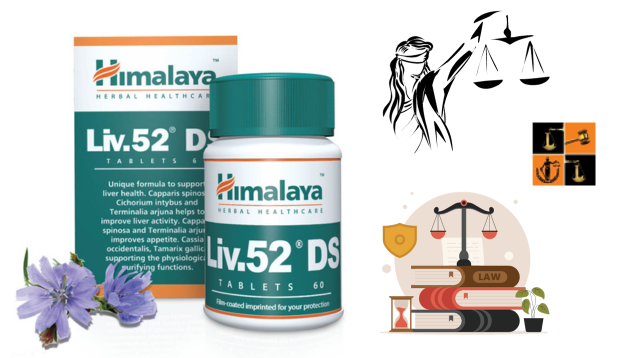
The Delhi High Court granted a permanent injunction in favour of Himalaya Wellness Company. The case pertained to the defendants' unauthorized adoption of Himalaya Wellness' registered trademarks and trade dress "LIV.52."
High Court's decision was driven by the striking resemblance between the defendants' marks and packaging and Himalaya Wellness' distinctive "LIV.52" trademark and trade dress.
Brief Facts:
The plaintiffs in this case alleged infringement of their registered trademark "LIV.52," held by them since 1957. The plaintiffs claimed to have accumulated goodwill and reputation associated with the "LIV.52" marks over time and presented sales turnover data which revealed that for fiscal year 2021-22 alone, products with the "LIV.52" marks yielded revenues of ₹ 209.02 crores. The defendants were accused of using the mark "LIV.55 DS" for a similar liver tonic, employing trade dress deceptively similar to that of the plaintiffs. The visual resemblance of the trade dresses between the plaintiffs and defendants was evident, featuring a thin orange border, a central white strip, and a green lower half of the bottle/package. The lettering was also similar.
Contentions of the Parties:
The plaintiffs argued that both the word marks "LIV 52" and "LIV 55" were deceptively similar, posing a risk of confusion among consumers, especially when used for liver tonics with identical bottle/package appearances (visual and phonetic similarities). The defendants also marketed "LIV.999," and the plaintiffs contended that this combination of "LIV" with a number was unjustified for liver tonics, potentially causing confusion with "LIV.52" or similar products and constituted trademark infringement.
On the other hand, the defendants claimed that these similarities were unintentional as the products were developed during the COVID-19 pandemic and intended to address various health issues. They further argued that the products were not yet sold but merely listed on e-commerce websites.
Observations of the Court:
The Delhi High Court discussed the fundamental principle of the presumption of intent to deceive consumers when a defendant consciously replicates a plaintiff's trademark or trade dress. The Court held that in such instances, the Courts should scrutinise similarities rather than differences between the marks and products. The High Court found that "LIV.55" and "LIV.999" bore a deceptive resemblance to "LIV.52" and were employed for similar liver tonic products, aligning with the infringement criteria laid out in Section 29(2)(b) of the Trade Marks Act. The Court clarified that the actual sales of the defendant's products were not a requisite for establishing infringement, emphasizing that the potential for consumer confusion sufficed.
The Court applied the 'triple identity test' and said, 'Section 29(2)(b) clearly applies where the competing marks are similar, used for similar or identical products and where the similarity between the marks and the similarity or identity of the product or services for which the marks are used, is likely to result in confusion or in the public or the public to believe an association between the marks'.
To substantiate its decision, the Court drew on established legal precedents in the case of ‘Slazenger & Sons v. Feltham & Co.[1]’ which provided a basis for considering the defendant's intent to deceive while underlining the significance of such intent. The High Court also referenced ‘Munday v. Carey[2],’ where it was held that in cases marked by dishonesty, the focus should be on similarities rather than disparities. When a defendant deliberately copies a plaintiff's trademark, the presumption is of the intention to mislead consumers. The Court also relied on ‘Himalaya Drug Company v. M/s S.B.L. Ltd.[3],’ which highlighted the plaintiff's contention that using a mark featuring "LIV" in isolation could encroach upon the plaintiff's trademark.
The Decision of the Court:
The Delhi High Court passed the judgment in favour of the plaintiffs, granting a permanent injunction against the use of the marks "LIV.55," "LIVA 55," or "LIV.999," or any deceptively similar marks or trade dress for liver tonics or pharmaceutical preparations. The plaintiffs were awarded actual costs for the legal proceedings. The Court considered the plaintiffs' claim for costs justified due to the defendants' conscious adoption of deceptively similar marks and trade dress.
Case Title: Himalaya Wellness Company & Ors. vs. Abony Healthcare Limited Through Its Directors & Anr.
Coram: Hon’ble Justice C. Hari Shankar
Case no.: CS(COMM) 476/2021, I.A. 12699/2021 & I.A. 2201/2023
Advocate for the Plaintiff: Prachi Agarwal and Kanupriya Chawla
Advocate for the Defendants: Gagnish Bhatia
Picture Source :




















