









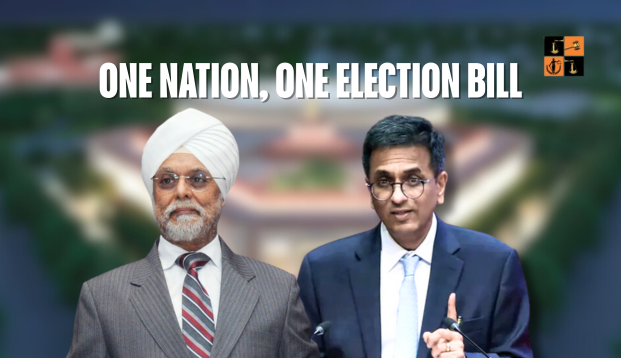
Former Chief Justices of India J.S. Khehar and D.Y. Chandrachud, in detailed interactions with the Joint Parliamentary Committee (JPC) examining the Constitution (One Hundred and Twenty-Ninth Amendment) Bill, 2024, raised searching constitutional and legal concerns over certain provisions in the proposed legislation, particularly those assigning expansive powers to the Election Commission of India (ECI).
While both jurists reportedly affirmed that the idea of synchronising elections does not, in itself, offend the Constitution’s basic structure, they maintained that the bill, in its present form, is marred by structural infirmities that demand redress. Particular attention was drawn to Clause 82A(5), which authorises the ECI to defer elections to a state assembly if it opines that simultaneous conduct with Lok Sabha elections is not feasible. In such cases, the affected state assembly’s term would cease along with that of the Lok Sabha, even if its original tenure was still intact. This, according to the judges, amounts to vesting the Commission with a discretion that is both legally unchecked and constitutionally vulnerable. One of the former Chief Justices reportedly described such a conferral of power as “unprecedented,” noting that it was being granted “without parliamentary oversight.”
Justice D.Y. Chandrachud, in particular, is understood to have cautioned against the latitude being extended to the ECI through two proposed mechanisms. First, the bill authorises the Commission to make modifications to provisions in Part XV of the Constitution to facilitate the implementation of the proposed election schedule. Second, it empowers the ECI to postpone elections to any state legislature if synchronisation is deemed unworkable. He is learnt to have stated that “giving the ECI the power to alter substantive constitutional provisions or to shorten the tenure of elected assemblies through a unilateral report to the President cannot pass constitutional muster.” He further noted that the Constitution already provides for central intervention in state matters under Article 356(5), and any similar power must be expressly defined and narrowly construed.
Former Chief Justice of India D. Y. Chandrachud also flagged broader constitutional absences in the bill, describing them as “constitutional silences.” He drew attention to the lack of any provision addressing how synchronised electoral cycles would be affected in the event of a National Emergency under Article 352, where the tenures of both Parliament and state assemblies can be extended by one year. He reportedly questioned how electoral harmony would be restored once such an Emergency ceases, whether by curtailing Parliament’s next tenure or by prolonging the term of state assemblies. Another scenario that remains unaddressed, according to the former CJI, is when a state assembly is dissolved prematurely following a loss of majority support. In such cases, he noted, the bill does not clarify whether elections could be deferred to coincide with the parliamentary schedule, thereby raising potential for misuse or constitutional confusion.
Justice Khehar, during his deposition, raised comparable concerns. He is said to have scrutinised the bill’s implications for federalism and continuity of electoral accountability. For instance, he questioned the operational feasibility of aligning state elections with the Lok Sabha in the event that an Emergency is declared in a single state and extended for a year. Such a scenario, he pointed out, would distort the synchronised cycle envisioned in the bill and leave unresolved whether the constitutional scheme would permit staggered recovery or require another round of legislative intervention.
The JPC, which includes members from across political affiliations and is chaired by BJP MP P.P. Chaudhary, has undertaken extensive consultations with constitutional experts, jurists, and former Chief Justices. The committee includes Manish Tewari, Priyanka Gandhi Vadra, Sambit Patra, Randeep Surjewala, Anurag Thakur, Supriya Sule, and Bhartruhari Mahtab, among others. Previous depositions have included former CJI Ranjan Gogoi and former CJI U.U. Lalit, who similarly raised legal reservations on the proposed electoral realignment. According to sources within the JPC, the committee has remained open to recalibrating provisions in response to these expert submissions. One member stated that the objective is to “incorporate reforms suggested by experts and the public,” suggesting that substantive changes may yet be introduced prior to submission of the final report to Parliament.
Justice Chandrachud is reported to have concluded that while the principle of simultaneous elections is not constitutionally prohibited, the legislative scheme must be carefully refined to prevent a disproportionate concentration of authority in the Election Commission and to remedy unaddressed scenarios that may otherwise trigger future legal contestation. The Committee’s deliberations on these issues remain ongoing, with the views of former CJIs expected to carry substantial influence in shaping the statutory contours of the final draft.
Picture Source :




















