









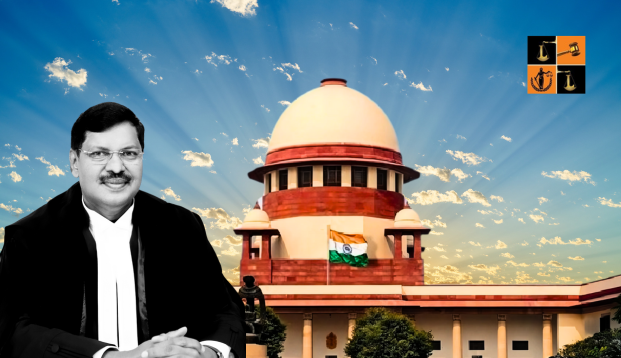
In a packed ceremonial sitting marking his final day on the bench, Chief Justice of India BR Gavai reflected on his judicial journey, underscored the Supreme Court’s institutional character, and reiterated the Court’s growing reliance on indigenous constitutional principles. The farewell proceedings were held in Courtroom No.1, with Attorney General R. Venkataramani, Solicitor General Tushar Mehta, senior advocates, AORs and members of the Bar extending their tributes.
Responding to Solicitor General Tushar Mehta’s remark that “a fresh breeze of Indianness” had emerged in the Court’s recent judgments, CJI Gavai noted that the Constitution Bench opinion in the Presidential Reference was consciously crafted without citing any foreign precedents.
“We relied solely on Indian jurisprudence, a purely swadeshi interpretation,” he said, emphasising that the Bench had distinguished the U.S. and U.K. constitutional models to reaffirm India’s own framework.
Mehta praised the clarity of the judgment, observing that the Constitution Bench had resolved complex questions on legislative procedure in a concise 110-page opinion that “felt like a judgment, not an academic article.” Throughout the ceremony, members of the Bar highlighted the Chief Justice’s warmth, accessibility and egalitarian approach. AG Venkataramani remarked that CJI Gavai had lived up to his name by being a “Bhushan” to every institution he served. SG Mehta recalled the CJI’s habit of personally addressing members of the Nagpur Bar and enquiring about their families.
President of the Supreme Court Bar Association Vikas Singh reiterated his demand for raising the retirement age of judges, while Senior Advocate Kapil Sibal said that CJI Gavai’s rise reaffirmed that the Supreme Court is not an elitist institution but one that remains open to individuals from diverse backgrounds.
In a lighter moment, a lawyer attempted to shower flower petals on the Chief Justice, prompting CJI Gavai to immediately interject with a smiling, “No, no, don’t throw… hand it over,” sending waves of laughter across the courtroom.
Speaking at a separate farewell organised by SCAORA, CJI Gavai described himself as “truly secular,” stating that he believed in and respected all religions while personally practising Buddhism. He recalled his upbringing in a household strongly influenced by Dr. B.R. Ambedkar, noting that this shaped his belief in fraternity and equal respect for diverse faiths.
He also recounted how the long-pending chamber allotment issue, unresolved for years, was settled within a few meetings after he, Justice Surya Kant and Justice Maheshwari joined the committee. He said this was possible because the judiciary worked “collectively rather than in a Chief Justice-centric manner.”
Reflecting on nearly four decades in the legal profession, CJI Gavai said he entered the field in 1986 as a “student of law” and leaves as a “student of justice.” He recalled his modest beginnings, studying on the floor of a municipal school in Amravati, while Justice Surya Kant, who will succeed him, came from a village school in Hisar. He said their journeys were possible only because the Constitution and Dr. Ambedkar’s vision opened doors for individuals from every stratum of society.
The outgoing Chief Justice expressed satisfaction that his first judgment as CJI concerned environmental protection and that he had authored several rulings on judicial reforms. Emphasising the Court’s institutional character, he said the Supreme Court’s work is the collective output of judges, lawyers, registry staff and court personnel.
He highlighted that, under his leadership, Bar associations were regularly consulted, including during the planning of the new Supreme Court building, which he said must serve not only judges but also lawyers and litigants, the “end consumers of justice.”
CJI Gavai concluded with gratitude to the Bar, the Bench and the institution. “In every responsibility I held, I saw an opportunity to serve. Whatever I achieved as a judge and as Chief Justice belongs to this institution,” he said, adding that he remained committed to the principles of justice, liberty, equality and fraternity throughout his service.
Justice Surya Kant, who will take over as the next Chief Justice of India, remarked that CJI Gavai had set a benchmark of “unshakable devotion to the rule of law.”
Picture Source :



















