









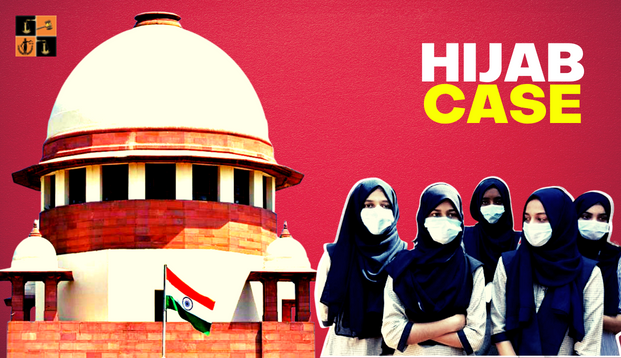
The Supreme Court as of now couldn't end the debate on whether wearing hijab in educational institution premises is protected under Fundmanental Rights or not as the split verdict leaves the issue open.
The Division Bench of Justice Hemant Gupta and Justice Sudhanshu Dhulia expressed contrary views.
While the former rejcted appeal seeking protection under the purview of Constitution, the latter was of the view that asking a pre-university schoolgirl to take off her hijab at her school gate, is an invasion on her privacy and dignity and thereby unconstitutional.
Justice Dhulia opined that the same is clearly violative of the Fundamental Right given to her under Article 19(1)(a) and 21 of the Constitution of India. He said that the State Government has powers to prescribe a uniform/dress code but that still has to be passed muster the provisions of Articles 19 and 25 of the Constitution.
Let's deliberate on his judgement.
ERP not the issue
The Judge stated that ERP is an invasion of the Fundamental Rights and cannot be provided protection.
"The Petitioners had to prove that wearing of hijab forms a core belief in the religion of Islam. ERP also meant that such a practice should be fundamental to follow as a religious belief or practice as ERP was held to be the foundation, on which the superstructure of the religion was erected. Essential Religious Practice would mean a practice without which religion would not remain the same religion. Also, the Petitioners had to prove that the practice of wearing hijab is a practice which is being followed since the very beginning of their religion. This was the task set up for the Petitioners to prove their case. But this was not enough, this was only the threshold requirement. The Petitioners also had to prove that the ERP does not militate against any of the Constitutional values. This perhaps was right, because an ERP which is an invasion on the Fundamental Rights of others will not be given the protection."
Noting that the question of Essential Religious Practices, also referred as ERP, was not at all relevant in the determination of the dispute before the Court, he added that when protection is sought under Article 25(1) of the Constitution of India, as is being done in the present case, it is not required for an individual to establish that what he or she asserts is an ERP.
It may simply be any religious practice, a matter of faith or conscience and what is asserted as a Right should not go against “public order, morality and health,” and of course, it is subject to other provisions of Part III of the Constitution, he clarified.
He remarked that it was the petitioner rather who were to be partly blamed for the course taken by the High Court as it was indeed the Petitioners or some of the Petitioners who had claimed that wearing of hijab is an essential practice in Islam.
"The approach of the High Court could have been different. Instead of straightaway taking the ERP route, as a threshold requirement, the Court could have first examined whether the restriction imposed by the school or the G.O on wearing a hijab, were valid restrictions? Or whether these restrictions are hit by the Doctrine of Proportionality", he said.
Referring to the historical context of it, he told that the expression ‘essential religious practices’ seems to be taken from the Constituent Assembly Debates.
In response to a query, Dr. Ambedkar categorically said that what is protected under Article 25 of the Constitution is not every religious practice but only such practices which are essentially religious, he told.
Noting that though the concept like ERP had come, but what constitutes Essential Religious Practices was left to the doctrine of that religion itself, he observed:
"While dealing with the concept of Essential Religious Practices or whether a particular practice can be termed as an ERP, this Court was dealing with questions related to both Article 25 as well as Article 26 of the Constitution. These were the cases which were either concerned with the management of an activity related to a religious shrine or Institution or where the State had met some kind of resistance or challenge by the citizens, who claimed rights both under Article 25 and 26 of the Constitution of India. These were also the cases where a community, sect or a religious denomination of a religion was against the State action. This, however, is not presently the case before this Court. We have before us a case of assertion of individual Right as different from what would be a community Right. We are concerned only with Article 25(1) and not with Article 25(2) or Article 26 of the Constitution of India. Whereas Clause 1 of Article 25 deals with individual rights, Article 25(2) and Article 26 of the Constitution of India, deal by and large with community-based rights. In that sense what has been decided by this Court earlier as ERP would not be of much help to us. For this reason, the entire exercise done by the Karnataka High Court, in evaluating the rights of the Petitioners only on the touchstone of ERP, was incorrect."
Importantly, he said that Courts should be slow in the matters of determining as to what is an ERP.
"In my humble opinion Courts are not the forums to solve theological questions. Courts are not well equipped to do that for various reasons, but most importantly because there will always be more than one viewpoint on a particular religious matter, and therefore nothing gives the authority to the Court to pick one over the other. The Courts, however, must interfere when the boundaries set by the Constitution are broken, or where unjustified restrictions are imposed."
Article 25(1) can solely rest the case in petitioner's favour
The Judge was of the opinion that freedom of expression given to a citizen under Article 19(1)(a) was not an issue or the central issue so to say and also not Article 25(2), or even Article 26.
The focus should only be Article 25(1) which deals with the Rights of an individual, whereas Article 25 (2), and Article 26 deal with the Rights of communities or religious denominations, as referred above. Additionally, we must deal with the Fundamental Rights given to an individual under Article 19(1)(a) and its interplay with Article 25(1) of the Constitution.
"Article 25 gives a citizen the “freedom ofconscience and free profession, practice and propagation of religion.” It does not speak of Essential Religious Practice. This concept comes in only when we are dealing with Article 25(2) or Article 26, and where there is an inter-play of these two Articles. We have before us two children, two girl students,asserting their identity by wearing hijab, and claim protection under Article 19 and Article 25 of the Constitution of India. Whether wearing hijab is an ERP in Islam or not is not essential for the determination of this dispute. If the belief is sincere, and it harms no one else, there can be no justifiable reasons for banning hijab in a classroom."
Bijoe Emmanuel Case and Reasonable Accommodation Criteria
The decision which is of essential importance in this case for our purposes is the decision given by this Court in the case of Bijoe Emmanuel, the Justice Dhulia said.
"It is necessary to refer to this case in some detail, as in my opinion this case is the guiding star which will show us the path laid down by the well established principles of our Constitutional values, the path of understanding and tolerance, which we may also call as “reasonable accommodation,” as explained by some of the lawyers before this Court. Karnataka High Court, all the same, chose not to rely on this seminal Judgement for reasons that “Bijoe Emmanuel is not the best vehicle for drawing a proposition essentially founded on the freedom of conscience100 .” But this is not correct."
Noting that the present case is squarely covered by the case of Bijoe Emmanuel and pointed out that present Petitioners too wear hijab as an article of their faith and too believe that it is a part of their religion and social practice.
On Karnataka High Court's finding that the Petitioners cannot assert their Fundamental Rights inside a classroom which it termed as “qualified public places” and the rights inside a school are only “derivative right" on ground of ‘reasonable accommodation', the Judge has different view.
"Comparison of a school with a war room ordefense camp, seems odd, to say the least. Schools are not required to have the discipline and regimentation of a military camp. Nevertheless, in my understanding, what the High Court wanted to convey was that all public places have a certain degree of discipline and limitations and the degree of enjoyment of a Right by an individual inside his house or anywhere outside a public space is different to what he or she would enjoy once they are inside a public space. As a general principle, one can have no quarrel with this proposition. But then let us come to the facts of the case. Laying down a principle is one thing, justifying that to the facts of a case is quite another. We must be a judge of fact as well as a judge of law. Do the facts of the case justify the restrictions inside a classroom, which is admittedly a public place? In my opinion there is no justification for this."
School is a public place, yet drawing a parallel between a school and a jail or a military camp, is not correct, he said while agreeing on the point of 'discipline in a school' made by High Court.
"it is necessary to have discipline in schools. But discipline not at the cost of freedom, not at the cost of dignity. Asking a pre university schoolgirl to take off her hijab at her school gate, is an invasion on her privacy and dignity. It is clearly violative of the Fundamental Right given to her under Article 19(1)(a) and 21 of the Constitution of India. This right to her dignity107 and her privacy108 she carries in her person, even inside her school gate or when she is in her classroom. It is still her Fundamental Right, not a “derivative right” as has been described by the High Court."
Assertion of religious and cultural rights in our school premises
For this, the Judge brought into discussion, two cases- the ‘nose-stud’ case of the Constitutional Court of South Africa and a decision of the House of Lords in England.
When a decision has to be made between schooldiscipline and cultural and religious rights of minorities a balance has to be maintained, held in one of the above was the viewpoint of Justice Dhulia as well as he stressed that what is more important: Education of a girl child or Enforcement of a Dress Code?
"One of the best sights in India today, is of a girlchild leaving for her school in the morning, with her school bag on her back. She is our hope, our future. But it is also a fact, that it is much more difficult for a girl child to get education, as compared to her brother. In villages and semi urban areas in India, it is commonplace for a girl child to help her mother in her daily chores of cleaning and washing, before she can grab her school bag. The hurdles and hardships a girl child undergoes in gaining education are many times more than a male child. This case therefore has also to be seen in the perspective of the challenges already faced by a girl child in reaching her school. The question this Court would therefore put before itself is also whether we are making the life of a girl child any better by denying her education, merely because she wears a hijab!"
All the Petitioners want is to wear a hijab! Is it toomuch to ask in a democracy? How is it against public order, morality or health? or even decency or against any other provision of Part III of the Constitution, the Court said.
"A girl child has the right to wear hijab in her houseor outside her house, and that right does not stop at her school gate. The child carries her dignity and her privacy even when she is inside the school gates, in her classroom. She retains her fundamental rights. To say that these rights become derivative rights inside a classroom, is wholly incorrect. We live in a Democracy and under the Rule of Law,and the Laws which govern us must pass muster the Constitution of India. Amongst many facets of our Constitution, one is Trust. Our Constitution is also a document of Trust. It is the trust the minorities have reposed upon the majority."
Diversity and our rich Plural Cultureis
The above which the Judge said was skipped by the Karnataka High Court is an important issue in the context of our present case.
"Our schools, in particular our Pre-University colleges are the perfect institutions where our children, who are now at an impressionable age, and are just waking up to the rich diversity of this nation, need to be counselled and guided, so that they imbibe our constitutional values of tolerance and accommodation, towards those who may speak a different language, eat different food, or even wear different clothes or apparels! This is the time to foster in them sensitivity, empathy and understanding towards different religions, languages and cultures. This is the time when they should learn not to be alarmed by our diversity but to rejoice and celebrate this diversity. This is the time when they must realise that in diversity is our strength. The National Education Policy 2020, of theGovernment of India underlines the need for inculcating the values of tolerance and understanding in education and making the children aware of the rich diversity of this country. The Principles of the Policy state that ‘It aims at producing engaged, productive, and contributing citizens for building an equitable, inclusive, and pural society as envisaged by our Constitution."
Matter of Choice and Nothing
The Judge was of the view that the present is a matter of choice and nothing else.
"Under our Constitutional scheme, wearing a hijab should be simply a matter of Choice. It may or may not be a matter of essential religious practice, but it still is, a matter of conscience, belief, and expression. If she wants to wear hijab, even inside her class room, she cannot be stopped, if it is worn as a matter of her choice, as it may be the only way her conservative family will permit her to go to school, and in those cases, her hijab is her ticket to education."
Noting that the unfortunate fallout of the hijab restriction would be that we would have denied education to a girl child
"A girl child for whom it is still not easy to reach her school gate. This case here, therefore, has also to be seen in the perspective of the challenges already faced by a girl child in reaching her school. The question this Court would put before itself is also whether we are making the life of a girl child any better by denying her education merely because she wears a hijab!"
Read Judgement @LatestLaws.com:
Share this Document :Picture Source :




















