









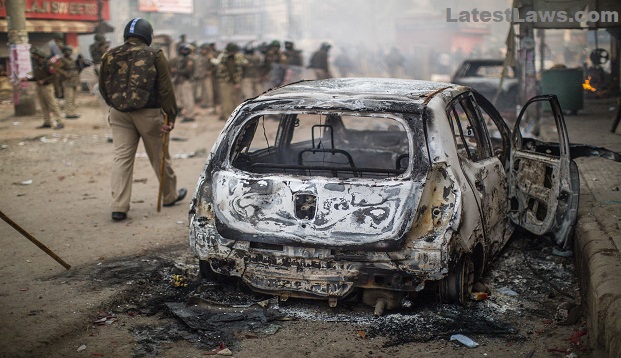
The Delhi High Court recently comprising of a bench of Justices Siddharth Mridul and Rajnish Bhatnagar turning down the bail application filed by Jawaharlal Nehru University (JNU) student leader Umar Khalid in the larger conspiracy case related to the North-East Delhi riots 2020, noted that epitome of these “pre-meditated conspiracy was attack by women on police personnel which is covered under terrorist attack". (Umar Khalid v. State)
The HC further noted that the protest planned was “not a typical protest", which is normal in political culture or democracy, but one far more destructive and injurious, geared towards extremely grave consequences.
Facts of the case
Khalid, Sharjeel Imam, and several others have been booked under section 120B read with 124A, 302, 207, 353, 186, 212, 395, 427, 435, 436, 452, 454, 109, 114, 147, 148, 149, 153A, 34 IPC, Sections 3 and 4 of the Prevention of Damage to Public Property Act (PDPP) Act, 1984, Sections 25/27 Arms Act, 1959 and Sections 13, 16, 17, 18 of the Unlawful Activities (Prevention) Act 1967 (UAPA) for allegedly being the "masterminds" of the February 2020 riots, which left 53 people dead and more than 700 injured.
The violence had erupted during protests against the Citizenship (Amendment) Act (CAA) and the National Register of Citizens (NRC).
The Appellant has preferred the present Appeal under Section 21(4) of the National Investigation Agency Act, 2008 r/w Section 43-D(5) of the Unlawful Activities Prevention Act, 1967, seeking setting aside of impugned order passed by the trial Court whereby the appellant's application for grant of Regular Bail was dismissed.
Courts Observation and Judgment
The bench at the very outset observed, “Thus, as per the pre-meditated plan, there was an intentional blocking of roads to cause inconvenience and disruption of the essential services to the life of the community residing in North-East Delhi, thereby creating panic and an alarming sense of insecurity. The attack on police personnel by women protesters in the front only followed by other ordinary people and engulfing the area into a riot is the epitome of such a pre-mediated plan and as such the same would prima facie be covered by the definition of ‘terrorist act."
The bench observed, "Section 15 of the UAPA defines a terrorist act whereas section 18 provides for the punishment for conspiracy, for the commission of a terrorist act."
The bench noted that under UAPA, it is not just the intent to threaten unity and integrity but also likelihood of the same which is covered under Section 15, which defines a terrorist act.
The court observed, "not just the intent to strike terror but the likelihood to strike terror; not just the use of firearms but the use of any means of whatsoever nature, not just causing but likely to cause not just death but injuries to any person or persons or loss or damage or destruction of property, that constitutes a terrorist act."
It was also observed, "under Section 18, not merely conspiracy to commit a terrorist act but an attempt to commit or advocating the commission or advising it or inciting or directing or knowingly facilitating commission of a terrorist act is also punishable."
The court said, "In fact, even acts preparatory to commission of terrorist acts are punishable under Section 18 of UAPA. Thus, the objection of the appellant that a case is not made-out under UAPA is based on assessing the degree of sufficiency and credibility of evidence not the absence of its existence but the extent of its applicability; but such objection of the appellant is outside the scope and ambit of section 43D(5) of the UAPA."
The bench further observed, "Different roles were ascribed to different people (accused) in carrying out the said conspiracy. Different protected witnesses have stated the role of the appellant and other accused persons and about the open discussion on violence, riots, finance and weapons.
Further, the weapons used and the manner of attack and the resultant deaths and destruction caused indicates that it was pre-planned.
The name of the appellant finds recurring mention from the beginning of the conspiracy till the culmination of the ensuing riots."
The bench further noted, "Admittedly, he was a member of the WhatsApp group of Muslim students of JNU. He participated in various meetings at Jantar Mantar, Jangpura Office, Shaheen Bagh, Seelampur, Jaffrabad and Indian Social Institute on various dates. He was a member of the DPSG (Delhi Protest Support Group) on whatsApp.
He referred to the visit of the president of the USA to India in his Amrawati Speech. The CDR analysis depicts that there had been a flurry of calls that happened post the riots amongst the appellant and other co-accused."
The bench further observed that these protests and riots prima-facie seem to be orchestrated at the conspiratorial meetings held from December 2019 till February 2020. The cumulative statement of the protected witnesses indicates the presence and active involvement of the appellant in the protests, engineered against the CAA/NRC.
The bench dismissing the appeal remarked, "Having heard learned counsel for the parties and having carefully gone through the charge sheet and taking into consideration the fact that the Appellant was in constant touch with other co-accused persons, including Sharjeel Imam, who arguably is at the head of the conspiracy; at this stage, it is difficult to form an opinion that there are not reasonable grounds for believing that the accusation against the petitioner is prima facie not proved."
Read Judgment @Latestlaws.com
Picture Source :




















