









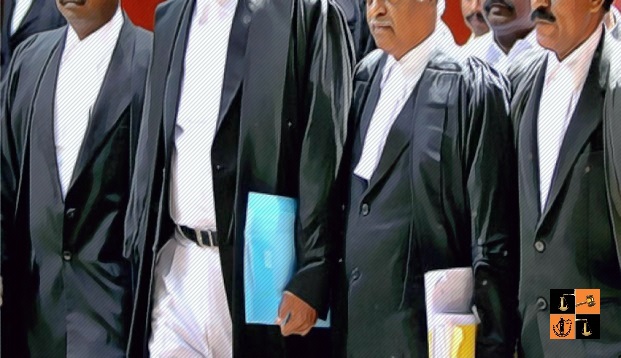
The Madras High Court held that in criminal proceedings, the legal heirs are allowed to continue as party upon death of the original complainant.
The Division Bench comprising of Justice P.N Prakash and Justice AA Nakkiran set aside the order passed by the Disciplinary Committee of Bar Council of Tamil Nadu and Puducherry via which it held that the legal heirs cannot step into the shoes of the original complainant and cannot carry on disciplinary proceedings against the advocates.
In the present case, one T.S. Varadhammal was owning 25 acres of land and gave a power of attorney to her son Jagannathan to manage the subject property. One Nagaraj entered into a loan agreement projecting as the owner of the subject property and gave it away as collateral security.
The loan agreement contained an arbitration clause. On a contrived premise that a dispute has arisen between the said Nagaraj and Rajendran, a collusive arbitration proceeding was initiated in conspiracy with some advocates and a fictitious award was passed on 31.10.2014. The said fake award directed Nagaraj to execute a sale deed in respect of the subject property in favour of Rajendran.
On coming to know of this, Jagannathan lodged a complaint. Upon enquiry, it was revealed that Nagaraj and Rajendran were not alone in this adventure and that they were actively assisted by three advocate. Complaints against them were lodged with Stae Bar Council consequent of which disciplinary proceedings were initiated.
Apprehending that the proceedings before the Bar Council will not be fair, Jagannathan filed a writ petition to constitute an independent Committee. The Division Bench of this High Court stayed the two interlocutory applications filed by two of the Advocates before the Bar Council restraining it from revoking the suspension orders of the Advocates. The Bench also directed the Disciplinary Committee to proceed with the disciplinary proceedings.
Jagannathan died on 04.10.2020 and therefore, his widow and two children filed two applications before the Bar Council for getting themselves substituted in the name of Jagannathan and for continuing the disciplinary proceedings.
The interlocutory applications so filed were dismissed by the Disciplinary Committee of the Bar Council, by holding that the legal heirs of Jagannathan cannot step into the shoes of Jagannathan and continue the disciplinary proceedings against the said two advocates.
Learned Counsel for the petitioners, submitted that the reasons assigned by the Bar Council are ex facie unsustainable because even in a criminal proceeding, only if the accused dies, can the prosecution abate and not when the complainant dies. He further submitted that the death of the complainant can, by no stretch of imagination, enure to the advantage of the fourth respondents/advocates.
Reliance was placed on In The Matter of an Advocate of The Supreme Court, 1955 Latest Caselaw 68 SC in support of the reasons assigned by the Disciplinary Committee in the impugned order that the disciplinary proceedings before the Bar Council are quasi-criminal in nature. It was submitted that submitted that the substitution petition that was filed by the petitioners under Order XXII Rule 3 C.P.C. cannot be maintained as that provision would not apply to proceedings before the Bar Council as the Disciplinary Committee has only the powers of a Civil Court that have been enumerated in Section 42 of the Advocates Act, 1961 and Order XXII has not been enumerated in Section 42, ibid. The Case of Sundaram Finance Limited Vs. Abdul Samad & ANR., 2018 Latest Caselaw 103 SC was cited to contend that an arbitral award can be enforced in the place where the property is located and that is why, one of the Advocate had filed the execution petition in the jurisdictional Court for enforcing the arbitral award.
The Court at the outset noted that it is true that in An Advocate (supra), the Supreme Court Court has held that the proceedings before the Bar Council are quasi-criminal in character but it was held so in the idea of importing the doctrine of benefit of doubt, which governs criminal prosecutions, into disciplinary proceedings before the Bar Council.
In view of this, the Court stated that it is baffled by the Committee's decision and failed to understand the import of the observation in the second sentence of the aforesaid passage which appears to be legally and linguistically incomprehensible. Further noting that the Disciplinary Committee appears to have been blissfully ignorant of Part VII of the Bar Council of India Rules, which sets out the procedure to be followed by the Disciplinary Committee while enquiring into a complaint of misconduct, the Court held:
"Where the legal representatives of the complainant do not come forward to substitute themselves in place of the deceased complainant, the Disciplinary Committee is given the discretion to either proceed with the enquiry or to drop it. Thus, even where there is none to prosecute a case before the Disciplinary Committee, the complaint cannot be mechanically dropped on the technical ground that it has abated. The logical sequitur is that where the legal heirs have come forward to prosecute the complaint in place of the deceased, the Disciplinary Committee is not powerless to order substitution and, at any rate, cannot reject their request on the specious ground of abatement."
Under Rule 11(2)(a), the enquiry can be dropped only in cases where the enquiry is against one Advocate who has died during the enquiry, it clarified.
"In the case at hand, the Disciplinary Committee appears to have been greatly swayed by the fact that the proceedings before them were quasi-criminal in nature, and that the legal heirs of the complainant cannot be substituted in place of the original complainant for that reason. This conclusion betrays woeful ignorance of the settled position in criminal law that the legal heirs can apply for continuation of the proceedings against the accused upon the death of the original complainant."
The Court mentioned Rashida Kamaluddin Syed & Anr Vs. Shaikh Saheblal Mardan (Dead)Through Lrs. & Anr, 2007 Latest Caselaw 183 SC. On contention that the remedy for the petitioner is to file an appeal under Section 37 of the Advocates Act before the Bar Council of India and not a writ petition, the Court cited M/s. Magadh Sugar & Energy Ltd. Vs. State of Bihar, 2021 Latest Caselaw 433 SC wherein, the Supreme Court has held that if the order or proceedings under challenge is wholly sans jurisdiction, the High Court is not powerless to issue an appropriate writ.
Case Title: K.J Sumathy and Ors v. The Chairman, Bar Council of Tamil Nadu and Puducherry and Ors.
Case Details: W.P No 20601 of 2021 and W.P No 20606 of 2021
Coram: Justice P.N Prakash and Justice AA Nakkiran
Read Order Here:
Share this Document :Picture Source :




















