









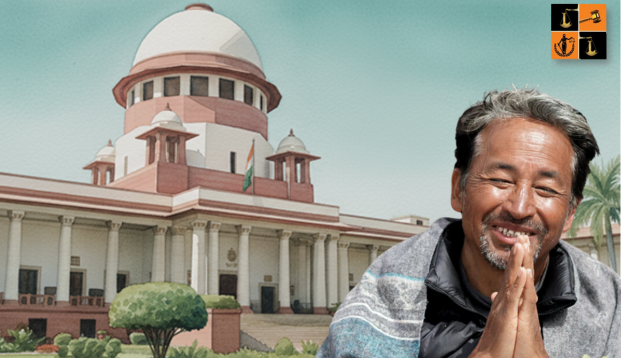
Today, in a proceeding that drew attention to procedural safeguards under preventive detention law, the Supreme Court issued notice to the Central Government on a habeas corpus petition filed by Gitanjali Angmo, wife of Ladakh-based social activist and education reformer Sonam Wangchuk, challenging his detention under the National Security Act, 1980 (NSA).
The Division Bench of Justice Aravind Kumar and Justice N.V. Anjaria directed the issuance of notice to the Union of India, the Ladakh Administration, and the Superintendent of Jodhpur Central Jail, where Wangchuk is reportedly lodged. The Court listed the matter for further hearing on October 14.
The writ petition, filed under Article 32 of the Constitution, challenges the legality of Wangchuk’s detention, asserting a violation of Article 22, as neither Wangchuk nor his wife was furnished with the grounds of detention. Senior Advocate Kapil Sibal appeared for the petitioner, while Solicitor General Tushar Mehta represented the Centre.
Senior Advocate Sibal submitted that the non-supply of the detention grounds rendered the detention unlawful and deprived the petitioner of her right to challenge it. He contended that the wife, as a close relative, is entitled to know the grounds on which the detention was ordered. The Solicitor General, however, maintained that the “grounds of detention have been served on the detenu (Sonam Wangchuk)” and argued that “there is no legal requirement for the grounds of detention to be communicated to the wife.”
When Sibal sought an interim order directing the authorities to provide a copy of the grounds to the petitioner, Justice Aravind Kumar remarked, “At this stage, we will not say anything.” The Bench, however, queried the Solicitor General on the rationale behind withholding the grounds from the petitioner. To this, Tushar Mehta reiterated that “there was no legal mandate” to do so, adding that “the petitioner was trying to create a new ground for challenge by raising the issue of non-supply.”
Responding to this, Sibal clarified that his plea was not to introduce a new ground but to enable a lawful challenge to the detention itself, “Without the grounds of detention, the detention order cannot be challenged,” he said, emphasizing that the non-supply of grounds to the wife would not be used as an independent ground of challenge.
The Solicitor General agreed to “examine the feasibility” of serving a copy of the grounds to the petitioner.
On the issue of medical support, Sibal sought interim relief to ensure the detenu’s well-being. Mehta informed the Court that Wangchuk had undergone medical examination and “stated that he was not on any medication.” He assured that if any medical supplies were required, “they would be ensured.”
When Sibal requested permission for Wangchuk’s wife to meet him in custody, Justice Aravind Kumar enquired whether any such formal application had been made. Upon being informed that no request had yet been submitted, the Bench directed, “First make a request, and if it is rejected, then approach the Court.”
The Solicitor General argued that the petitioner was attempting to create “a hype” and “an emotive issue” through media portrayal, asserting, “This is all just to portray in media and in that region that he is deprived of medicines and access to wife. Just to create an emotive atmosphere. That's all.”
Before concluding, the Bench also asked Sibal why the petitioner had not approached the jurisdictional High Court. Sibal responded that since the detention order had been passed by the Central Government, it was unclear which High Court had territorial jurisdiction. The Court observed, “You tell us. Answer this question also next date.”
Disclaimer: This news/ article includes information received via a syndicated news feed. The original rights remain with the respective publisher.
Picture Source :




















