









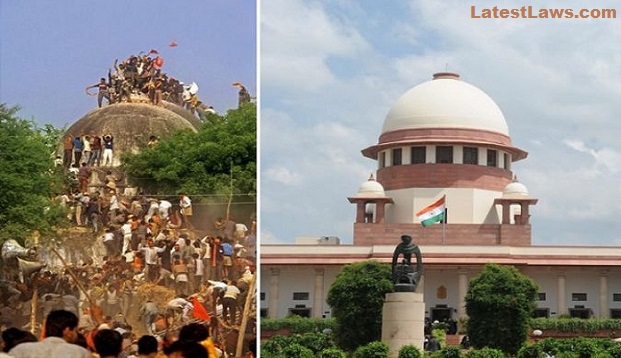
Stating that “Complete Justice is exclusive jurisdiction of Supreme Court” Senior Advocate Parasaran concluded his arguments on day 5 of the hearing.
Senior Advocate CS Vaidyanathan has commenced his arguments for Ram Lalla. He stated that he will be dealing with the following pertinent aspects:
- Identification of Janmsthaan of Lord Ram
- Whether there was a temple in place of which the mosque came up?
- Who is in possession of the disputed site?
Mr. Vaidyanathan submitted that there is no evidence that the Mosque was built by Babur.
CS Vaidyanathan argued on scope of religion & God with reference to Hinduism and the significance of idol and deity in Hinduism. He dealt with the question whether Janmsthaan is a deity?
He submitted that existence of idol is not an essential condition for existence of a temple. People’s belief of religious efficacy and that there is superhuman power is what is essential regarding existence of temple. Citing precedents, he stated that presence of idol is not a legal necessity. Madras High Court had held that temple is a place which creates edifice that god is there. Temple is a public place of worship. Procedure of seeking divine spirit in idol is there in Hinduism, but, through the idol, deity just manifests itself.
He further submitted that the concept of legal identity of Hindu deity got developed during the British rule. He stated that the principle that deity is always considered underage and should be treated like an infant, is adopted in India. Property dedicated to deity belongs to it. No limitation is applied against deities since they are considered perpetual minors.
He submitted that Nirmohi Akhara’s claim to the disputed property, of which it considers itself to be shebait, is averse to the deity. Since property cannot be alienated there cannot be adverse possession of the same.
Mr. Vaidyanathan submitted that there is no evidence that namaz was offered in inner courtyard, whereas, it is admitted by Muslims that prayers are being offered by Hindus and fairs on occasions like Ram Navami are being organised regularly, which are attended by thousands of Hindus visiting from all over the country and abroad for darshan.
Mr. Vaidyanathan pointed out that Justice SU Khan in the impugned Allahabad High Court Judgement observed that it’s not necessary to decide whether land itself is a deity or not, however there is no doubt that an idol is deity capable of holding property.
He stated that neither Muslims have been able to prove exclusive possession nor Nirmohi Akhara can claim possession. There has been no ouster of Hindus, therefore without ouster of the owners, adverse possession cannot be established. Thus, Muslims cannot claim to be given even 1/3rd of the property.
Justice Chandrachud asked what if the possession was joint? Then how would Mr. Vaidyanathan approach?
Mr. Vaidyanathan said that deity’s possession is there prior to mosque. He said that claim that mosque was built on vacant land cannot be accepted, in Allahabad High Court judgement 2 judges were of the view that a temple existed prior to the mosque and Justice S.U. Khan held that the mosque was constructed over the ruins of temple and some material was used in construction of mosque.
He submitted that since deity and Hindus have the title, Muslims by construction of mosque can’t claim joint possession. He further stated that Muslims can’t claim possession through adverse possession since ouster of Hindus was never done. Muslims never has exclusive possession. Thus, Hindus continue to be owner. It is also accepted by Muslims that Hindus always had access. Therefore, he submitted that Hindus’ possession and title has remained unaffected.
Justice Chandrachud asked the counsel if there is joint possession by mutual co-existence shown by non-exclusive possession of Muslims. Justice Ranjan Gogoi also asked how will joint possession establish his title?
Mr. Vaidyanathan stated that Janmasthaan itself is a deity and abode of deity is temple. There can’t be joint possession of the same.
He highlighted that the Allahabad High Court judgement says three different contrary things, one, that the place is deity, second, deity is owner of the place and third, that there is joint possession.
Justice Chandrachud said that Janmasthaan itself is divine and devotees have right to prayer, right to access, right to be present there. As per Mr. Vaidyanathan’s vision there are two different views. One is that God personified and other that it is place of worship. Justice Chandrachud asked how would the counsel balance these two views.
Mr. Vaidyanathan submitted that once place is a deity, the questions of adverse possession and joint possession do not arise, as it would lead to dissection and destruction of deity, and you can’t have destruction, dissection and division of deity. It will continue to be deity. Construction of mosque does not take away the sanctity of deity.
Justice Chandrachud asked that mosque was constructed on ruins of temple and Janmsthaan pre-dated the mosque, so it continues to be deity personified?
Mr. Vaidyanathan said that the place became deity the day Ram was born, construction of mosque did not affect it and Hindus right to worship was never stopped.
Referring to the Allahabad High Court Judgement, Mr. Vaidyanathan said that it was observed by the High Court that Muslims were not able to prove that no temple was demolished and that it was built over ruins. Similarly, Hindus were not been able to prove that temple was existing before the mosque. Thus, it can be inferred that it has been accepted that there was a temple earlier before the mosque was constructed.
Justice Bobde remarked that the earlier temple, even if in ruins, was always a deity.
Mr. Vaidyanathan submitted that faith and belief of devotes did not go into ruins, faith always existed. It’s just the structure which got ruined. Structure didn’t continue but worship continues.
The counsel for Ram Lalla further stated that despite railings and walls worship by Hindus in the inner courtyard continued. Britishers tried to maintain peace and balance. He said that on one hand orders were passed, on other hand they weren’t executed, apparently Britishers did not want to displease anybody.
Picture Source :




















