









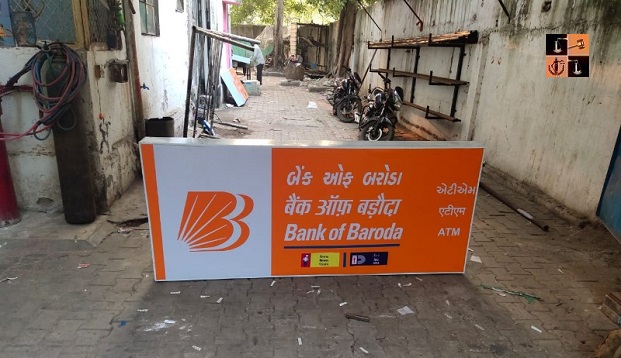
The Delhi High Court has ruled that signboards could be seen as 'advertisement' if they, in any way convey via their name or nomenclature, 'nature of the business'.
The division bench of Justice Rajiv Shakdher and Justice Tara Vitasta Ganju has ruled the above while adjudicating upon two cross-appeals preferred by Bank of Baroda against single-judge bench ruling in writ via which compensation has been sought in a death caused due to collusion with signboard.
Brief Facts and Submissions
The writ petition has not been disposed of, as the single-judge issued directions for constituting a Medical Board to evaluate the bills tendered by the deceased writ petitioner concerning his medical treatment and the expenses that he would have had to incur during his life span. The second limb of the direction has been rendered redundant given the writ petitioner‟s death during the pendency of the proceedings.
It was the arguement of Counsel for the petitioner-Bank that the object which fell on the deceased writ petitioner was a signboard and since it did not advertise the business carried on by the Bank there was no obligation cast on the Bank to seek prior permission of the Municipal Corporation under Section 143 of the Delhi Municipal Corporation Act, 1957.
He contended that an advertisement constitutes a large-size notice or announcement, placed in the public domain concerning the product and/or service offered by the advertiser or an event held by an advertiser.
To buttress his submission, he stated the diferrence between the two.
"Advertising is a form of marketing communication which employs an openly sponsored, non-personal message to promote or sell a product, service or idea. On the other hand, a signboard which is relatively smaller in size displays the name or logo of a business or product and is ordinarily fixed on the facade of the building in which the place of business is located. The signboard which fell on the writ petitioner‟s head was not an advertisement and hence, as stated above, did not require prior permission of the Municipal Corporation under the DMC Act", he said.
His another arguement was that the doctrine of res ipsa loquitur would have no application in this case as the accident occurred because of an act of God. The Counsel claimed that the signboard fell due to high-velocity winds.
He thumpingly further argued that the writ was framed as a tort action and hence in defence all that the Bank had to place before the court was a reasonable explanation for the incident in issue, which was equally consistent with the presence as well as the absence of negligence. Thus, once such a reasonable explanation was furnished by the Bank, the learned Single Judge could not have invoked the doctrine of res ipsa loquitur to conclude that the Bank was negligent. The burden of proving negligence in the affirmative, rested, at the relevant time, on the writ petitioner.
This burden had not been discharged by the deceased writ petitioner and hence, the Bank could not have been held liable for the injuries caused to the deceased writ petitioner due to its signboard falling on his head, he submitted.
High Court's Observation
The Court, after persuing the facts was clear that the impact of the signboard caused the deceased writ petitioner to suffer contusion in the area described as the right frontal lobe causing a 'severe head injury'.
It then analysed the that the signboard came off the facade of the building because of high-velocity winds, which, being an act of God, no negligence could be attributed to it for the injuries suffered by the deceased writ petitioner.
It noted that the Single Judge has not only taken recourse to the principle of res ipsa loquitur but also the principle of strict liability in concluding that the Bank was guilty of negligence. To this, the Court citing one UK Court ruling opined that before one can hold a defendant guilty of negligence by invoking the principle/maxim known as res ipsa loquitur; firstly, it would have to be ascertained whether or not the defendant had control over the thing or object, the escape of which caused the mischief i.e., injury to the plaintiff. Secondly, whether the accident of the type which occurred, would not have normally occurred without the defendant's fault.
Analysing various Supreme Court Ruligs, the Court framed two principles with regard to the facts of the case. These are as following:
1. First, once it is shown that an accident has occurred and the surrounding circumstances show that its occurrence was due to the thing or object or a being (say, for example, an animal) under the control and management of the defendant, the presumption would be that the defendant was guilty of negligence. The thing or object escaping should be of a kind, if it were to escape, would be potentially dangerous. In ascertaining whether the object or thing can morph into a potentially dangerous article, inter alia, its size, shape, material, position and, like in the instant case, the height from which the object/thing falls.
2. In cases of persons using public pathways and passages, the law presumes that the owners of structures and buildings which abut such pathways, highways or roads have a duty of care to the passer-by to periodically inspect and maintain such structures. Therefore, objects which form part of the structure or are fastened to such a structure or building, if not periodically inspected or maintained, cause an injury to a passer-by by coming off the façade of the building, would result in the defendant and/or his agents being held liable under the tort of negligence
Applying the above, the Court found the petitioner-Bank guilty of the tort of negligence.
"The fact that the signboard fell on the deceased writ petitioner's head causing severe injuries is not in dispute; there is no averment either in the counter-affidavit or the Bank‟s appeal that the Bank had entered into a maintenance or supervision contract with AGIPL which was responsible for putting up the signboard."
Are Signboards 'Advertisement'?
The Court the looked into as to whether the Bank was required to take written permission from the Commissioner in accordance with the provisions of the DMC Act and the bye-laws framed thereunder. In other words, is Section-143 DMC Act applicable in the instant case.
The Court opined that the arguement is 'too broad' as to anything which is a signboard cannot fall in the category of an advertisement within the meaning of Section 143 of the DMC Act.
It was not tenable in court's view for the reason that Section 143 of the DMC Act adverts to the expression “advertisement” which is nothing but a mode of communication directed towards the public at large or a particular set of people [in this case, customers] to, inter alia, convey the kind of business the advertiser is involved in and to promote its business and commercial interest.
"In certain cases, the nomenclature or a name under which the business is conducted acts as an advertisement whereas in other cases where the business is conducted under a random name which has nothing to do with the kind of business being operated by the advertiser, the advertiser may have to use different mediums to promote its business interests, which could include billboards, hoardings, electronic media, social media platforms or print media to reach its target customers/consumers.", the Court observed.
It examplified it with 'airlines'.
"The mere fact that the signboard bears the name of the entity without extolling its strengths would not in every case take it out of the purview of Section 143 of the DMC Act. Much would depend on the facts and circumstances that subsist in each case. Say for instance, if an entity has signboards installed bearing only its name in multiple locations of a city, one could argue that such a signboard is an advertisement as it increases visibility and enhances the recall factor. Add to it another dimension; each signboard carries the address of its branches. Such a “Signboard” could convey a lot to the customers [both existing and prospective] of such an entity. To appreciate this aspect further, one may advert, once again, to certain examples in the airline industry. There are entities whose names do not convey the nature of their business; these are entities which have chosen random names. Examples of such entities are Indigo, Virgin Atlantic, Emirates, etcetera."
Noting that in the banking business, more often than not, the name itself conveys the nature of the entity‟s business, the Court ruled that entities which convey the nature of their business via their names or nomenclature could fall, in our opinion, within the provisions of Section 143 of the DMC Act, if facts and circumstances obtain in a case which suggests that there is an intent to draw potential customers and/or consumers to the place of business and/or to consume or receive services offered by the advertiser.
"Thus, if signboards bear the name of the entity, which is descriptive of the entity‟s business are put up in various parts of the city, they could, in a given case, be treated as an advertisement. Likewise, the size of the signboard and what is stated therein, apart from the name of the entity, could also in certain circumstances lead to the conclusion that the
entity is seeking to promote its business interests", the Court clarified.
It concluded that it cannot be said that every signboard is excluded from the purview of Section 143 of the DMC Act.
As far as the present case was concerned, the Court observed that even if we assume, for the moment, that the Bank was not required to take permission under Section 143 of the DMC Act, it would, in our view, not absolve the Bank of the charge of negligence levelled against it.
CASE TITLE: M/S BANK OF BARODA & ANR vs MAHESH GUPTA & ORS
CASE DETAILS: LPA 382/2019, CM Nos.26594/2019 & 33521/2020
CORAM: JUSTICE RAJIV SHAKDHER and JUSTICE TARA VITASTA GANJU
CITATION: M/S BANK OF BARODA & ANR vs MAHESH GUPTA & ORS
Advocates for Petitioner: Mr Neeraj Kumar Jain, Sr Adv with Mr Krishan Kumar, MR Nitin Pal, Mr Atul Sheopuri, Mr Kartik S., Advs.Mr Santosh Krishanan with Ms Deepshikha Sansanwal, Advs.
Advocates for Respondent: Mr Santosh Krishanan with Ms Deepshikha Sansanwal, Advs., Advs. for R-1. Mr Amit Singh Chauhan, Standing Counsel for R-2/MCD, Mr Neeraj Kumar Jain, Sr Adv with Mr Krishan Kumar, MR Nitin Pal, Mr Atul Sheopuri, Mr Kartik S., Advs. for R-1. Mr Tushar Sannu, Standing Counsel with Ms Priyansha Sinha and Ms Pooja Gupta, Advs. for MCD.
Read Judgement @LatestLaws.com:
Share this Document :Picture Source :




















