









The Interviewer, Shiv Kumar is a 1st year student of BA.LLB at Dr. B.R Ambedkar National Law University, Sonipat, Haryana.
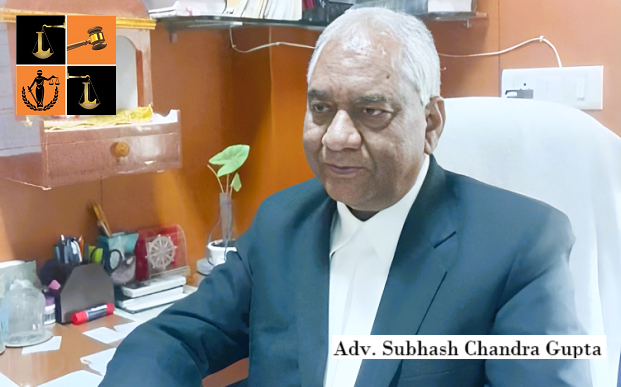
Name of Legal Stalwart: Subhash Chandra Gupta
Designation: Advocate at Delhi High Court
Bar Council No.: D/210/1981
Areas of Practice: Usually deals with matters related to Civil and Corporate laws, specialised in commercial litigation
About: Advocate Subhash Chandra Gupta did his Bachelor of law from Meerut College, he also completed his B.Sc and M.Sc in physics. He started his professional career at the Delhi High Court and got enrolled in the Bar Council of Delhi. He has experience of more than 40 years in this field, and despite being a master in his field, he is so humble and polite. He is also standing counsel for the Government of NCT of Delhi in various matters. He is also an avid reader.
Questions for the Interview:
Q. 1: Please tell us about your journey from being a junior advocate to the stage when you are regarded as the highly learned Lawyer of the High Court of Delhi.
Ans: It was challenging and not easy for me like others, many instances came when I felt lost and about to give up but my seniors told me that consistency is the crucial factor in this field whether you win or lose. So in my starting years, I just engaged with the cases without thinking about the result, I continued the learning process under my seniors, and gradually when I realised that I can take independent cases, I went for them. I identified the areas in which I was doing good and also had more inclination like civil and commercial.
Q. 2: Are you a first-generation lawyer? How does it make a difference from 2nd or subsequent-generation Advocates, in terms of struggle and work?
Ans: Yes I am a first-generation lawyer. If you have someone who is already in the legal arena, literally it becomes way easier for you. It makes a huge difference as you do not have to worry about guidance or mentorship, which is very essential in starting phase. Sometimes you get a made-up client base and you do not need to look for them, at the end of the day it is your network which is your net worth and there are many advantages which a second or third-generation lawyer gets.
Q. 3: How do you think that Law School education has changed since then?
Ans: At present law school focuses more on practical aspects of law rather than theoretical knowledge only. Nowadays the main focus of law schools is practical things such as internships from 1st year onwards moot court, ADR, client counselling etc. The aim of law school is to produce ready advocates after 5 years of the program.
Q. 4: Why does the profession of law excite you?
Ans. The thing that excites me most in the legal profession is that every day you will end up learning something new no matter whether you are a judge or advocate.
Q. 5:Who is your inspiration and what all things motivate you to keep all your zeal in the highest spirit?
Ans: This Black Coat is my inspiration and the responsibilities given by this coat keep me motivated. When you become a lawyer, you are not any ordinary person. This black coat differentiates between you and the rest of the crowd. As an advocate, we are here to assist the court of law to dispense justice, It is our responsibility that we do our part with due diligence.
Q. 6: The underlying principles and values that you preach & apply to excel in professional life?
Ans. I strongly believe that if you are honest with yourself and consistent in your practice, so your luck and hard work both would pay off.
Q.7: Litigation is a full-time profession, so how do you balance both your personal and professional life?
Ans. Yes, it is true that Litigation is a full-time profession but personal life is very much important. For me, it was not easy to balance both but I decided to give time to my family, friends and relatives, I believe that because of my professional life, the people who need me or expect me to be with them would feel bad because of my absence, so I always try to be with them but not at the cost of my clients.
Q. 8: What are the challenges and changes which you see and wish to be brought into the Indian Legal System?
Ans. One of the most significant challenges in the Indian legal system is the backlog of cases. Courts often face a large number of pending cases, leading to delays in justice delivery. Addressing this issue requires improving case management, increasing the number of judges, and encouraging alternative dispute resolution methods like mediation and arbitration. I strongly prefer the ADR, and I wish that it should be promoted as it saves time of the both courts and the parties involved.
Q. 9: What are the hardships you face while presenting a case before the Hon’ble Court?
Ans. I usually go for civil and commercial matters. The absence of records and proper contractual agreements sometimes makes our case weak. Apart from this, there is a lot of paperwork, so you need to maintain every piece of paper in an organised way. As new-generation lawyers are tech-savvy, it is easy for them to cope with the paperwork and organise everything on their tablets or laptops. I feel that this is the point where I see hardship in presenting a case before Hon’ble Court because it is related to access to information swiftly.
Q. 10: What will be your advice to our young and blooming lawyers, please shower your wisdom on them with your sparkling words.
Ans. As I told you earlier that consistency is the key, I would say that young and blooming lawyers should always be ready to learn, as learning is a lifelong process. In your starting days do not run after money, just gain the skill set, even if you are getting a meagre amount, just accept it. Once you get that skill set, you would make a lot of money, I am talking about money because most of the blooming lawyers are attracted towards this field because of the money factor. One thing I observe is the lack of patience in young lawyers, they should be more patient because the whole game is based on that.
Picture Source :




















